
Herniated Disc Treatment in Düsseldorf Unterbilk
Professional physiotherapy for herniated disc – centrally located at Fürstenwall 146
If you work at a desk with a herniated disc, you wonder how long sitting is manageable and when training is allowed again. Here you can read what a herniation means for everyday office life, how the return to work and sport can proceed in stages, and which symptoms cannot wait. Praxis Pirnay treats patients in Düsseldorf-Unterbilk, near the Medienhafen.
Herniated disc in everyday office life: physiotherapy in Düsseldorf-Unterbilk
Intervertebral discs work like shock absorbers between the vertebral bodies. If the outer shell gives way, core material pushes toward the spinal canal. Whether this causes symptoms depends on whether a nerve is pressed or irritated. Then the pain runs from the lower back into a leg or from the neck into an arm, sometimes accompanied by tingling, numbness or loss of strength.
Long periods of sitting are not considered the sole cause of a herniation. But if you already have one, you often tolerate it poorly: in a bent sitting posture the pressure in the discs of the lower back rises, and many people feel more pulling in the leg at the desk than when walking. Standing, lying down and short walks are usually experienced as more comfortable.
The way back to work and sport proceeds in stages. First the aim is to find tolerable positions and stay active. After that the load is increased in a planned way until a working day and training are possible again. How long this takes depends on the assessment. The treating doctors decide on fitness for work and on a possible operation.
What puts strain on the disc at work and in training
Hours in the same sitting posture
The disc thrives on the alternation of pressure and relief. If the posture stays the same for hours, this alternation is missing, and an already damaged shell is loaded on one side.
Little balance to desk work
If regular movement is missing besides sitting, the trunk and gluteal muscles become weaker. They then take less load off the spine.
Strength training with a rounded back
Deadlifts or rows with a heavy load and a rounded back put heavy strain on the lumbar discs. Technique matters, as does an increase that fits your training level.
Natural aging and predisposition
Already in young adulthood the water content of the core decreases and the shell develops fine tears. Family history, body weight and smoking also influence the risk.
How a herniation makes itself felt in everyday life
At the desk
- • Increasing pain after prolonged sitting
- • Pulling in the buttock, leg or foot when bending forward
- • Standing up from the chair is only possible slowly at first
- • Neck and arm pain when looking at the screen
On the go and during sport
- • Stabbing pain when coughing, sneezing or laughing
- • Leg pain during longer car journeys
- • Unsteady push-off from the foot when running
- • Pain during exercises with a bent trunk
Signs of nerve involvement
- • Numb or tingling area of skin on the leg or arm
- • Less strength when walking on heels or toes
- • Objects fall from the hand more often
These symptoms belong in a doctor’s hands immediately
Physiotherapy assumes that serious causes have been ruled out. If paralysis, numbness in the buttock and genital area, or problems with urination or bowel movements occur, do not wait for an appointment: this is a case for the emergency number 112.
- Bladder or bowel no longer obey: involuntary leakage or urinary retention
- Loss of sensation in the perineum, anus, genitals or inner thighs
- A foot drags, the knee gives way or the hand no longer grips firmly
- Weakness or numbness in both legs at the same time
- Severe pain after a fall, sports accident or traffic accident: see a doctor promptly
- Fever, night sweats, unexplained weight loss or a known cancer: see a doctor promptly
Therapies for back, workplace and training build-up
Treatment combines pain relief with a gradual build-up of load that is guided by your working day and your sport. The basis is a prescription from your doctor (Heilmittelverordnung); it names the therapy that we carry out.
Physiotherapy exercises (Krankengymnastik)
We work out movements that calm the radiating pain, plus nerve gliding exercises for the leg or arm. In addition there is practical training: sitting dynamically, getting up from a chair, carrying a bag and laptop, and short exercises for breaks.
Exercise therapy on equipment (Krankengymnastik am Gerät)
Once the acute phase is over, you build strength in the trunk, buttocks and legs on training machines. Weights and repetitions go up in measured steps, and we keep an eye on technique – a preparation for the gym, running or ball sports.
Manual therapy
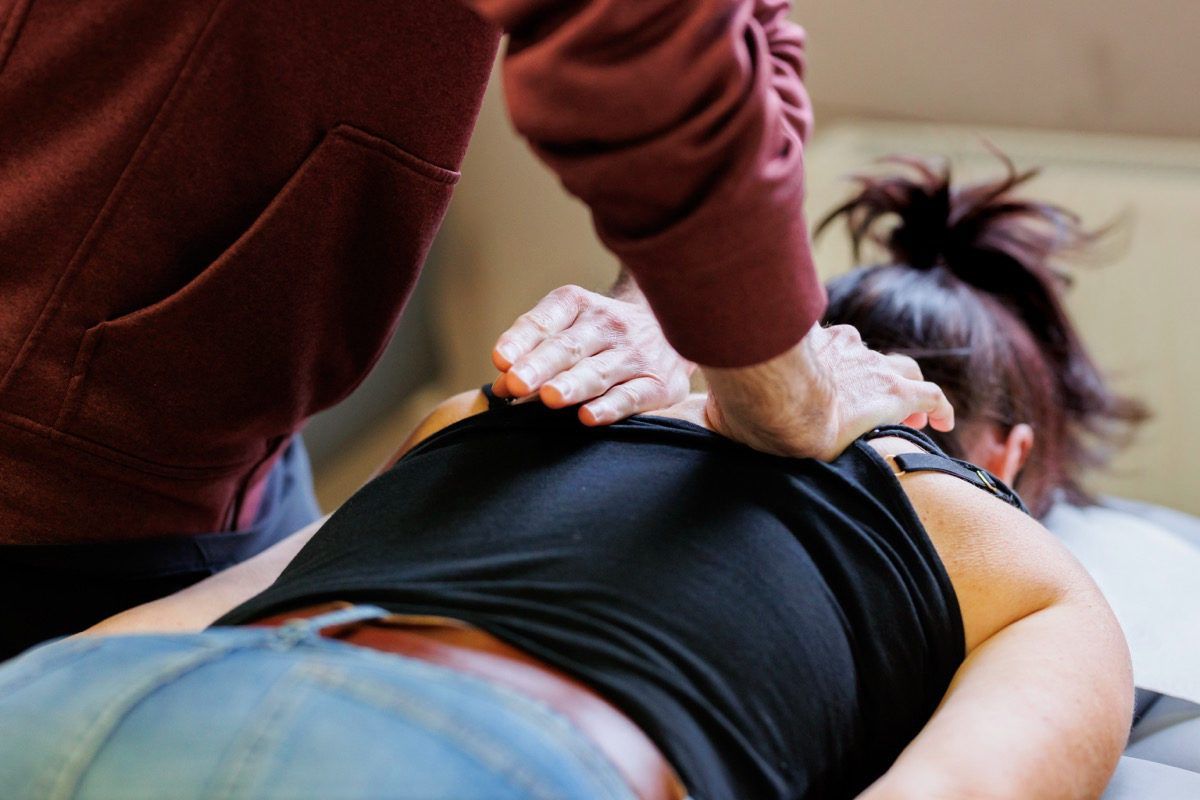
Stiff vertebral joints, a thoracic spine that moves little or tight hips force the affected level to work harder. We mobilize these neighboring regions by hand and use relieving techniques for the irritated nerve.
From the first appointment back to the workplace
- 1
Conversation and examination
We clarify what your working day looks like, which sport you do and when the pain occurs. Tests of mobility, nerve tension, sensation and muscle strength follow.
- 2
Agreeing on stages
From the assessment and your wishes, verifiable stages emerge, for example sitting for an hour, a full working day, the first easy run.
- 3
Treating and training
Every session combines treatment with active exercise. The training share grows as soon as the radiating pain decreases and your strength allows it.
- 4
Program and review
You receive short exercises that fit into your working day and a plan for sport. When the prescription runs out, we go through the stages once more.
Tips for desk, commute and training
The following suggestions are intended for people whose herniation has been checked by a doctor. If the pain in your leg or arm increases as you try them, stop and ask for advice.
Change posture often
There is no single right sitting posture. Switch between leaning back, sitting upright and standing, and get up briefly about every half hour – to make a phone call, to go to the printer, to the window.
Set up your workstation
Feet flat, forearms supported, screen straight in front of you. A small roll in the lumbar area can make sitting more bearable. Ask at work about a height-adjustable desk.
Do errands on foot
Walking is usually well tolerated with a herniation in the lower back. Get off a stop earlier, take the stairs and go for a walk during your lunch break.
Take up sport in stages
Start with brisk walking, cycling or swimming as soon as that is possible with little discomfort. Running, jumping and heavy weights follow later and in small steps, agreed with your doctor or therapist.
Getting to us at Fürstenwall
Praxis Pirnay in Düsseldorf-Unterbilk is at Fürstenwall 146, 40217 Düsseldorf; the Medienhafen is close, and the Königsallee is about 1.5 km away. The stops “Fürstenplatz” and “Kirchplatz” are nearby. By car you take the B8 or the A46, exit Düsseldorf-Bilk. The practice has no parking lot of its own; you park along Fürstenwall or in the side streets.
You can book appointments online via Doctolib, by phone or with the appointment form on this website. For your first visit, bring your health insurance card, the prescription and, if you have them, a doctor’s letter and MRI report. If you come straight from the office, pack comfortable sportswear, especially for training on the machines.
The initial examination takes somewhat longer; a regular appointment lasts, depending on the prescribed therapy, roughly 20 to 60 minutes. Treatment is in German, English or Spanish. When booking, feel free to say which you prefer.
Opening hours: Mon 8:00–19:30, Tue–Wed 7:00–18:30, Thu 9:00–18:30, Fri 9:00–14:00
Answers on work, sport and appointments
Can I keep working in the office with a herniated disc?
Often yes, as long as the pain allows it and there are no neurological deficits. Frequent changes of posture, short walking breaks and, if possible, working standing up for part of the time help. Whether you are fit for work or need a sick note is for your doctor to assess.
Is a standing desk better than an ergonomic chair?
Neither is the solution on its own. What does the disc good is variety: sometimes sitting, sometimes standing, walking in between. A height-adjustable desk makes this switching easier, and a good chair makes the sitting phases more comfortable. Standing for hours at a stretch also strains the back.
When can I go jogging or to the gym again?
There is no fixed point in time. The requirement is usually that the radiating pain has subsided, no muscle weakness is increasing and everyday loads go well. Then the build-up begins at low intensity and is increased gradually. Agree on the start with your doctor and with your therapist.
What is a phased return to work (stufenweise Wiedereingliederung)?
After a longer period of sick leave, you return to the workplace with initially shortened working hours and increase them according to a plan. The treating doctor’s office draws up the step-by-step plan with you; your employer and health insurer are involved. Physiotherapy can accompany this phase, for example with load training and break exercises.
Does my herniated disc come from sitting a lot?
Probably not from that alone. Herniations usually arise on the basis of age-related changes, in which predisposition also plays a part. Long, motionless sitting and little physical balance are considered unfavorable, however, and can intensify existing symptoms. More variety in the working day therefore makes sense in any case.
What do I need for health insurance to pay for the treatment?
You need a prescription from your doctor. With it we bill your statutory health insurer, and you pay only the statutory co-payment, unless you are exempt. If you have private health insurance, reimbursement depends on your plan; ask your insurer beforehand.
You Might Also Be Interested In
Back Pain
Treatment for lumbar spine and back muscles
SI Joint Dysfunction
Effective relief from sacroiliac joint problems
Manual Therapy
Spinal mobilization and treatment
Pain Therapy
Effective treatment for chronic pain
All Therapies
Overview of our treatment services