
SI Joint Blockage Treatment in Düsseldorf Unterbilk
Professional physiotherapy for sacroiliac joint blockages – centrally located at Fürstenwall 146
Pain in the lower back that increases when sitting in the office or appears after running training is quickly blamed on the disc. Not infrequently the sacroiliac joint, or SI joint (Iliosakralgelenk, ISG), is involved instead, and sometimes the hip. This page helps with sorting this out and describes the treatment at Praxis Pirnay in Düsseldorf-Unterbilk.
SI joint, disc or hip: sorting out your symptoms correctly
The SI joint is the connection between the spine and the pelvis. It lies on both sides below the palpable bony points above the buttocks and allows only the smallest movements. If it is overloaded or loses its fine play of movement, a mostly one-sided, well-localized pain results. In everyday language this is called an SI joint blockage, in medical terminology SI joint syndrome.
Telling them apart is difficult because three regions radiate in similar ways. A herniated disc more often causes pain down into the lower leg or foot, often with numbness, tingling or loss of strength. Hip problems show up preferably in the groin and when rotating the leg. With the SI joint, the main pain lies next to the sacrum and usually ends above the knee. This can be reliably distinguished only by an examination; the diagnosis is made by the doctor.
Prolonged sitting and running challenge the joint in different ways: sitting through sustained pressure in one position, running through many one-sided impacts in a row. In both cases the symptoms often improve when load and muscle strength fit together again. We cannot promise how it will go.
Strains on the SI joint in the office and in running
Crooked sitting
Crossed legs, a foot tucked under you or a wallet in the back pocket tilt the pelvis to one side. Over hours one joint carries more than the other.
Sitting without interruption
If the pelvis stays in one position for a long time, the supporting muscles tire. The first step after getting up is then often the most painful.
Quick increase in running training
More kilometers, more speed or new hilly routes in a short time overload the muscles and ligaments at the pelvis, which adapt more slowly than endurance does.
Weak gluteal and trunk muscles
When running, body weight lands on one leg at a time. If the gluteal muscles and trunk do not keep the pelvis stable then, the load on the SI joint grows.
SI joint, disc, hip: typical differences
Points more toward the SI joint
- • Pinpoint pain next to the sacrum
- • Radiating into the buttock, rarely below the knee
- • Symptoms when standing up and when standing on one leg
- • Long periods of sitting make it worse, walking loosens it up
Points more toward the disc
- • Pain pulls down into the calf or foot
- • Tingling or numbness in a strip of skin
- • Coughing, sneezing or straining increase the pain
- • Declining strength in the foot or toes
Points more toward the hip
- • Pain in the groin or at the front of the thigh
- • Restricted rotating and bending of the leg
- • Difficulty putting on socks and shoes
- • Start-up pain after rest
Alarm signs that must be checked by a doctor
The distinction matters, because behind supposed SI joint pain there can be a compressed nerve or an inflammation. Call the emergency number 112 for signs of paralysis, for a numb feeling around the anus and genitals, or if the bladder or bowel no longer work properly.
- Numbness in the saddle area: buttocks, perineum, genitals, inner side of the thighs
- Urinary retention or involuntary loss of urine or stool
- Weakness in lifting the foot or toes, a leg giving way, weakness in both legs
- Pain mainly in the second half of the night with morning stiffness, better with movement: have it checked by a rheumatologist
- After sharply increased running training, pain with every footstrike: have a stress fracture ruled out
- Fever, accident, known osteoporosis, cancer or unintentional weight loss
Treatment for SI joint symptoms from sitting and running
After the assessment we know whether it is more the SI joint, the lumbar spine or the hip that keeps the pain going. That determines which therapy from your doctor’s prescription (Heilmittelverordnung) takes priority and what you train yourself.
Manual therapy
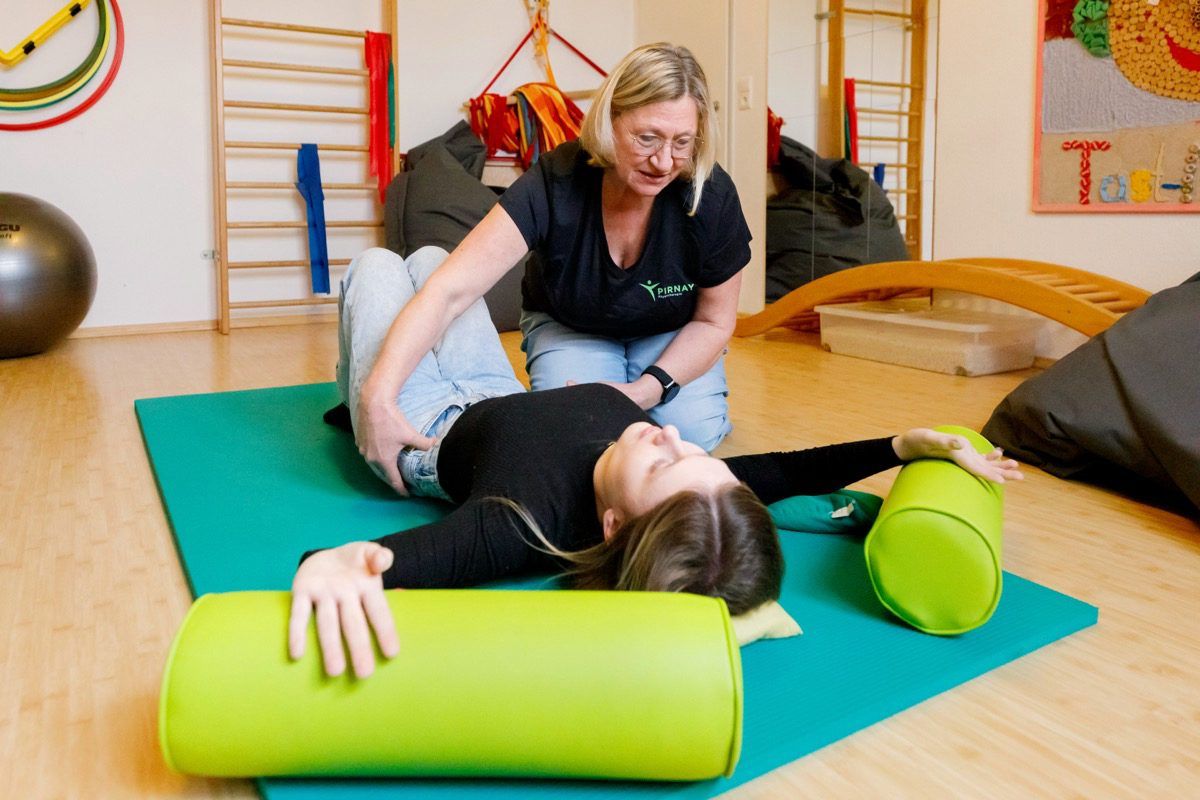
We examine and mobilize the SI joint and at the same time check the hip joint and lower lumbar vertebrae, because they are often involved as well. We treat tension in the deep gluteal muscles with stretching and pressure techniques.
Physiotherapy exercises (Krankengymnastik)
The focus is on activation and strength of the muscles that hold the pelvis when standing on one leg. In addition there are mobility exercises for the hip flexors and buttocks, as well as advice on sitting position and breaks at the office.
Exercise therapy on equipment (Krankengymnastik am Gerät)
On training machines, the strength of the buttocks, thighs and trunk can be dosed precisely and increased step by step. For runners, single-leg exercises and strength endurance prepare for the impact load.
Electrotherapy
Stimulation current can have a relieving effect on acute pain at the sacrum and, if it is prescribed, is applied before the active part. It complements mobilization and training but does not replace them.
From assessment back to the running route
- 1
Analysis
We ask about sitting time, workplace and running volume. In the examination we combine several provocation tests for the SI joint with tests for the hip, lumbar spine and nerves.
- 2
Plan with milestones
From this comes a plan with measurable goals, such as sitting through a meeting without pain or running easily for twenty minutes.
- 3
Treatment and training
In the appointments we combine manual techniques with exercises. The calmer the joint, the larger the training share becomes.
- 4
Return and conclusion
We stagger the return to running by duration, frequency and pace. Finally you receive a strengthening program for the time after the prescription ends.
What you can change at work and in training
Some SI joint symptoms respond to simple changes. Try one measure after another so that you notice what helps you.
Sit evenly
Sit on both sit bones, place your feet side by side and empty your back pockets. Get up briefly after half an hour at the latest and walk a few steps.
Adjust running volume instead of stopping
Reduce distance and pace to the point where the pain does not increase during the run or on the day after. Increase only when several runs have been well tolerated.
Strengthen the glutes
The bridge is a good start: lie on your back, feet flat, lift the pelvis, hold briefly, lower slowly. The single-leg variation follows later. Two to three short sessions per week are enough to start with.
Keep the hip mobile
After long sitting, stretch the hip flexor in a lunge and the gluteal muscles while sitting with one leg crossed over. Hold the stretch calmly and without bouncing.
Praxis Pirnay in Düsseldorf-Unterbilk: directions and booking
You can reach us at Fürstenwall 146, 40217 Düsseldorf, near the Medienhafen; it is about 1.5 km to the Königsallee. The stops “Fürstenplatz” and “Kirchplatz” are not far. By car the route leads via the B8 or the A46 (exit Düsseldorf-Bilk). Since the practice has no parking lot of its own, look for a space on Fürstenwall or in a side street.
Book appointments online via Doctolib; alternatively, call or use the appointment form on the website. Bring your prescription, your health insurance card and any existing reports. Wear comfortable clothing; if you run, pack shorts and running shoes.
Allow somewhat more time for the assessment the first time. The following appointments last between 20 and 60 minutes, depending on the prescribed therapy. We treat in German, in English and in Spanish.
Opening hours: Mon 8:00–19:30, Tue–Wed 7:00–18:30, Thu 9:00–18:30, Fri 9:00–14:00
Questions about sitting, running and telling the causes apart
How can I tell whether the SI joint or the disc is hurting?
It cannot be determined with certainty on your own, but there are clues. If the pain pulls down into the foot, the skin there is numb or strength is missing, that points more toward an irritated nerve root. If it stays next to the sacrum and in the buttock, the SI joint is more likely. A medical examination brings certainty.
Can the pain also come from the hip?
Yes, the hip joint can cause very similar symptoms. Typical for the hip are pain in the groin, restricted rotation of the leg and difficulty tying shoes. That is why we always test the hip as well in the assessment.
May I keep running with SI joint symptoms?
Often yes, at an adapted volume. What matters is that the pain does not increase while running and is not stronger the next day than before. Shorten the distance, run more slowly or switch to cycling for a while. If it stabs with every step, pause and have it checked by a doctor.
Is prolonged sitting harmful for the sacroiliac joint?
Sitting in itself does not harm the joint. It becomes unfavorable when you stay in the same, often crooked position for hours and move little overall. Changes of posture, short walking breaks and strong gluteal muscles usually bring more than the search for the perfect chair.
Can an SI joint blockage be seen on an MRI?
No, a functional disorder of the joint is generally not visible on images. X-rays or MRI serve to identify or rule out other causes, for example a herniated disc, an inflammation or a stress fracture. Whether imaging makes sense is decided by a doctor.
How do I get an appointment, and what does the insurer cover?
You can book appointments via Doctolib, by phone or with the appointment form. For people with statutory health insurance, a prescription from a doctor is required; the insurer then covers the treatment, and you pay the statutory co-payment yourself unless you are exempt. With private health insurance, reimbursement depends on your plan.
You Might Also Be Interested In
Back Pain
Treatment for lumbar spine and back muscles
Disc Herniation
Effective treatment for disc problems
Manual Therapy
SI joint mobilization and release of blockages
Pain Therapy
Effective treatment for chronic pain
All Therapies
Overview of our treatment services