
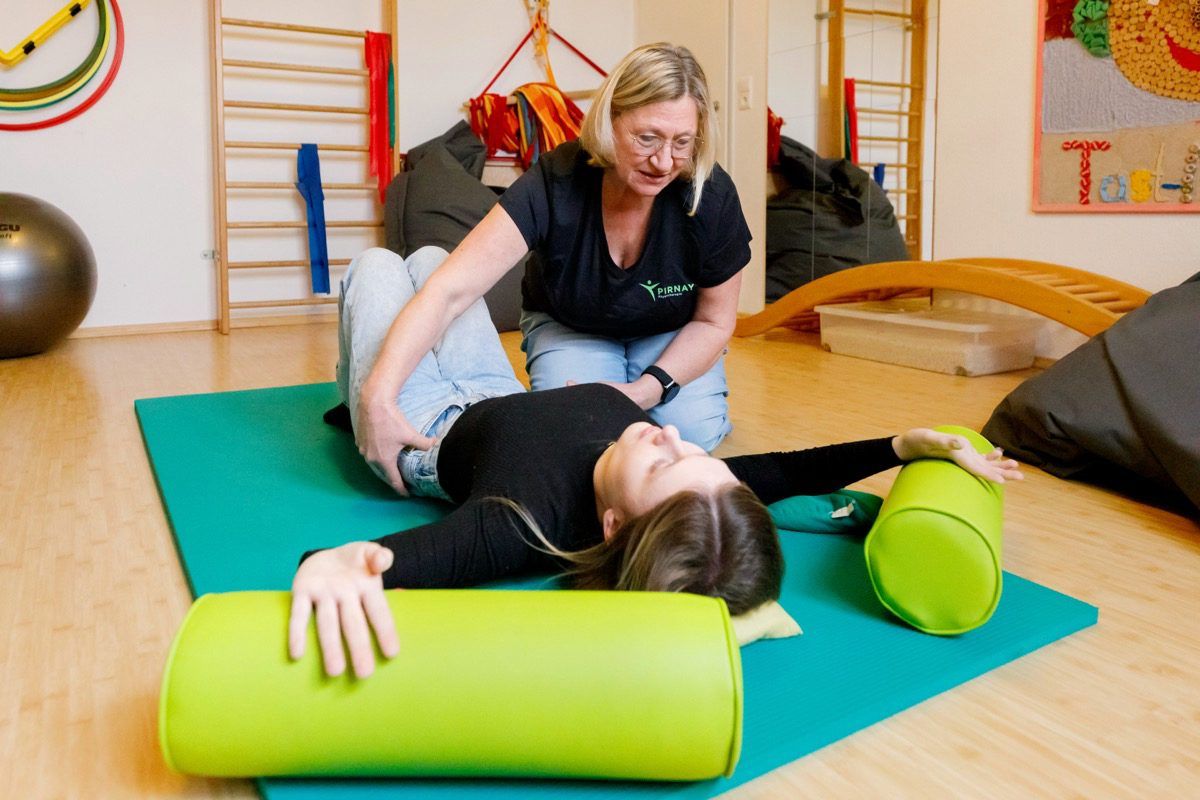
Hip Pain Treatment in Düsseldorf Unterbilk
Professional physiotherapy for hip pain – centrally located at Fürstenwall 146
A stabbing pain in the groin when you get up from a low office chair, pull your knee to your chest or take off your shoes after a run: such symptoms often affect younger, physically active people. Here you can read what may be behind groin pain and hip impingement, when a medical check is needed, and how Praxis Pirnay in Düsseldorf-Unterbilk treats hip pain.
Understanding groin pain and hip impingement
The medical term is femoroacetabular impingement, FAI for short. It means a tight spot between the femoral neck and the rim of the socket: either the transition from the femoral head to the femoral neck is shaped too thick, or the socket reaches too far over the head. When the hip is bent deeply and rotated inward, the two hit each other. This can irritate the labrum, a ring of fibrous tissue at the rim of the socket, and the adjacent cartilage. The bone shape alone does not yet mean symptoms.
Not every pain in the groin comes from the joint. The tendons of the adductors at the pubic bone, the hip flexor, an inguinal hernia or the lumbar spine can also be the cause. Telling these apart is the job of medical diagnostics, often with X-ray or MRI. In physiotherapy, we carry out an assessment: which movement triggers the pain, how mobile and strong the hip is, and how the pelvis and leg alignment behave under load.
The symptoms usually vary with load. Long sitting with the hip strongly bent, deep squats or sport with twisting and kicking make them worse; breaks and changed movement patterns calm them. Conservative treatment is the usual first step. Whether arthroscopy comes into question afterward is judged by orthopedics.
Where groin pain in active people comes from
Bony shape variant
A thickened femoral neck (cam type) or a protruding rim of the socket (pincer type) reduce the space in which the hip can bend and rotate freely.
Deep bending under load
Deep squats, lunges, rowing or martial arts repeatedly bring the joint into the end position in which it gets tight.
Kicks and changes of direction
In football, hockey or tennis, the adductors work against high forces. Their tendons at the pubic bone sometimes respond with stubborn irritation.
Rapidly increased running
More kilometers, more speed, fewer breaks: the hip flexors and tendons cannot keep up with the adaptation. Rarely, the bone at the femoral neck reacts too.
Hours of sitting
In an office chair or car seat, the hip stays bent for a long time. The hip flexor works in a shortened position, and the buttock muscles are hardly challenged.
Comparing the symptom patterns
More likely from the joint
- • Deep, stabbing pain on bending with inward rotation
- • The hand wraps around the hip in a C shape to show the spot
- • Clicking or a brief feeling of catching
- • Dull pain after a long car journey
More likely from muscles and tendons
- • Pain at the pubic bone when squeezing the knees together
- • Pulling on the inside of the thigh when sprinting
- • Pain at the front when lifting the straight leg
In training
- • Deep squat works less well on one side
- • Pain starts after a certain running distance
- • Symptoms ease during a break and come back
Groin pain: these signs belong in a doctor's hands
In the groin, the joint, muscles, abdominal wall and internal organs lie close together. Before physiotherapy, it should therefore be clarified where the pain comes from – all the more so with these signs.
- A bulge in the groin that gets bigger when coughing or straining.
- A bulge that cannot be pushed back, with severe pain, nausea or vomiting: emergency number 112.
- Sudden, severe pain in the testicle: go to the emergency room immediately.
- Groin pain when running that increases with every step and stays at night.
- Teenagers who are still growing and who limp or complain of groin and knee pain.
- Fever with severe joint pain, or an accident after which the leg cannot bear weight.
Physiotherapy for groin pain in Düsseldorf-Unterbilk
At its core, it is about making the hip more resilient and changing the movements that irritate it. Depending on your prescription from your doctor (Heilmittelverordnung), we use the following therapies for this.
Equipment-based exercise therapy (Krankengymnastik am Gerät)
On training machines, you build strength in the buttocks, trunk and adductors with precisely adjustable resistance. We choose the bending angle and weight so that the hip does not reach the painful end position, and widen both bit by bit.
Physiotherapy exercises (Krankengymnastik)
Here you learn to control the pelvis and leg alignment in squats, lunges, landing and running. If the knee sinks inward, the hip rotates with it – that is exactly what we train away.
Manual therapy
With targeted hand techniques, we treat the joint capsule and surrounding tissue and include the lumbar spine and pelvis. With impingement, we do not push in the direction that jams, but work in the range with few symptoms.
Classical massage
Hip flexors, adductors and buttock muscles are often tight and tender with groin problems. Massage can lower this tension and make training more comfortable; it does not replace building strength.
From the first assessment back to sport
- 1
Assessment with load tests
We ask about your sport, training volume and sitting times, compare mobility and strength on both sides, and test which positions trigger the groin pain.
- 2
Goal and yardstick
You tell us where you want to get back to – for example the running group or squats with weight. Together we decide how we will measure progress.
- 3
Building up in stages
First, adjusted loading calms the irritation, then strength and control follow, and finally sport-like movements with speed and changes of direction.
- 4
Your own training
You receive a short plan for the gym or the living room. What you change in your sport for the time being, we write down with it.
- 5
Return to sport
At the end, we repeat the tests from the beginning. If the result fits, you increase your training according to plan; if the pain remains, we advise seeing a doctor again.
Relieving the groin at the office and in training
A lot can be managed with small changes. As a rule of thumb: a slight pulling that fades quickly is fine; a stabbing pain in the groin means changing the movement.
Sit higher
Set the chair so that your hips are slightly higher than your knees, and avoid deep sofas. Interrupt sitting about every half hour, or take phone calls standing up.
Modify training instead of cutting it
Limit the depth of squats and leg presses to the range before the stabbing pain, and place your feet slightly wider. Run shorter and flatter for the time being.
Do not force end positions
Stretches that pull the knee firmly toward the chest or toward the opposite shoulder lead exactly into the tight spot. Leave out such positions as long as they cause stabbing in the groin.
Strengthen buttocks and trunk
Hip bridges lying on your back and the side forearm plank need no equipment and challenge the muscles that hold the pelvis. Start with a few clean repetitions.
How to get to us on Fürstenwall
Our address is Fürstenwall 146, 40217 Düsseldorf, near the Medienhafen; it is about 1.5 km to Königsallee. The nearest stops are called "Fürstenplatz" and "Kirchplatz". By car, you reach Düsseldorf-Unterbilk via the B8 or the A46, exit Düsseldorf-Bilk. The practice has no parking lot of its own; there are parking spaces along Fürstenwall and in the side streets.
You can book appointments online via Doctolib, by phone or with the appointment form. Have your prescription, health insurance card and, if you have them, MRI or X-ray findings ready. Shorts and sports shoes make sense, because we look at your squat, lunge and gait. The first session is scheduled for longer because it includes the assessment. You can speak German, English or Spanish with us.
Opening hours: Mon 8:00–19:30, Tue–Wed 7:00–18:30, Thu 9:00–18:30, Fri 9:00–14:00
Groin pain and impingement: your questions
Does hip impingement have to be operated on?
No, not in every case. Conservative treatment with adjusted loading and targeted training is usually the starting point. The bone shape does not change as a result, but the symptoms can ease. If that is not enough or the labrum is clearly damaged, the orthopedic specialist will discuss with you whether an operation makes sense.
Can I keep jogging with groin pain?
Often yes, in a reduced form – provided there is no medical reason against it. If the pain stays slight while running and is not stronger the next day, you can usually carry on. If it increases from step to step or persists at rest, pause and have it checked.
Why does my hip act up after a long day at the desk?
Because it stays bent for hours while sitting. With impingement, this position is close to the angle at which it gets tight; in addition, the hip flexor tires in a shortened position. A higher seat, a wedge cushion sloping slightly forward and regular standing up often defuse this.
How do I tell adductor problems from pain from the hip joint?
That can only be done reliably through an examination. As a rough guide: adductor pain sits more on the inside of the thigh near the pubic bone and arises when squeezing the legs together. Joint pain lies deeper in the groin and shows up on bending with rotation. Both can be present at the same time.
Does the insurer pay for equipment-based exercise therapy?
Yes, if it is prescribed by a doctor; equipment-based exercise therapy is among the therapies that can be prescribed. People with statutory health insurance pay the statutory co-payment as long as they are not exempt. If you have private health insurance, reimbursement depends on your plan – clarify that with your insurer before the first appointment.
You Might Also Be Interested In
Knee Pain
Professional treatment for knee joint problems
Back Pain
Treatment for lumbar spine and back muscles
Manual Therapy
Hip joint mobilization and treatment
Medical Training Therapy
Targeted hip muscle building
All Therapies
Overview of our treatment services