
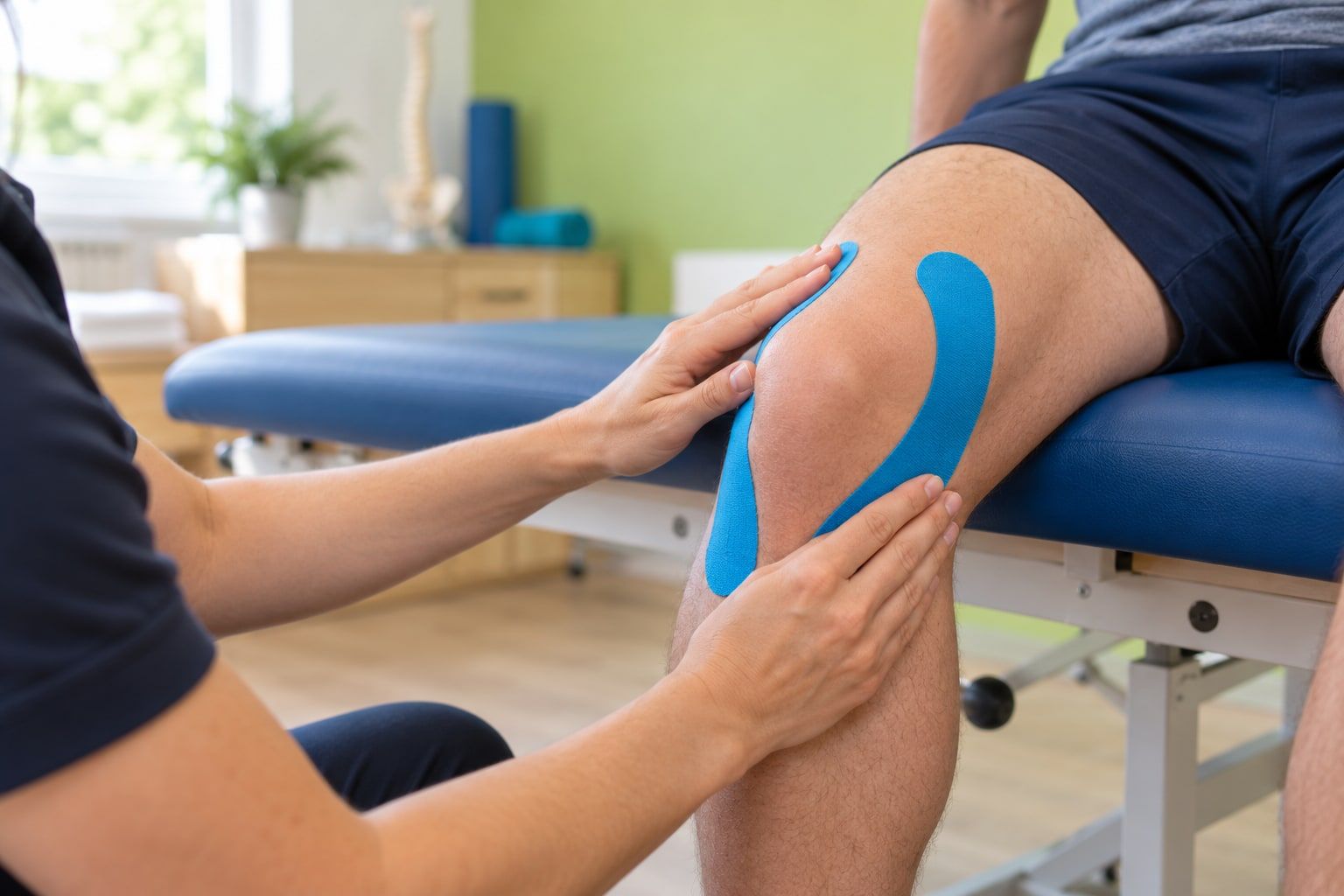
Knee Pain Treatment in Düsseldorf Unterbilk
Professional physiotherapy for knee pain – centrally located at Fürstenwall 146
Your knee hurts at the front when climbing stairs, after sitting at the desk for a long time, or on the outside after a few kilometers of running – such symptoms often start from the kneecap or from overloaded tendons. At Praxis Pirnay in Düsseldorf-Unterbilk, they are treated with physiotherapy, provided you have a prescription from your doctor (Heilmittelverordnung). Here you can find out how iliotibial band syndrome (called Läuferknie in German) and kneecap pain develop, and how you can adapt your training and sitting.
Knee pain in Düsseldorf-Unterbilk: kneecap, iliotibial band, sport
With every bend of the knee, the kneecap glides in a groove of the thigh bone. It is embedded in the tendon of the front thigh muscle and transmits that muscle's force to the lower leg. The deeper the knee is bent, the more firmly it is pressed into its groove. Pain around or behind the kneecap is called patellofemoral pain syndrome. It often occurs in young, active people without there necessarily being any damage to the joint.
In German, "Läuferknie" (literally "runner's knee") usually means iliotibial band syndrome: a strong band of tissue on the outside of the thigh, the iliotibial band (tractus iliotibialis), becomes irritated at the outer knee. The pain typically starts after a certain running distance and often forces you to stop. With "jumper's knee", by contrast, the tendon below the kneecap is overloaded.
What all three conditions have in common is that the load over a longer period was greater than what the tendons and joint are used to. That can be a rapidly increased running program, but also hours of sitting with the knees strongly bent. Treatment aims to bring load and load capacity back into balance; that takes patience.
What overtaxes the kneecap and tendons
Increasing too quickly
More kilometers, more speed or more sessions in a short time: tendons and cartilage adapt more slowly than endurance and muscles.
Leg alignment under load
If the hip muscles do not hold the leg stable, the knee sinks inward when running or climbing stairs. The kneecap is then loaded unevenly.
Long sitting with bent knees
At the desk, in the car or at the cinema, the kneecap is under constant pressure. Many people feel the pain when getting up.
Jumps and landings
Basketball, volleyball or jumping exercises in a fitness class challenge the tendon below the kneecap with every landing.
Downhill and long runs
Running downhill and long, uniform distances irritate the band of tissue on the outside of the knee in particular.
Typical symptoms depending on the spot on the knee
At the front, around the kneecap
- • Dull pain behind or beside the kneecap
- • Pain going downstairs, in squats and when walking downhill
- • Pain when getting up after long sitting
- • Rubbing or grinding, which on its own is usually harmless
Outside of the knee (iliotibial band syndrome)
- • Stabbing pain on the outside after a certain running distance
- • Stronger when running downhill
- • Eases at rest, returns on the next run
Below the kneecap (jumper's knee)
- • Tenderness at the tip of the kneecap
- • Pain on take-off and landing
- • Start-up pain at the beginning of training
When knee pain has to be checked by a doctor
Overload symptoms develop gradually and without an accident. If that does not apply, or if the following signs are added, have the knee examined before you keep training.
- Twisting injury or fall with a pop, rapid swelling or the knee giving way.
- Knee red, hot and swollen, accompanied by fever.
- Pain and swelling in the calf; with shortness of breath as well: emergency number 112.
- The joint locks or can no longer be fully straightened.
- Pain at night and at rest that has nothing to do with load.
- In children and teenagers: knee pain with limping – the cause can lie in the hip.
What physiotherapy does for iliotibial band syndrome and kneecap pain
The most important building block is training that strengthens the hip and thigh and stabilizes the leg alignment. On top of that comes a plan for loading in sport. Passive measures complement this when they are prescribed.
Equipment-based exercise therapy (KGG)
On machines, the thigh, gluteal and hip muscles can be trained with finely graded load. For tendon problems such as jumper's knee, slowly increased strength training is a central part of treatment.
Physiotherapy exercises (Krankengymnastik)
You practice keeping the knee over the foot in squats, lunges and step-ups instead of letting it fall inward. Later, jumping and running exercises and a plan for getting back into sport are added.
Manual therapy
The therapist checks whether the kneecap glides freely and whether mobility in the hip or ankle is restricted, and treats these areas with targeted hand techniques.
Classical massage
Very tense muscles in the thigh and calf can be loosened with massage. That can make training more comfortable, but it does not change the load capacity of the tendon.
From the first assessment back to training and daily life
- 1
Assessment and load profile
We ask about your sport, weekly volume, shoes and sitting times, and look at your squat, single-leg stance and step-up. We take the medical diagnosis into account.
- 2
Goal and yardstick
You decide where you want to get to – for example a certain running distance or a working day without pain when getting up. That is how we read off progress.
- 3
Training and treatment
Strengthening and alignment training form the core; hand techniques and massage accompany them. The load goes up as long as the knee stays calm the next day.
- 4
Planning the return
You receive a step-by-step plan for running or your sport and a strength program that you continue on your own. At the end, we check strength and leg alignment again.
Making training and sitting easier on the knees
With overload, it is rarely about a ban on sport, but about the right dose. The following adjustments are simple and can be reversed again.
Reduce the volume, do not stop
Run shorter, slower and on flat ground for the time being – so much that the pain stays slight and has faded by the next day. Leave out downhill sections at first.
Stretch your legs in between
At the desk, stretch your legs out more often and stand up before the knee makes itself known. Tucking your feet under the chair keeps the knee strongly bent.
Strengthen hip and thigh
Hip bridges lying on your back, side leg raises and squats to a low-pain depth are a good start. Make sure the knee stays over the foot.
Switch to cycling or swimming
Cycling in an easy gear and front crawl swimming maintain endurance while running is on pause. Set the saddle so high that the knee is almost straight at the bottom.
Your knee assessment on Fürstenwall: getting here and preparing
You can reach Praxis Pirnay at Fürstenwall 146 in 40217 Düsseldorf, not far from the Medienhafen; it is about 1.5 kilometers to Königsallee. The stops "Fürstenplatz" and "Kirchplatz" are nearby. If you come by car, you drive via the B8 or the A46, exit Düsseldorf-Bilk, and park on Fürstenwall or in a side street – the practice has no parking lot of its own.
For the assessment, shorts and the shoes in which you run or train are helpful. If you wear insoles, bring those too. Also bring your prescription, health insurance card and, if you have them, a doctor's letter and MRI or X-ray findings.
You can book online via Doctolib, by phone or via the appointment form on this website. Treatment is possible in German, English or Spanish. The first session is scheduled for longer because the assessment takes time; after that, a session lasts 20 to 60 minutes depending on the prescribed therapy.
Opening hours: Mon 8:00–19:30, Tue–Wed 7:00–18:30, Thu 9:00–18:30, Fri 9:00–14:00
Iliotibial band syndrome, kneecap, office: frequently asked questions
Is Läuferknie the same as pain behind the kneecap?
No, even though both occur in runners. With Läuferknie in the narrower sense, iliotibial band syndrome, the pain is on the outside of the knee. Patellofemoral pain syndrome hurts at the front, around the kneecap. In English, however, "runner's knee" often means exactly this front knee pain – hence the mix-up.
Can I keep running with knee pain?
Often yes, at a reduced volume. As a rule of thumb: the pain stays slight while running, does not change your running style and is gone again the next day. If it gets stronger from run to run or you limp, a break with substitute training makes sense. Swelling, locking or giving way need to be checked by a doctor.
Why does my knee hurt after sitting for a long time?
When sitting, the knee is bent and the kneecap is pressed into its gliding groove. If this pressure lasts for a long time, sensitive structures react with pain that you notice when getting up. Regularly stretching your legs and short walking breaks relieve the pressure. Stronger thigh and hip muscles often make the knee less sensitive in the long run.
Do knee supports, tape or insoles help?
Some people find them relieving, especially for a while. They do not replace building strength. Whether an aid makes sense for you is something to discuss with your doctor; that is also where knee supports and insoles are prescribed.
How do I book, and how is the treatment billed?
You book online via Doctolib, by phone or via the appointment form. Bring a prescription from your doctor to the appointment, which can also specify equipment-based exercise therapy. The practice bills all statutory and private insurers. People with statutory health insurance pay the statutory co-payment unless they are exempt; with private health insurance, reimbursement depends on your plan.
You Might Also Be Interested In
Hip Pain
Treatment for hip joint and pelvic region
Sports Injuries
Rehabilitation after sports injuries
Manual Therapy
Knee joint mobilization and treatment
Medical Training Therapy
Targeted knee muscle building
All Therapies
Overview of our treatment services