
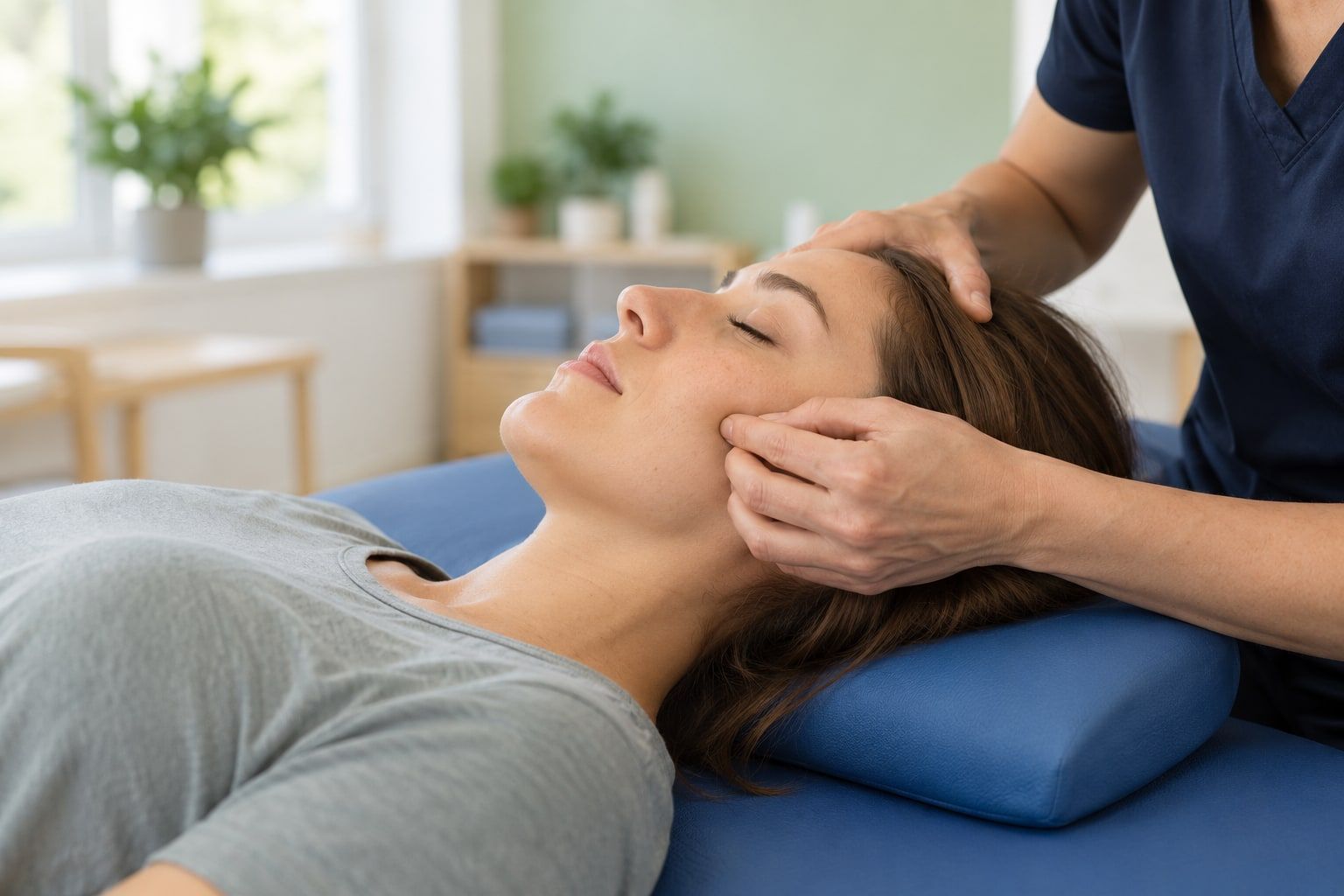
TMJ Disorder Treatment in Düsseldorf Unterbilk
Professional TMD therapy for jaw pain – centrally located at Fürstenwall 146
Clenched teeth in a video conference, a tight jaw after a long day, plus headache at the temples: stress and desk work show up in the chewing system in many people. Praxis Pirnay in Düsseldorf-Unterbilk treats jaw joint complaints and includes posture and the neck. Read how tension, sitting and the jaw are connected and what you can change in your working day.
Jaw joint complaints from stress and desk posture
In technical language, jaw joint complaints are called craniomandibular dysfunction, CMD for short. This refers to pain and functional disorders of the chewing muscles and the jaw joints. Very often the muscles are the starting point: anyone under pressure tenses the jaw, shoulders and neck without noticing. If that continues for hours, the muscles become painful and the joint becomes sensitive.
Posture is added to this. When the head moves forward at the screen, the pull of the muscles that connect the lower jaw, hyoid bone and neck changes. That can alter the relaxed resting position of the lower jaw. Overloaded chewing muscles can also transfer pain to the temple and forehead. Many people therefore notice the headache first and the jaw only later.
The complaints usually fluctuate with the load: stronger in demanding phases, calmer on vacation. That does not mean they are imagined; it only shows how closely tension and muscles are connected. The diagnosis belongs in the hands of a dentist or doctor. Physiotherapy works on muscles, joint, posture and habits.
How tension and sitting load the jaw
Clenching during the day
During concentration, anger or time pressure, the teeth rest firmly on each other, often for long stretches. The technical term for this is awake bruxism.
Head in front of the body
A head position pushed forward at the monitor increases tension in the neck and the front neck muscles and shifts the resting position of the lower jaw.
Restless sleep
Poor sleep and grinding at night often occur together. The chewing muscles then start the day already tired.
Coffee, nicotine, alcohol
These stimulants are associated with increased grinding. In stressful phases, their consumption often rises unnoticed.
One-sided habits
Clamping the phone between ear and shoulder, resting the chin in the hand, chewing on pens: all of this loads the jaw and neck one-sidedly.
How an overloaded jaw makes itself felt
At the jaw
- • Tired, tight jaw in the evening
- • Pain when chewing or opening wide
- • Clicking noises in the joint
- • Teeth feel sensitive in the morning
At the head
- • Pressing pain at both temples
- • Headache that increases over the course of the day
- • Pressure at the forehead or behind the eyes
At neck and shoulders
- • Hunched-up shoulders
- • Tight neck, difficulty looking over the shoulder
- • Pulling from the back of the head toward the ear
In connection with stress
- • More complaints in stressful phases
- • Improvement on days off
- • Clenching is only noticed when you are asked about it
With these signs, see a doctor or dentist first
Jaw pain usually has a muscular, harmless cause. There are exceptions that do not tolerate delay. For the first two points, call the emergency number 112, and have the others examined at short notice.
- Pulling pain in the lower jaw, accompanied by tightness in the chest, shortness of breath, sweating or nausea – this is how a heart attack can show itself.
- A corner of the mouth drooping on one side, numbness in the face or slurred speech that appear suddenly.
- After an accident: the bite no longer fits, or the mouth cannot be opened or closed – go to the emergency department.
- Swollen cheek, fever, throbbing toothache or difficulty swallowing: see a dentist the same day; with difficulty breathing, call the emergency number 112.
- Temple pain with pain when chewing and visual disturbance in people from age 50: have it checked by a doctor without delay.
- Shooting facial pain lasting only seconds, persistent numbness, a sore spot in the mouth that does not heal or a steadily smaller mouth opening.
Physiotherapy for jaw, neck and posture
Depending on the prescription from your doctor (Heilmittelverordnung), we combine treatment at the jaw and cervical spine with active training. We cannot treat stress itself, but we can treat its physical consequences and how you deal with them in your working day.
Jaw joint and chewing muscles
We release tension in the chewing muscle and in the temple muscle and move the joint with calm techniques. In doing so, you learn how a relaxed jaw feels, so that you can recognize the difference at your desk.
Manual therapy
The upper neck vertebrae and the transition to the thoracic spine are often stiff after long screen work. We mobilize these sections because head posture and jaw position affect each other.
Physiotherapy exercises (Krankengymnastik)
The focus is on awareness and relaxation: resting position of the jaw, breathing exercises, sitting upright. A short program is added that can be carried out unobtrusively in the office.
Exercise therapy on machines (Krankengymnastik am Gerät)
With measured resistance, you strengthen the back and shoulder girdle. Resilient postural muscles make it easier to carry the head over the trunk and can thereby relieve the neck and jaw.
Your path through treatment in Düsseldorf-Unterbilk
- 1
Assessment
We examine mouth opening, chewing muscles and cervical spine and ask about your workplace, stressful phases and sleep. This first appointment is scheduled for longer than the following ones.
- 2
Choosing a focus
You name what bothers you most: the temple headache in the afternoon, the clicking, the tired jaw. We align the treatment accordingly.
- 3
Releasing and noticing
First we lower the tension in the chewing and neck muscles. In parallel, you practice noticing clenching early and interrupting it.
- 4
Stabilizing
Then posture and strengthening are added, on machines too depending on the prescription. The exercises gradually move into your working day.
- 5
Taking stock
At the end, we check what has changed and discuss what you continue yourself. Further prescriptions are decided by the doctor’s or dentist’s office.
Relaxing the jaw in the office and when working from home
The first step is to notice the clenching at all. The following points cost hardly any time and can be built into any working day.
Jaw check with a fixed cue
Link the check to a routine, such as every phone call or every new email. Then check whether the teeth are in contact. If so: breathe out and let the lower jaw drop.
Breathe out and let go
Breathe in through the nose and out slowly through slightly opened lips. Let the shoulders and lower jaw drop as you do so. Three calm breaths are enough.
Screen closer, arms supported
Move the monitor close enough that you do not have to push your head forward, and rest your forearms on the desk. The phone belongs in your hand or on a headset.
Winding down in the evening
Exercise after work, a fixed time to switch off screens and less coffee in the afternoon can improve sleep. Calmer nights often relieve the jaw too.
Appointment at Fürstenwall: directions, booking, documents
You will find Praxis Pirnay at Fürstenwall 146 in Düsseldorf-Unterbilk, near the Medienhafen; it is about 1.5 kilometers to the Königsallee. The nearest stops are called “Fürstenplatz” and “Kirchplatz”. By car, you come via the B8 or the A46, exit Düsseldorf-Bilk. There is no parking lot of its own; you park on Fürstenwall or in the side streets.
You book your appointment online via Doctolib, by phone or with the form on this website. Please bring the prescription, your insurance card and, if you have them, your bite splint as well as dental records and doctors’ letters.
Because we also examine the neck and shoulders and, depending on the prescription, train with you, comfortable clothing is sensible. German, English or Spanish is spoken. At the first visit, we plan more time for the assessment.
Opening hours: Mon 8:00–19:30, Tue–Wed 7:00–18:30, Thu 9:00–18:30, Fri 9:00–14:00
Questions about jaw, stress and headache
Can stress alone cause jaw pain?
Stress is a significant influencing factor, but rarely acts alone. It increases muscle tension and promotes clenching and grinding; posture, sleep and habits add to it. That is why treating only the jaw is usually not enough. With lasting psychological strain, medical or psychotherapeutic support can also make sense.
Are my headaches connected with my jaw?
That is quite possible if the pain sits at the temples, increases when chewing or is already there on waking. In the assessment, we check whether pressure on the chewing muscles triggers your familiar headache. New or unusually severe headaches must first be checked by a doctor.
Can I tell myself whether I clench during the day?
Often only when you consciously pay attention. Pointers are tooth imprints on the edge of the tongue, a pale line on the inside of the cheek at the level of the teeth and a jaw that is tired in the evening. A regular reminder in which you briefly check tooth contact usually makes the pattern visible after a few days.
Does health insurance pay for the treatment, and how do I get an appointment?
With a prescription, statutory health insurance covers the treatment except for your statutory co-payment; if you are exempt, you do not pay it. Private health insurers reimburse depending on the contract, so ask beforehand. Appointments are available online via Doctolib, by phone or via the form on this page.
May I keep exercising with jaw pain?
Yes, as a rule nothing speaks against it, and endurance exercise helps many people reduce tension. During strength exercises, take care not to clench your teeth: breathe out on exertion, jaw loose. You should put aside sports with blows to the face if you have acute joint complaints.
You Might Also Be Interested In
Headaches
Relief from tension headaches and migraines
Neck Pain
Treatment for cervical spine syndrome and neck tension
TMJ Therapy
Treatment for craniomandibular dysfunction
Manual Therapy
Jaw joint mobilization and treatment
All Therapies
Overview of our treatment services