
Shoulder Pain Treatment in Düsseldorf Unterbilk
Professional physiotherapy for shoulder pain – centrally located at Fürstenwall 146
Hours at the screen and mouse, strength training, swimming or tennis in the evening – your shoulder gets either too little variety or too much load at once. Praxis Pirnay on Fürstenwall in Düsseldorf-Unterbilk treats shoulder pain on a prescription from your doctor (Heilmittelverordnung). This page covers how the shoulder and neck are connected, what overloads the shoulder in sport, and how you can adapt your work and training.
Shoulder pain in Düsseldorf-Unterbilk: between desk and training
Shoulder pain is a collective term. It can come from the joint, from tendons and bursa, from the acromioclavicular (AC) joint at the outer end of the collarbone – or from the muscles between the shoulder blade and the neck. These areas work together: when the arm lifts, the shoulder blade rotates with it, and several of the muscles involved originate at the cervical spine. Shoulder and neck therefore can rarely be looked at separately.
In screen work, the problem usually lies less in a particular posture than in a lack of variety. If the mouse arm stays stretched out in front without support for a long time, or the shoulders are permanently raised slightly, the neck and shoulder muscles work without a break. They tire, become tender to the touch and ache. Problems in the cervical spine can also radiate into the shoulder and arm even though the shoulder joint itself is unremarkable.
In sport, shoulder pain mostly arises from overload: too much, too often or increased too fast. The tendons of the rotator cuff – the group of muscles that guides the head of the upper arm bone in the socket – and the long biceps tendon are affected above all. Acute injuries such as a dislocation (luxation) or an injured AC joint need a medical examination first.
Triggers at the screen and in training
Mouse arm without support
If the forearm is not supported, the shoulder carries the weight of the arm for hours. The muscles on top of the shoulder tense up.
Rigid sitting
If you stay in the same position for a long time, you keep loading the same muscle fibers. A laptop screen that sits low makes this worse.
The cervical spine as a source
Irritated vertebral joints or nerve roots in the neck can trigger pain in the shoulder, shoulder blade or arm.
Strength training with heavy loads
Bench presses, overhead presses or dips put heavy demands on the tendons and the AC joint, especially when the weight is increased quickly.
Many identical arm strokes
Swimming, tennis or climbing require the same movement above shoulder height again and again. Without recovery, the tendons react with irritation.
How the symptoms show up
More likely from the neck
- • Pulling from the neck to the top of the shoulder
- • Hard, tender muscles on top of the shoulder
- • Getting worse over the course of the working day
- • Head movements change the pain
More likely from the shoulder joint
- • Pain when the arm is lifted or turned
- • Pain on the side of the upper arm
- • Lying on the shoulder disturbs sleep
Under sporting load
- • Pain with particular exercises, such as pressing overhead
- • Stabbing pain at the front of the shoulder when serving or throwing
- • Tenderness at the AC joint
- • A feeling that the shoulder is not stable
When the shoulder has to be examined by a doctor
Tension and overload are annoying but usually harmless. Some signs do not fit that picture. In that case, a medical examination comes before physiotherapy.
- Pressure in the chest, shortness of breath or breaking out in a sweat with pain in the shoulder, arm or jaw – emergency number 112.
- Sudden weakness or paralysis of an arm, a drooping corner of the mouth, speech disturbance – emergency number 112.
- A fall during sport: dislocated shoulder, a step at the collarbone or an arm that can no longer be lifted.
- Neck pain radiating into the arm, with numbness or loss of strength in the hand.
- Swelling, redness and warmth of the shoulder, accompanied by fever.
- Pain that is present regardless of movement and gets worse at night, or weight loss without explanation.
What physiotherapy does for shoulder and neck problems
The aim is to get the shoulder used to load again – at the desk as well as in sport. Passive treatments loosen and relieve; training is meant to make the shoulder more resilient. What you receive depends on your prescription.
Equipment-based exercise therapy (KGG)
On training machines, you strengthen the rotator cuff, shoulder blade muscles and trunk with precisely adjustable resistance. For athletes, the training gradually moves closer to the movements of their own sport.
Physiotherapy exercises (Krankengymnastik)
You learn to control the shoulder blades and to keep your neck and thoracic spine mobile. Short exercises for the working day and tips on setting up your workstation are added.
Manual therapy
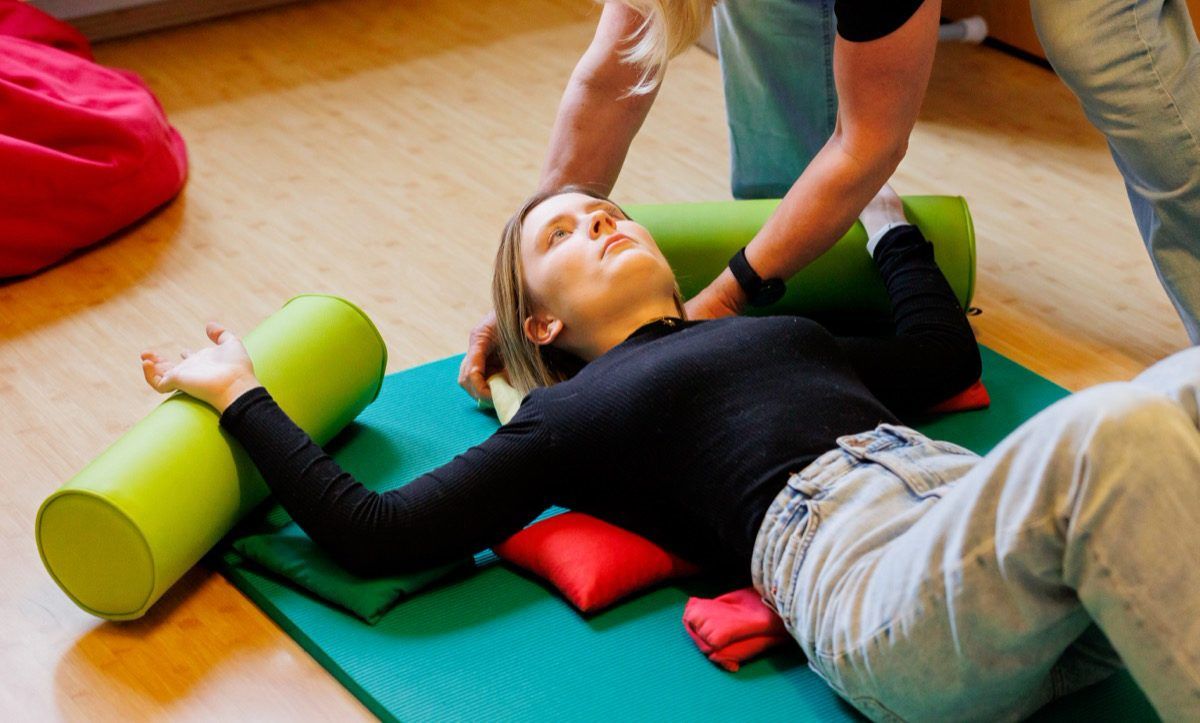
The therapist examines whether the cervical spine, upper ribs or AC joint are involved, and mobilizes restricted joints with targeted hand techniques. This often makes the active exercise that follows easier.
Classical massage
When the neck and shoulder muscles are permanently tense, massage loosens the tissue and eases the pain for a while. It complements the active therapy; it does not change anything about long, rigid sitting.
Your path through treatment
- 1
Asking about work and training
We ask about your workplace, sport, training volume and the moment when the pain occurs. Then we examine the shoulder, shoulder blade and cervical spine in motion and under load.
- 2
Setting a goal
You name the goal: getting through the working day without neck pulling, swimming front crawl again or moving your former training weight. We measure progress against that.
- 3
Treating and loading
Hand techniques and massage take tension out. In parallel, training begins with loads that the shoulder tolerates well and is increased in small steps.
- 4
Conclusion and outlook
At the end, we check strength and mobility again. You receive exercises for the desk and the gym, and you know how to recognize overload early if it returns.
Working and training in a shoulder-friendly way
A lot can be changed with little effort. If the symptoms persist anyway or get stronger, have your shoulder examined.
Rest your forearms
Adjust your chair and desk so that both forearms are supported and your shoulders hang loosely. The mouse belongs close to the keyboard, the top edge of the screen roughly at eye level.
Change position
Get up regularly and take phone calls while walking. In between, roll your shoulders and draw your shoulder blades back and down a few times.
Adjust training instead of stopping
For the exercise that hurts, reduce the weight, range of motion or frequency, and keep training what the shoulder tolerates well. Slight pulling that fades by the next day is usually not a concern.
Balance pulling and pushing
If you do a lot of pushing, for example bench presses or push-ups, schedule pulling exercises such as rows just as regularly. That also works the back of the shoulder.
How to find us on Fürstenwall
Praxis Pirnay is at Fürstenwall 146, 40217 Düsseldorf, near the Medienhafen and about 1.5 kilometers from Königsallee. The stops "Fürstenplatz" and "Kirchplatz" are nearby. If you come by car, take the B8 or the A46 to the exit Düsseldorf-Bilk. The practice has no parking lot of its own; you can park along Fürstenwall and in the side streets.
You can book appointments online via Doctolib, by phone or with the appointment form on the website. We treat in German, English and Spanish. For your appointment, bring your prescription, health insurance card and any existing findings, for example doctor's letters, X-ray or MRI images.
For the examination of the shoulder, a strappy top is practical; for training, comfortable sportswear. At the first appointment, we take more time for the assessment; the following sessions last 20 to 60 minutes depending on the prescribed therapy.
Opening hours: Mon 8:00–19:30, Tue–Wed 7:00–18:30, Thu 9:00–18:30, Fri 9:00–14:00
Short answers: shoulder, office and sport
How do I tell whether the pain comes from the neck or from the shoulder?
A first clue is which movement changes the pain. If turning or tilting the head triggers it, the source is more likely in the neck. If lifting or turning the arm hurts most, that points to the shoulder. Often both are involved. In the assessment, we check both regions; the diagnosis is made by the doctor's practice.
Does a standing desk help against shoulder and neck pain?
It can help if you use it to switch. Standing for a long time in one posture is no better for the shoulder and neck than sitting for a long time. What matters is that you change position several times a day and that your forearms are supported at both heights.
Do I have to pause strength training while my shoulder hurts?
Usually not completely. As a rule, it is enough to change the triggering exercises for a while: less weight, a smaller range of motion, a different grip. Legs, trunk and low-pain upper-body exercises can carry on. After a fall, a dislocation or a sudden loss of strength, this does not apply – then have it checked by a doctor first.
What is equipment-based exercise therapy, and how do I get it?
Equipment-based exercise therapy (Krankengymnastik am Gerät, KGG for short) is strength training on machines under physiotherapeutic guidance. It is a remedy in its own right and has to be written on the prescription as such. Raise it at your doctor's practice if building strength is your priority. In Düsseldorf-Unterbilk, KGG is part of what we offer.
Will my private health insurance reimburse the treatment?
That depends on your plan; clarify it with your insurer before the first appointment. We bill all health insurers, private as well as statutory. In any case, bring a prescription from your doctor. People with statutory health insurance pay the statutory co-payment if they are not exempt.
You Might Also Be Interested In
Neck Pain
Treatment for cervical spine syndrome and neck tension
Sports Injuries
Rehabilitation after sports injuries
Manual Therapy
Shoulder joint mobilization and treatment
Medical Training Therapy
Targeted shoulder muscle building
All Therapies
Overview of our treatment services