
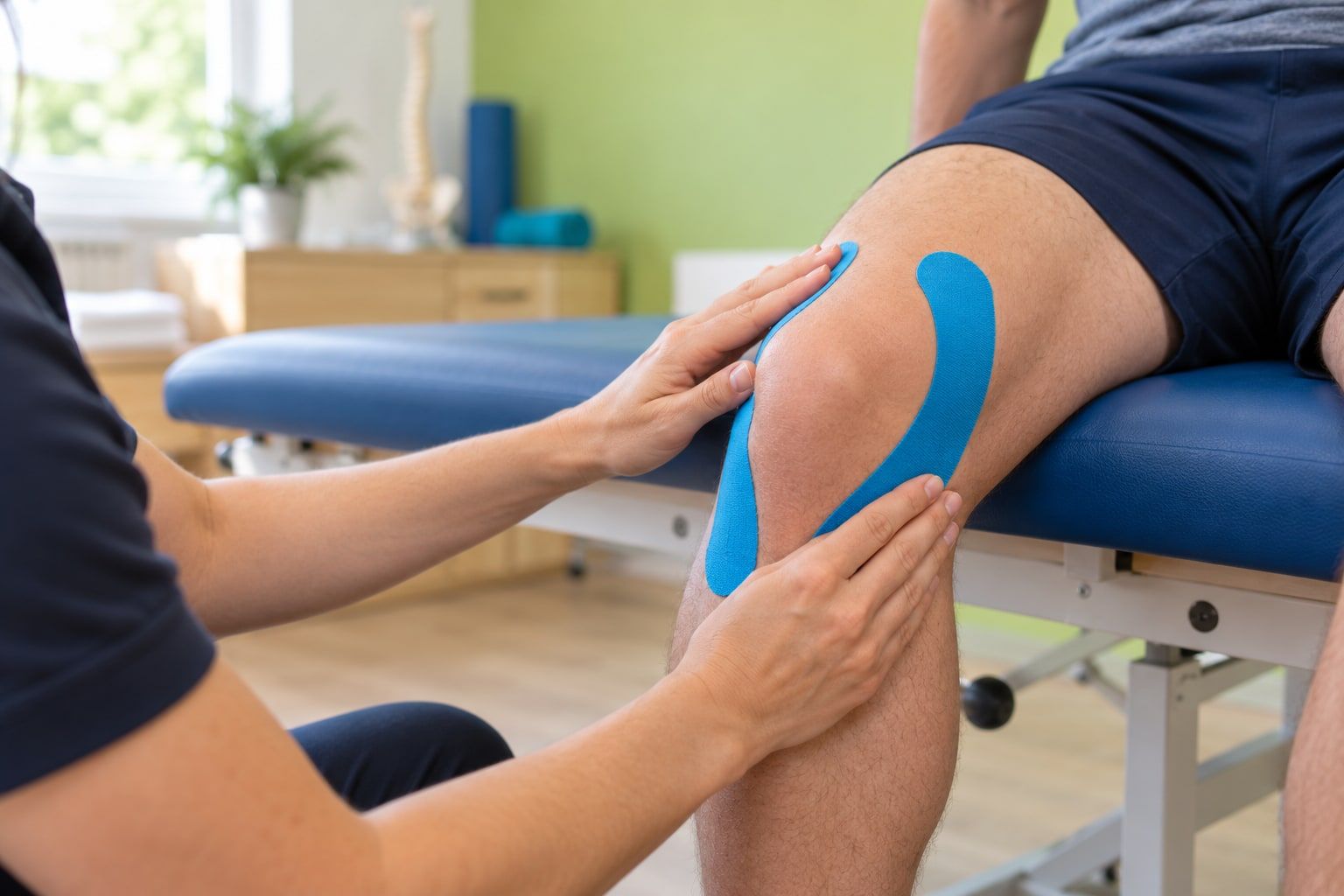
Knee Pain Treatment in Cologne Esch
Runner's Knee, Arthritis & Meniscus Treatment at Martinusstraße 53
The first steps after getting up are stiff, the stairs become a chore, and you can hardly get into a squat any more – this is how knee osteoarthritis shows itself in everyday life. Praxis Pirnay in Cologne-Esch treats knee pain with physiotherapy on a prescription from your doctor (Heilmittelverordnung). This page explains what is going on in the joint, why movement still matters, and how you can make stairs, squatting and carrying easier on your knees.
Knee pain in Cologne-Esch: understanding knee osteoarthritis
In the knee joint, the thigh bone, the shin bone and the kneecap meet. Their joint surfaces are covered with cartilage, a smooth, springy layer. In knee osteoarthritis, medically called gonarthrosis, this cartilage gradually becomes thinner and rougher. But the whole joint is affected: the bone underneath becomes denser, the lining of the joint can become inflamed, and the muscles grow weaker.
Typical is start-up pain: the first steps after sitting or in the morning hurt, then it loosens up as you walk. Later, the knee also hurts under load, for example after longer walks. Osteoarthritis goes through phases. Calmer periods alternate with days when the joint is warm and swollen; this is then called activated osteoarthritis.
The loss of cartilage cannot be reversed. But how much a knee hurts does not depend on the X-ray image alone. Strong muscles, a mobile joint and a load that suits the knee all influence the symptoms. This is where physiotherapy comes in. The diagnosis is made by your doctor, usually based on an examination and an X-ray.
What promotes knee osteoarthritis
Age and predisposition
Over the years, cartilage loses resilience. A family tendency toward osteoarthritis also plays a role.
Earlier knee injuries
Meniscus damage, cruciate ligament tears or fractures involving the joint change how load is distributed and, after a long time, can lead to osteoarthritis.
Bow legs or knock knees
If the leg axis deviates, one side of the joint carries more load – the inner side with bow legs, the outer side with knock knees.
High body weight
When walking and climbing stairs, a multiple of your body weight acts on the knee. Excess weight is therefore considered a risk factor that can be influenced.
A lot of kneeling and squatting
Anyone who works kneeling or squatting over a long period, or lifts heavy loads, puts more stress on cartilage and menisci.
How osteoarthritis makes itself felt in the knee
When starting to walk and under load
- • Start-up pain after sitting or in the morning
- • Pain on stairs, especially going down
- • Pain after longer walking or standing
- • Getting up from low seats is difficult
Mobility
- • The knee no longer straightens or bends fully
- • Brief stiffness after rest
- • Rubbing or grinding when moving
- • Squatting and kneeling hardly possible
In irritated phases
- • The joint is warm and swollen
- • Pain even at rest or at night
- • A feeling of tightness at the back of the knee
When a knee has to be examined by a doctor first
Osteoarthritis develops slowly. If something does not fit this picture, the knee belongs in a doctor's practice first – in some cases on the same day.
- Knee suddenly hot, red and very swollen, together with fever or feeling unwell.
- Calf swollen, warm and tender to pressure; with shortness of breath or chest pain as well: emergency number 112.
- After a fall or twisting injury, the leg cannot bear weight, or the knee swells within hours.
- The knee locks and can no longer be straightened.
- Persistent night pain and pain at rest with unintended weight loss.
Physiotherapy for knee osteoarthritis
Exercise therapy is the core of osteoarthritis treatment. It cannot renew the cartilage, but it works on strength, mobility and load tolerance. Which treatments are added depends on your prescription and on whether the knee is currently calm or irritated.
Physiotherapy exercises (Krankengymnastik)
You strengthen the thigh and hip muscles that guide the knee and absorb impact, and you practice straightening and bending. This includes everyday movements: getting up from a chair, stairs, walking safely. The dosage is set so that the knee tolerates it.
Manual therapy
With gentle traction and gliding movements, the therapist mobilizes the knee joint and kneecap. This is meant above all to preserve extension, which is important for fluid walking, and can ease pain temporarily.
Fango (mud packs), hot air or cold
A stiff knee with osteoarthritis that is not inflamed often responds well to heat before exercising. If the joint is warm and swollen, it is cooled instead.
Electrotherapy
For stronger pain, your doctor's practice can additionally prescribe electrical stimulation. It is meant to make exercising easier in an irritated phase and does not replace it.
How treatment proceeds
- 1
Assessment and goals
We ask what makes the knee hurt and what matters to you in daily life – the stairs to your apartment, the walk to the shops. Then we measure extension and flexion and check strength, leg alignment and gait.
- 2
Treatment
Mobilization and, depending on the prescription, heat or cold prepare the joint. Active exercise takes up the larger part, and we increase it step by step.
- 3
Home exercises
You learn a few exercises that work at home without equipment, and you find out how to adjust the load to good and bad days.
- 4
Conclusion
At the end of the course, we measure again and discuss how you can carry on on your own. Osteoarthritis remains; an exercise program that you keep up therefore counts for a great deal.
Getting through the day with knee-friendly habits
Rest alone does not help a knee with osteoarthritis. It needs regular movement and a sensible way of dealing with load peaks. These are things you can try.
Move steadily
Cycling, swimming or walking on level ground move the knee without hard impacts. The alternation of loading and unloading supplies the cartilage with nutrients. Better a little every day than a very long session rarely.
Stairs with a system
Hold on to the handrail. Going up, the stronger leg starts; going down, the painful one. That way the stronger leg does the bigger share of the work each time.
Replace squatting and kneeling
For jobs close to the floor, sit on a low stool or use a kneeling pad. Change position before the knee gets stiff.
Spread out loads
A backpack or a shopping trolley relieves the knees more than heavy bags in your hands. Better to go twice with a little than once with a lot.
To Praxis Pirnay in Cologne-Esch with knee pain
Praxis Pirnay is at Martinusstraße 53, 50765 Cologne, in the north of Cologne near Pesch and Auweiler. You can park directly in front of the practice, which spares you long walks. By car, you drive via the A57 to Köln-Chorweiler or via the A1 to Köln-Bocklemünd. From the bus stop "Esch Schulstraße" it is a few minutes' walk.
Wear shorts or trousers that can be pushed up above the knee, and bring the shoes you usually wear day to day. We also need your prescription and health insurance card and, if you have them, doctor's letters and X-ray or MRI findings.
You can get appointments by phone or via the form on this website. The team speaks German, English and Spanish, and at reception also Turkish. If getting to the practice is not possible, a home visit can take place if it is noted on the prescription.
Opening hours: Mon 7:00–20:00, Tue 8:00–19:50, Wed 8:00–19:30, Thu 7:00–19:50, Fri 7:00–15:30
Questions about knee osteoarthritis and daily life
Does the knee wear out even more through movement?
No, appropriate movement does not harm a knee with osteoarthritis. Cartilage has no blood vessels of its own and is supplied through the joint fluid, which is distributed when you move. Rest, by contrast, weakens the muscles that protect the joint. What you should avoid are load peaks that clearly irritate the knee, such as jumping or long downhill walking.
Why does the knee hurt more going downstairs than going upstairs?
Going downstairs, the thigh muscle has to brake your body weight with the knee bent. This raises the pressure in the joint, especially behind the kneecap. If the muscle is weakened, it absorbs less. Strengthening and the right order of the legs on the stairs can make this easier.
My knee is suddenly warm and swollen – should I keep exercising?
Not as usual. In an irritated phase, reduce the load, cool the knee and raise the leg; gentle movement without load is usually still possible. Let the practice know, and we will adjust the treatment. If fever, marked redness or severe pain are added, see a doctor the same day.
When is an artificial knee joint an option?
You decide that together with your orthopedic doctor. Joint replacement is usually considered when pain and limitations remain severe despite consistent conservative treatment and the X-ray shows advanced osteoarthritis. Physiotherapy accompanies both paths: before an operation and afterward.
Who prescribes physiotherapy for knee osteoarthritis, and what do I pay?
The prescription is issued by your family doctor's or orthopedic practice. We bill every statutory or private health insurer. If you have statutory health insurance, the statutory co-payment applies unless you are exempt. With private health insurance, reimbursement depends on your plan; ask them beforehand.
You Might Also Be Interested In
Manual Therapy
Joint treatment for knee problems
Medical Training Therapy
Targeted knee training and muscle building
Pain Therapy
Effective treatment for chronic pain
Classical Massage
Muscle relaxation for knee pain
All Therapies
Overview of our treatment services
Book Your Appointment
Don't let knee pain hold you back. Our experienced team helps you with runner's knee, arthritis, and meniscus problems.
0221 - 7099885