
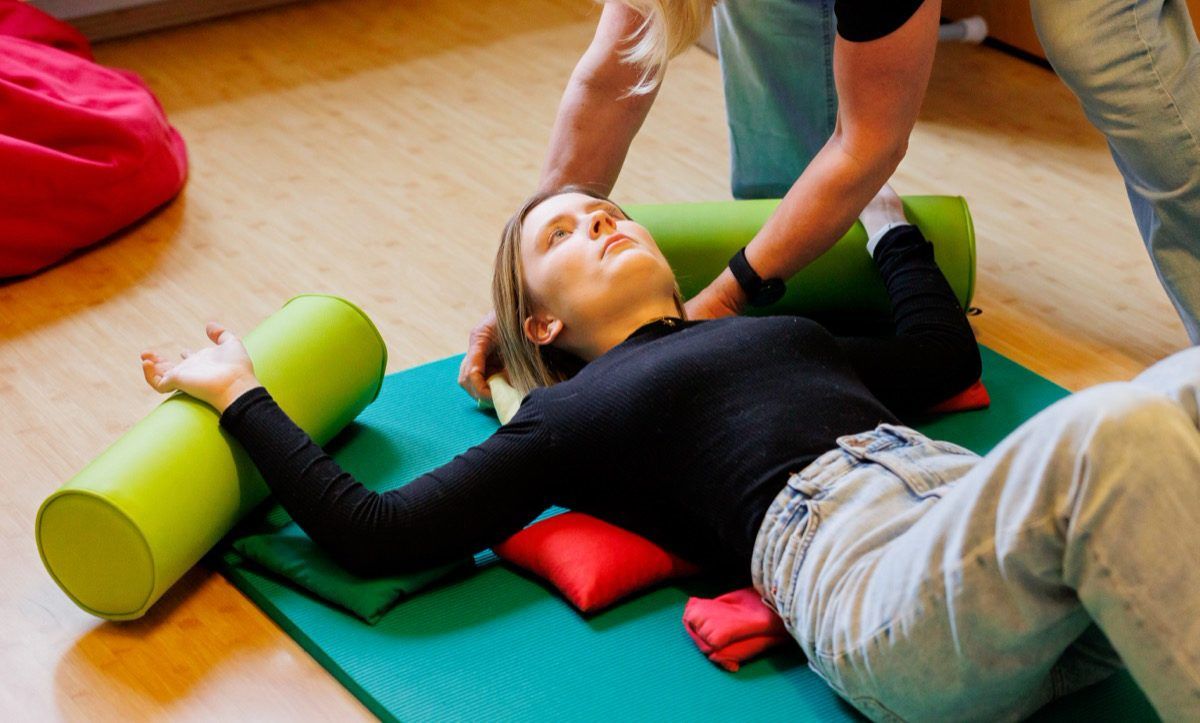
Shoulder Pain Treatment in Cologne Worringen
Professional physiotherapy for shoulder pain at Hackhauser Weg 61
When your shoulder is getting ever stiffer, or needs to get moving again after surgery, a fracture or a dislocation, it takes patience and a clear plan. Praxis Pirnay in Cologne-Worringen supports you with physiotherapy on a prescription from your doctor (Heilmittelverordnung). Here you can read how a stiff shoulder develops, what matters in follow-up treatment, and when something has to be checked by a doctor first.
Stiff shoulder and follow-up treatment: shoulder pain in Cologne-Worringen
In frozen shoulder, medically called adhesive capsulitis, the capsule that surrounds the shoulder joint becomes inflamed. It thickens and shrinks. The joint loses range of motion in every direction, most noticeably when turning the arm outward. A typical feature: the arm does not get any further even when someone else moves it for you.
The course usually has three stages. First, pain dominates, often at night too, and mobility decreases. Then the pain eases, but the stiffness remains. Finally, mobility gradually returns. This often drags on for many months, sometimes longer than a year, and the shoulder does not always become as mobile as before.
A shoulder can also become stiff as a consequence: after tendon surgery, a fracture of the head of the upper arm bone, a dislocation or a long period of immobilization. In follow-up treatment, the surgeon specifies what the shoulder may do and when – whether it is only moved with guidance, exercised actively or already loaded. Physiotherapy follows this protocol.
Why a shoulder becomes stiff
Inflamed joint capsule
Primary frozen shoulder begins without an obvious trigger. The capsule becomes inflamed, thickens and contracts.
Diabetes and thyroid
People with diabetes or a thyroid condition are affected more often. The exact connection is not fully understood.
Shoulder surgery
After a tendon repair, joint replacement or arthroscopy (keyhole surgery of the joint), tissue has to heal. While movement is limited, the capsule and muscles can shorten.
Fall onto the arm or shoulder
Fractures of the head of the upper arm bone, a dislocated shoulder or a torn tendon often happen when someone falls onto an outstretched arm.
Long immobilization
If the arm stays in a sling or bandage for a long time, the capsule loses stretchability. That is why it is only immobilized for as long as medically necessary.
Signs depending on the stage and your history
Painful initial stage
- • Deep, aching pain extending into the upper arm
- • Night pain, lying on your side hardly possible
- • Shooting pain with jerky movements
Stiff stage
- • The arm hardly turns outward any more
- • Combing your hair or fastening a bra is not possible
- • Pain mainly at the end of the movement
After surgery, fracture or dislocation
- • Swelling and bruising on the shoulder and upper arm
- • Wound pain and a feeling of tightness
- • Loss of strength after immobilization
These warning signs belong in a doctor's hands first
Especially after surgery or a fall, there are signs for which physiotherapy has to wait. In that case, contact the clinic that operated on you, your doctor's practice or the out-of-hours medical service.
- Chest pain, tightness in the chest or sudden shortness of breath, also in the days after surgery: emergency number 112.
- The surgical wound turns red, oozes or becomes hot; fever or chills come on top of that.
- After a fall, you cannot lift the arm under your own power, or the shoulder looks deformed.
- Your hand or arm becomes numb, tingles or can no longer be moved properly.
- After surgery, the pain suddenly increases sharply, for example after a jolt.
- Stiff shoulder with a persistent feeling of being unwell, night sweats or weight loss for no apparent reason.
How physiotherapy supports the stiff or operated shoulder
Treatment depends on the stage. As long as the shoulder hurts a lot, we work gently; forceful stretching can fuel the inflammation. When the pain eases, mobilization can become more intensive. After surgery, the clinic's follow-up protocol applies.
Physiotherapy exercises (Krankengymnastik)
After surgery, we first move the arm passively or with support; later you exercise actively and against resistance. For a stiff shoulder, stretching and movement exercises are the main focus, and you continue them at home.
Manual therapy
With measured gliding and traction techniques, the therapist stretches the shrunken capsule. In the painful early stage, she stays below the pain threshold; in the stiff stage, she works at the end of the range of motion.
Manual lymphatic drainage
After surgery or a fracture, the shoulder, upper arm and sometimes the hand are swollen. Gentle hand techniques stimulate the drainage of tissue fluid. When the swelling goes down, the tissue feels less tight.
Fango (mud packs), hot air and cold
Heat before mobilization makes muscles and connective tissue more pliable; many people find the stretching afterward more bearable. After recent surgery, or with swelling or acute inflammation, cold may be considered instead.
From the first assessment to the final assessment
- 1
Measuring and reviewing documents
We measure how far the arm goes actively and with guidance, and ask about pain, sleep and daily life. We go through the surgery report and the follow-up protocol with you.
- 2
Achievable goals
We discuss what is realistic in your current stage: lying more comfortably at night, bringing your hand to your mouth, later reaching up again.
- 3
Treatment and home exercises
Depending on how irritated the shoulder is and on medical clearance, we combine guided movement, mobilization, lymphatic drainage or heat. You also get a few clearly described exercises for every day.
- 4
Measuring again
At the end of the prescription, we measure again and record what has been achieved. For long courses, your doctor's practice will discuss with you whether further treatment is prescribed.
Exercising gently between appointments
With a stiff shoulder, regularity counts for more than strength. After surgery, the rule is: only exercise what has been cleared by your doctor or in therapy.
Let the arm swing
Support yourself on the table with your healthy hand, lean your upper body forward slightly and let the affected arm hang loosely and swing in small circles.
Short and often
Several short exercise sessions a day achieve more than one long one. A pulling feeling at the end of the movement is fine. If the pain does not fade for a long time afterward, the stretch was too strong.
Warmth before stretching
Many people find a warm shower or a grain pillow before exercising helpful. Heat does not belong on fresh wounds or swollen areas.
Dressing and undressing
Put the affected arm into the sleeve first, and take it out last when undressing. Loose tops with buttons or a zipper are easier to handle.
Coming to your appointment in Cologne-Worringen with shoulder problems
You will find Praxis Pirnay at Hackhauser Weg 61, 50769 Cologne. Worringen is the northernmost district of Cologne and lies close to the Rhine. If you are not yet allowed to drive after shoulder surgery, you can take the bus: from the stop "Worringen Hackhauser Weg" it is a few minutes on foot. By car, take the A57 to the exit Köln-Worringen and park directly in front of the practice.
For the first appointment, bring the prescription, your health insurance card and all documents from the hospital or doctor's practice: surgery report, follow-up protocol, X-ray or MRI findings. Wear a loose top that opens at the front. Depending on the prescription, expect 20 to 60 minutes; for the assessment, we plan extra time at the beginning.
We give appointments over the phone or via the appointment form on this website. Treatment is in German, English or Spanish. If you cannot come to the practice, a home visit at your home or in a care home is possible, provided it is noted on the prescription.
Opening hours: Mon–Tue 7:00–18:00, Wed 7:00–18:20, Thu 8:00–19:30, Fri 8:00–14:00
Questions about frozen shoulder and follow-up treatment
How long does a frozen shoulder last?
A long time – you should prepare for that. Frozen shoulder goes through stages and often takes many months, and in some people longer than a year. Physiotherapy can ease pain and help to maintain and regain mobility. What the course will look like in an individual case cannot be predicted.
Should I stretch into the pain with a frozen shoulder?
No, especially not in the early, inflammatory stage. Forceful stretching against the pain can irritate the capsule further. Gentle movements within a comfortably tolerable range make sense then. Only when pain at rest and at night subside and the stiffness predominates may the stretch at the end of the range be felt more clearly.
When does physiotherapy begin after shoulder surgery?
The clinic that operated on you sets the timing; often it is the first few days after the procedure. At first, depending on the operation, the shoulder is only moved with guidance. Active lifting and strengthening follow once the tissue can take enough load. Please bring the follow-up protocol.
Nothing was broken in the fall, but my shoulder still hurts – what should I do?
Have the shoulder examined by a doctor again. Even without a broken bone, a fall can tear a rotator cuff tendon, especially at an older age. Signs are persistent pain and weakness when you lift the arm or turn it outward. An ultrasound or MRI scan can bring clarity.
What do I pay for shoulder treatment with statutory health insurance?
You pay the statutory co-payment unless you are exempt from it; we bill everything else to your health insurer. This requires a prescription from your doctor. If you have private health insurance, reimbursement depends on your plan – ask your insurer beforehand.
You Might Also Be Interested In
Neck Pain
Treatment for neck tension and stiffness
Sports Injuries
Treatment for sports and recreational injuries
Manual Therapy
Joint mobilization and release of blockages
KGG
Device-based training for shoulder strength
All Therapies
Overview of our treatment services