
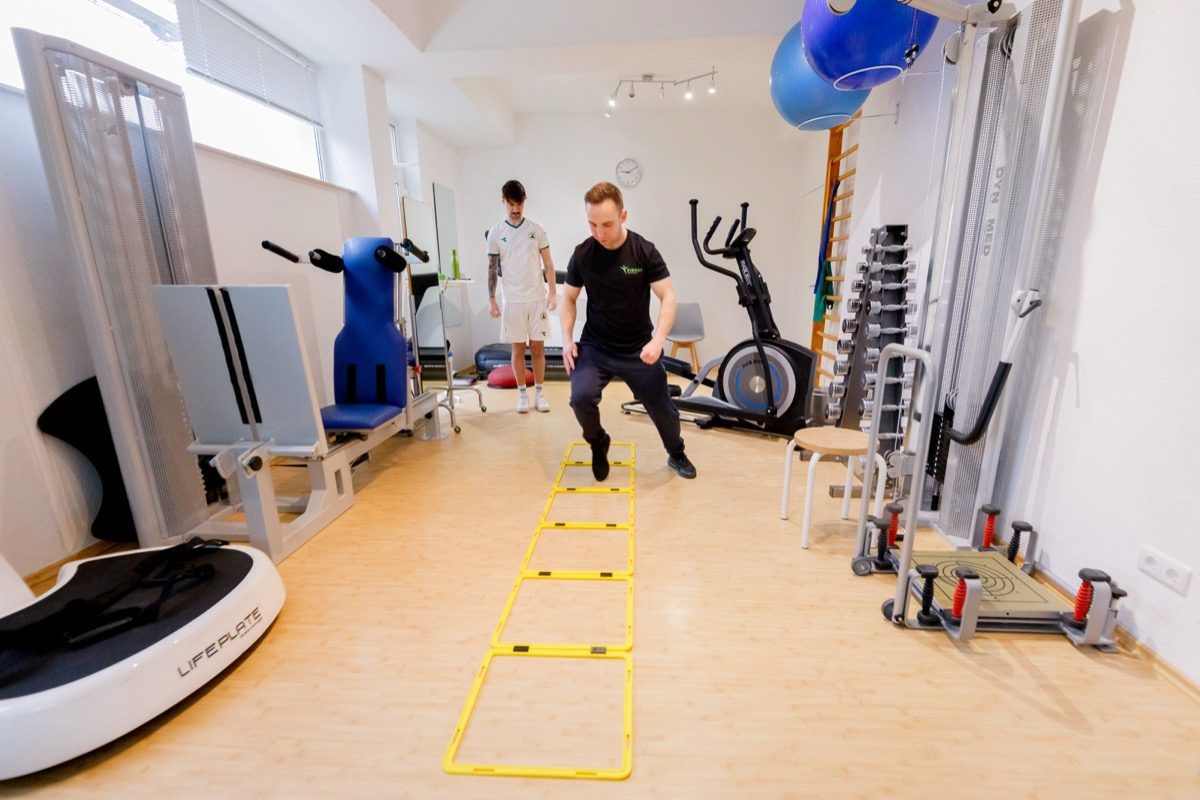
Physiotherapy for Parkinson's Disease in Düsseldorf
Stay mobile, prevent falls, preserve quality of life: specialized training for Parkinson's disease at Fürstenwall 146 in Unterbilk
For Parkinson's disease, regular, targeted exercise is, alongside medication, one of the most important parts of treatment: it can improve gait, balance and mobility and helps preserve independence for as long as possible. At our practice in Düsseldorf Unterbilk, we support Parkinson's patients at every stage of the disease.
Why Physiotherapy Is So Important for Parkinson's
In Parkinson's disease, the progressive loss of dopamine-producing nerve cells leads to the typical symptoms: slowed movements (bradykinesia), muscle stiffness (rigidity), tremor and postural instability. Intensive training cannot halt the disease, but it can help to maintain motor abilities, and with them independence, for longer. Physiotherapy does not replace medication – it adds what medication cannot provide: strength, balance, a confident gait and movement strategies for everyday life.
Typical Symptoms We Treat
Small, shuffling steps
We consciously train large, expansive steps and safe changes of direction
Balance disorders & tendency to fall
Targeted balance training is meant to help prevent falls
Freezing (motor blocks)
We practice strategies and cues to overcome blocks while walking
Muscle stiffness (rigidity)
Mobilization and stretching preserve the mobility of the trunk and joints
Stooped posture
Postural training and strengthening of the back muscles counteract the typical forward-bent posture
Fine motor skills & everyday movements
From turning over in bed to standing up from a chair – we practice the movements that matter in everyday life
Our Therapy Goals for Parkinson's
Early stage
- • Intensive endurance and strength training
- • Maintaining full mobility
- • Large, fast movement amplitudes
- • Establishing a training routine
Middle stage
- • Gait and balance training
- • Strategies against freezing
- • Fall prevention
- • Transfers and everyday movements
Advanced stage
- • Maintaining mobility and independence
- • Preventing contractures and pneumonia
- • Advice on assistive devices
- • Treatment also available as a home visit
Alongside therapy
- • Guidance for family members
- • A personal exercise program
- • Respiratory therapy
- • Coordination with your neurologist
With Parkinson's: these changes need a doctor first
Parkinson's usually changes slowly. If something worsens within a short time, there is often another cause behind it, such as an infection. In that case, medical assessment takes priority over physiotherapy. Please never stop or change your medication on your own.
- Call 112: pronounced rigidity and immobility together with fever, or if swallowing and drinking are no longer possible.
- Call 112 also for sudden paralysis on one side of the body or suddenly disturbed speech – this does not fit Parkinson's.
- A fall with a suspected broken bone: severe pain in the hip or wrist, or a leg that no longer bears weight.
- Blacking out or fainting when standing up, or repeated falls for no apparent reason.
- Coughing or throat-clearing at almost every meal, unintended weight loss or recurring chest infections.
- New confusion, seeing things that are not there or unusual sleepiness – please report this to your neurologist.
How We Treat Parkinson's in Düsseldorf
The treatment is prescribed as KG-ZNS – the German prescription code for neurological physiotherapy – and provided by our certified neuro therapists:
PNF Therapy
Three-dimensional movement patterns with large amplitudes – used to counteract the shrinking movements typical of Parkinson's.
Bobath Therapy
Neurophysiological treatment to improve postural control, balance and movement quality.
Gait and balance training
Training of stride length, pace and dual tasks – with external rhythmic cues against freezing.
Equipment-based exercise therapy
Strength and endurance training on equipment for resilience and an upright posture.
What Your Parkinson's Treatment Looks Like
- 1
Detailed assessment
Analysis of your gait, balance, mobility and everyday situations – including your history of falls and your personal goals.
- 2
A therapy plan suited to your stage
We match intensity and priorities to the stage of your disease, your medication phases (on/off) and how you feel on the day.
- 3
Intensive, goal-directed training
We train with large movement amplitudes, high repetition and practice situations taken from everyday life.
- 4
Exercises for every day
A daily exercise program is part of Parkinson's therapy – we put it together individually and adjust it regularly.
- 5
Long-term support
Parkinson's is a marathon, not a sprint: we support you on an ongoing basis and adapt the therapy as the disease evolves.
Frequently Asked Questions About Parkinson's Physiotherapy
Can physiotherapy halt Parkinson's disease?
No. Intensive physiotherapy training cannot halt Parkinson's disease, but it can help to maintain motor abilities, and therefore independence, for longer. Alongside medication, exercise is considered an important pillar of Parkinson's treatment.
How often should I have physiotherapy?
Usually 1–2 therapy sessions per week plus daily exercises at home. For Parkinson's, long-term therapy needs are recognized by health insurers, so the prescription can be continued on an ongoing basis.
What helps against freezing while walking?
We practice so-called cueing strategies: rhythmic acoustic or visual cues, conscious weight shifting and stepping techniques that help you overcome blocks in a targeted way.
Do you also treat patients at home?
Yes, if coming to the practice is no longer possible, we come to your home or nursing home with "home visit" noted on the prescription – in Unterbilk, roughly one kilometer around the practice.
What time of day is best for therapy?
Ideally during your "on" phases, when your medication is working well. We take your medication times into account when planning appointments.
You Might Also Be Interested In
Neurological Physiotherapy
An overview of our neuro specialty in Düsseldorf
Stroke
Physiotherapy after a stroke in Düsseldorf
Multiple Sclerosis
Individually paced therapy for MS
PNF Therapy
Training movement patterns with large amplitudes
Home Visits
Physiotherapy at home and in nursing homes
Book Your Parkinson's Therapy Appointment
Specialized training from certified neuro therapists at Fürstenwall 146 in Düsseldorf Unterbilk.
0211 - 55095744