
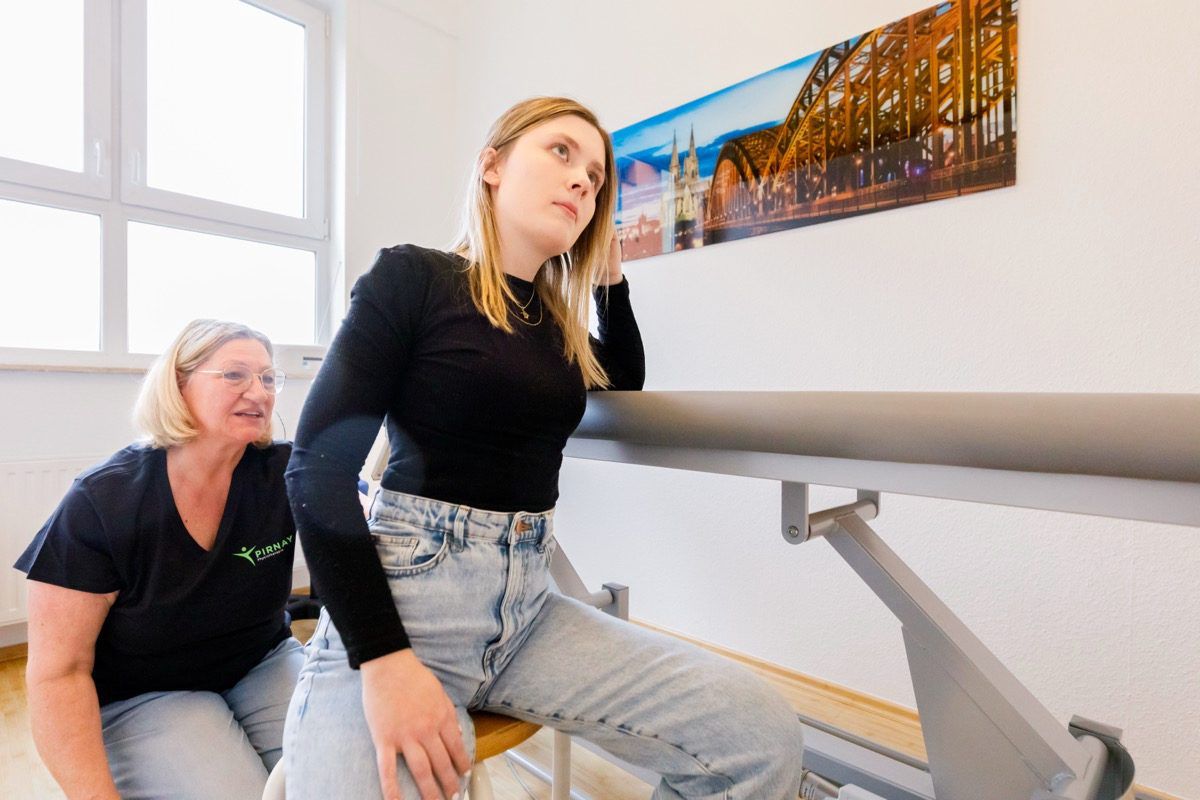
Neurological Physiotherapy in Düsseldorf (Unterbilk)
KG-ZNS based on Bobath and PNF for stroke, Parkinson's disease, multiple sclerosis and other neurological conditions – centrally located at Fürstenwall 146
After a stroke, or when living with Parkinson's disease or multiple sclerosis, targeted physiotherapy is one of the most important building blocks for maintaining or regaining mobility and independence. At our practice at Fürstenwall 146 in Düsseldorf Unterbilk, certified neuro therapists treat patients from Unterbilk, Friedrichstadt, Bilk, the Hafen district and Carlstadt. If you are unable to come to us, we visit you at home in Unterbilk, within about one kilometer of the practice.
What Is Neurological Physiotherapy (KG-ZNS)?
Neurological physiotherapy – listed on your doctor's prescription as KG-ZNS (a German prescription code for physiotherapy treating disorders of the central nervous system) – is a specialized form of therapy for people with conditions affecting the brain, spinal cord or nerves. It harnesses the nervous system's ability to reorganize itself (neuroplasticity): through targeted, frequently repeated movement facilitation, lost functions are rebuilt step by step or compensation strategies are learned. KG-ZNS may only be provided by therapists with recognized advanced training for it. At our location in Düsseldorf Unterbilk, certified therapists work with the Bobath and PNF concepts.
Conditions We Treat in Düsseldorf
Stroke (Apoplexy)
Relearning movement patterns after paralysis on one side of the body (hemiplegia/hemiparesis) – from standing up for the first time to walking safely in everyday life
Parkinson's Disease
Training gait, balance and mobility to prevent falls and maintain independence for as long as possible
Multiple Sclerosis (MS)
Individually dosed therapy to improve strength, coordination and endurance – adapted to your daily condition and the course of the disease
Traumatic Brain Injury
Neurophysiological treatment after accidents or surgery to restore motor and coordination skills
Polyneuropathy
Balance and sensorimotor training for numbness and unsteady gait, e.g. as a result of diabetes or chemotherapy
Other Neurological Conditions
Paraplegia, peripheral nerve lesions, ataxias and other disorders of the central and peripheral nervous system
What We Work on Together
Movement & Strength
- • Facilitating paralyzed or weakened muscles
- • Improving your gait
- • Building strength and endurance
- • Regulating spasticity and muscle tone
Balance & Coordination
- • Fall prevention and a stable stance
- • Training fine motor skills and targeted movements
- • Coordinating arm and leg movements
- • Postural control when sitting and standing
Everyday Life & Independence
- • Transfers: standing up, moving between seats, climbing stairs
- • Everyday activities such as getting dressed and gripping
- • Advice on aids (rollator, orthoses and more)
- • Guidance for family members
Accompanying Complaints
- • Pain caused by poor posture and compensation patterns
- • Tension from one-sided strain
- • Contracture prevention
- • Breathing and circulation training
When the emergency number or your doctor comes first
Neurological physiotherapy accompanies a diagnosis that a doctor has confirmed. If any of the following signs appear for the first time, a doctor needs to assess them first; with the first three, every minute counts.
- Call 112: an arm or leg suddenly loses its strength, one side of the face droops, or you can no longer form words.
- Call 112: a first seizure, a seizure lasting more than five minutes, or continuing loss of consciousness.
- Call 112: a sudden, extremely severe headache unlike any you have had before.
- After a fall: a head injury, increasing drowsiness or nausea, especially if you take blood-thinning medication – have a doctor examine you the same day.
- Strength, sensation or walking ability clearly decline within hours or a few days – see your neurologist promptly.
- New choking when eating and drinking, or a bladder that can no longer be emptied.
Our Treatment Methods at Fürstenwall
For neurological treatment we combine established neurophysiological concepts – always tailored to your prescription, your goals and how you are feeling on the day:
Bobath Therapy (KG-ZNS)
A widely used concept for treatment after stroke and for hemiplegia: everyday movements are re-facilitated and practiced in their natural sequence.
PNF Therapy
Proprioceptive Neuromuscular Facilitation: three-dimensional movement patterns activate the interplay of nerves and muscles – used for Parkinson's disease, MS and after injuries.
Device-Supported Exercise Therapy
Targeted strength and endurance building on modern training equipment as soon as basic functions allow – for greater resilience in everyday life.
Gait and Balance Training
Systematic training of walking distance, speed and safety – including fall prevention and stair training.
Home Visits for Immobile Patients
If you cannot come to the practice, we treat you at home or in your nursing home in Unterbilk, within about one kilometer of the practice – with the corresponding note on your prescription.
What Your Neurological Treatment in Düsseldorf Looks Like
- 1
Thorough Neurological Assessment
We analyze your movement patterns, strength, balance and everyday abilities and discuss medical reports as well as your personal goals – from walking safely to returning to work.
- 2
Individual Therapy Plan
Based on the assessment, we define the therapy concept (Bobath, PNF), focus areas and measurable milestones – aligned with your prescription.
- 3
Regular Treatment
In one-on-one sessions we specifically facilitate movements and practice them in everyday situations – with a high number of repetitions, because the nervous system learns through repetition.
- 4
Home Exercises & Family Guidance
You receive an exercise program for home. On request, we guide family members so that what you have learned is reinforced between appointments.
- 5
Progress Reviews & Adjustments
We regularly review your progress, adjust the therapy and, if needed, coordinate with your treating physicians.
Frequently Asked Questions About Neurological Physiotherapy in Düsseldorf
Do I need a special prescription for KG-ZNS?
To bill your statutory health insurance, yes: your general practitioner or neurologist issues a prescription for KG-ZNS. For neurological diagnoses, a long-term need for therapy is often recognized, so treatment can continue without interruption. Privately insured and self-paying patients can also book without a prescription if a medical finding (Befund) is available. We are happy to advise you on what should be stated on the prescription.
Who carries out the treatment?
KG-ZNS may only be provided by physiotherapists with recognized advanced neurophysiological training. At our Düsseldorf practice, you are treated by certified Bobath and PNF therapists. We do not offer Vojta therapy in Düsseldorf; it is available at our practice in Cologne-Esch.
How quickly is progress possible after a stroke?
This varies greatly from person to person. The greatest progress is often possible in the first months, but the nervous system remains capable of learning throughout life – even years after the event, consistent therapy can still achieve improvements. Regularity and high numbers of repetitions are key.
Do you also come to my home?
Yes, in Unterbilk, that is, within about one kilometer of the practice. If you live there and cannot come to Fürstenwall for health reasons, we treat you as a home visit – at home or in your nursing home. The home visit must be noted on the prescription by your doctor. The practice itself has step-free access.
Does health insurance cover the costs?
With a doctor's prescription, statutory health insurance covers the costs of KG-ZNS; statutorily insured patients only pay the usual co-payment, unless they are exempt. With private health insurance, reimbursement depends on your plan. Whether your private insurer also reimburses without a prescription is something to clarify with them beforehand.
Does physiotherapy also help with Parkinson's disease and MS?
Yes, for both conditions physiotherapy is a central part of the treatment: in Parkinson's disease, regular training cannot halt the condition, but it can help to maintain gait, balance and mobility – and with them independence – for longer; in MS, individually dosed exercises help maintain strength and endurance without overtaxing the body.
You Might Also Be Interested In
Bobath Therapy
Neurophysiological treatment after stroke – for adults and children
Stroke
Physiotherapy after a stroke in Düsseldorf
Parkinson's disease
Gait and mobility training for Parkinson's disease
Multiple sclerosis
Individually dosed therapy for MS
PNF Therapy
Activating movement patterns for Parkinson's disease, MS and after injuries
Physiotherapy in Nursing Homes
On-site treatment for residents of nursing homes
Home Visits
Physiotherapy at home and in nursing homes – in Cologne and Düsseldorf
Neurological Physiotherapy
Everything about KG-ZNS at our three locations
All Therapies
Overview of our treatment services
Book Your Appointment for Neurological Physiotherapy
Centrally located in Düsseldorf Unterbilk, Fürstenwall 146 – home visits in Unterbilk, within about one kilometer of the practice. We take time for you and your family.
0211 - 55095744