
TMJ Disorder Treatment in Cologne Esch
Professional TMD therapy for jaw pain at Martinusstraße 53
In the morning the jaw feels tired, the teeth are sensitive, and as the day goes on, pressure builds at the temples: behind this is often what is known as CMD (craniomandibular dysfunction), frequently together with teeth grinding or clenching. At Praxis Pirnay in Cologne-Esch, we treat the chewing muscles and the jaw joint as a complement to dental care. This page explains how a bite splint and physiotherapy fit together.
CMD, grinding and clenching: what happens in the chewing system
CMD is an umbrella term for disorders in the function of the chewing muscles, jaw joints and bite. The jaw joint sits right in front of the ear; a small disc of cartilage glides between the joint head and the joint socket. If the muscles are permanently overloaded or the disc no longer runs smoothly, pain, noises or a restricted mouth opening result.
A common driver is bruxism, the unconscious grinding or clenching of the teeth. It occurs during sleep and, often unnoticed, during the day as well. The chewing muscles work longer and harder than would be necessary for chewing. Bruxism is not considered a disease, but it can wear down the teeth and overload muscles and joints alike.
The diagnosis is made by the dentist. That is also where the decision is made as to whether a bite splint (occlusal splint) makes sense. It protects the teeth and can relieve the muscles. Physiotherapy complements this: we treat tense muscles, improve joint movement and practice with you how to notice and release clenching during the day.
What favors CMD
Grinding and clenching
During sleep or when tense during the day, the chewing muscles work without a break. Possible consequences are tired muscles in the morning, sensitive teeth and pain just in front of the ear.
Psychological strain
In many people, tension shows up in the jaw. Periods of high stress or poor sleep often go along with stronger symptoms.
Changes to the bite
New fillings, crowns, gaps between teeth or dentures can change the usual interplay of the teeth. Whether this plays a role is assessed by the dental practice.
Habits that challenge the jaw
Chewing gum for hours, nail biting, chewing on pens or frequently very hard food put additional load on muscles and joints.
Neck and head posture
Jaw and neck muscles work closely together. A head pushed forward changes the jaw’s resting position and can increase the tension of the chewing muscles.
Typical signs of CMD and bruxism
Chewing muscles
- • Tired or stiff jaw in the morning
- • Pain at the cheek or temple when chewing
- • Firm chewing muscles that are tender to pressure
Teeth
- • Worn-down chewing surfaces, fine cracks in the enamel
- • Sensitive teeth without cavities
- • Indentations from the teeth along the side of the tongue
- • Grinding noises at night
Jaw joint
- • Pain right in front of the ear
- • Clicking or grating when opening
- • Mouth opens crookedly or not wide enough
Accompanying symptoms
- • Pressure in the temples, headache
- • Tense neck
- • Feeling of pressure in the ear
When jaw pain needs a doctor’s or dentist’s examination first
Not every pain in the jaw is CMD. The following signs must be examined before physiotherapy begins. For the first point, please call 112 immediately.
- Pain in the lower jaw or throat together with pressure on the chest, breathlessness, nausea or cold sweat: suspected heart attack, call emergency services (112).
- Jaw pain after a fall or a blow to the face, when the teeth do not meet properly any more or the mouth will not close: emergency department.
- Swelling at the cheek or the angle of the jaw with fever, redness or difficulty swallowing: a sign of an inflammation that must be treated the same day.
- From around age 50, new pain on chewing together with headache at the temple or visual disturbance: see a doctor the same day.
- Numbness at the lip, chin or cheek, or lightning-like shooting facial pain; with a suddenly drooping corner of the mouth or speech disturbance, emergency services (112).
- Pain in a single tooth, a mouth opening that steadily gets smaller, a palpable lump or unintended weight loss.
CMD treatment in physiotherapy
The basis is a prescription issued by your doctor (Heilmittelverordnung); for CMD, a dental practice can issue one as well. We work on lowering pain and tension and improving the movement of the lower jaw. This does not replace the splint and dental measures.
CMD therapy
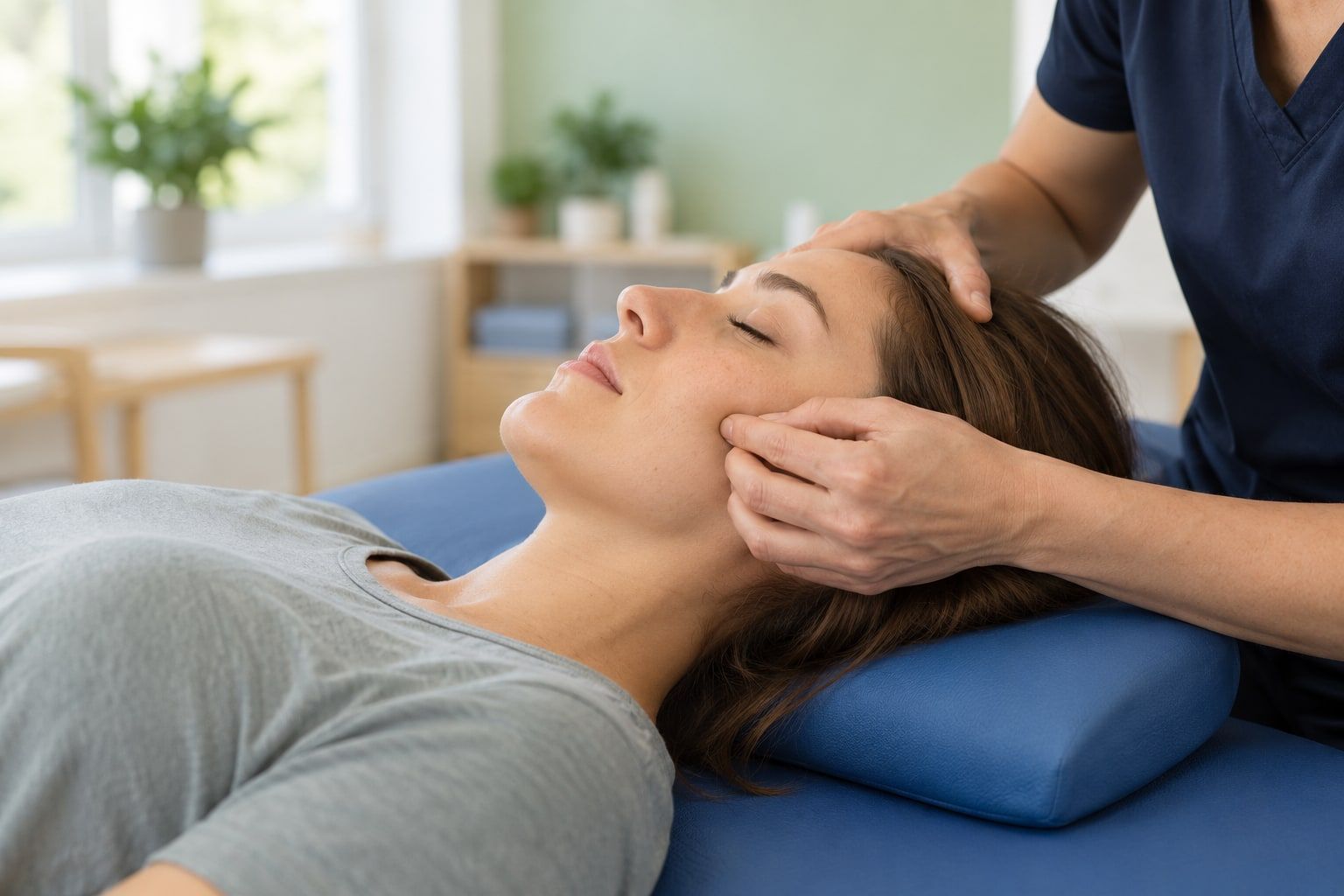
We treat the chewing muscles from the outside and, if you agree, wearing gloves, also from inside the mouth. Gentle techniques at the jaw joint and exercises for a straight, even mouth opening are added.
Manual therapy
The cervical spine and jaw influence each other. We therefore examine the topmost vertebrae of the neck and treat movement restrictions there as well if they contribute to your symptoms.
Physiotherapy exercises (Krankengymnastik)
You learn to find the relaxed rest position of the jaw, to notice clenching during the day and to loosen the chewing muscles yourself. Posture exercises for the head and shoulder girdle are part of it, as is a short program for home.
Heat with fango (mud packs) or hot air
Heat before treatment lowers tension in the neck, shoulder and chewing muscles. If the joint is freshly irritated, cooling is often found more pleasant. Heat is prescribed as a supplement.
This is how treatment goes in Cologne-Esch
- 1
Assessment of the chewing system
We record how far the mouth opens, observe whether the lower jaw opens straight, palpate the chewing muscles and joints and check the neck. We take dental findings into account. The first appointment takes longer.
- 2
Setting goals
We note what should change, for example less pain when chewing. If you wear a splint, adjusting it remains a matter for the dental practice; we work as a complement.
- 3
Treatment and your own program
The appointments combine muscle and joint techniques with exercises. A few short exercises and self-observation during the day are the part that you have in your own hands.
- 4
Conclusion
At the end, we compare mouth opening and symptoms with the beginning. Whether further treatment is needed is decided by the practice that issued the prescription.
Relieving the jaw in everyday life
These measures are simple and harmless. They replace neither a splint nor treatment, but they support both.
Teeth apart
At rest, the teeth do not touch. Check several times a day whether you are clenching, and then let the lower jaw go loose: lips closed, teeth apart, tongue resting loosely behind the top front teeth. A sticker dot on the mirror or steering wheel reminds you.
Soft food in painful phases
Temporarily do without chewing gum, tough meat and hard bread crusts. Cut apples into pieces instead of biting into them. Eating only soft food permanently is not the aim.
Warmth and self-massage
A warm washcloth on the cheek and temple and small circular movements with the fingertips over the chewing muscle can lower tension. Stay below the pain threshold.
Wear the splint and have it checked
Wear a prescribed splint as discussed with your dentist. If it presses, sits loosely or has been bitten through, contact the dental practice.
To Praxis Pirnay in Cologne-Esch with jaw complaints
Praxis Pirnay has its rooms at Martinusstraße 53 in Cologne-Esch, in the north of the city near Pesch and Auweiler. The bus stop “Esch Schulstraße” is a few minutes’ walk away. Drivers take the A57 (exit Köln-Chorweiler) or the A1 (exit Köln-Bocklemünd); parking is available right outside the practice.
Bring your insurance card and prescription to the appointment. Also bring your bite splint, if you have one, as well as dental findings or X-rays. A top that leaves the neck and shoulders free is practical, because we examine both as well.
You can arrange an appointment by telephone or through the website’s appointment form. Treatment is possible in German, English and Spanish; at the reception desk, you can also be helped in Turkish.
Opening hours: Mon 7:00–20:00, Tue 8:00–19:50, Wed 8:00–19:30, Thu 7:00–19:50, Fri 7:00–15:30
Questions about CMD, grinding and splints
Do I need physiotherapy if I already have a bite splint?
That can make sense, because the two work at different points. The splint protects the teeth and relieves the jaw at night; physiotherapy treats tense muscles, joint movement and clenching during the day. Whether both are needed depends on the assessment. Ask your dentist about it.
Can physiotherapy stop teeth grinding at night?
No, grinding during sleep cannot be switched off by physiotherapy. Its consequences can be treated: painful, hardened chewing muscles and an irritated joint. Clenching during the day, on the other hand, you can influence consciously, and that is exactly what we practice. The dental splint protects against tooth damage at night.
Who issues the prescription for CMD?
For CMD, the prescription can come from the dental practice, as well as from a family doctor’s, ENT or orthopedic practice. Patients on statutory health insurance pay the statutory co-payment unless they are exempt. Those with private health insurance ask their insurer about reimbursement in advance. We bill every insurer, whether statutory or private.
Does the treatment inside the mouth hurt?
It can be uncomfortable at tense spots, but it is meant to stay bearable. We work with gloves, explain each technique beforehand and adjust the pressure to your feedback. If you do not want treatment inside the mouth, we stay with the techniques from the outside.
How long does it take until the jaw settles down?
That cannot be predicted. In many people, muscle pain eases as the treatment series progresses; with long-standing complaints or continued strain, it often takes longer. What matters is that you keep up the self-monitoring during the day and stay under dental care.
You Might Also Be Interested In
Headaches
Treatment for tension headaches
Neck Pain
Treatment for neck tension and stiffness
TMJ Therapy
Treatment for jaw joint problems
Manual Therapy
Joint mobilization and release of blockages
All Therapies
Overview of our treatment services