
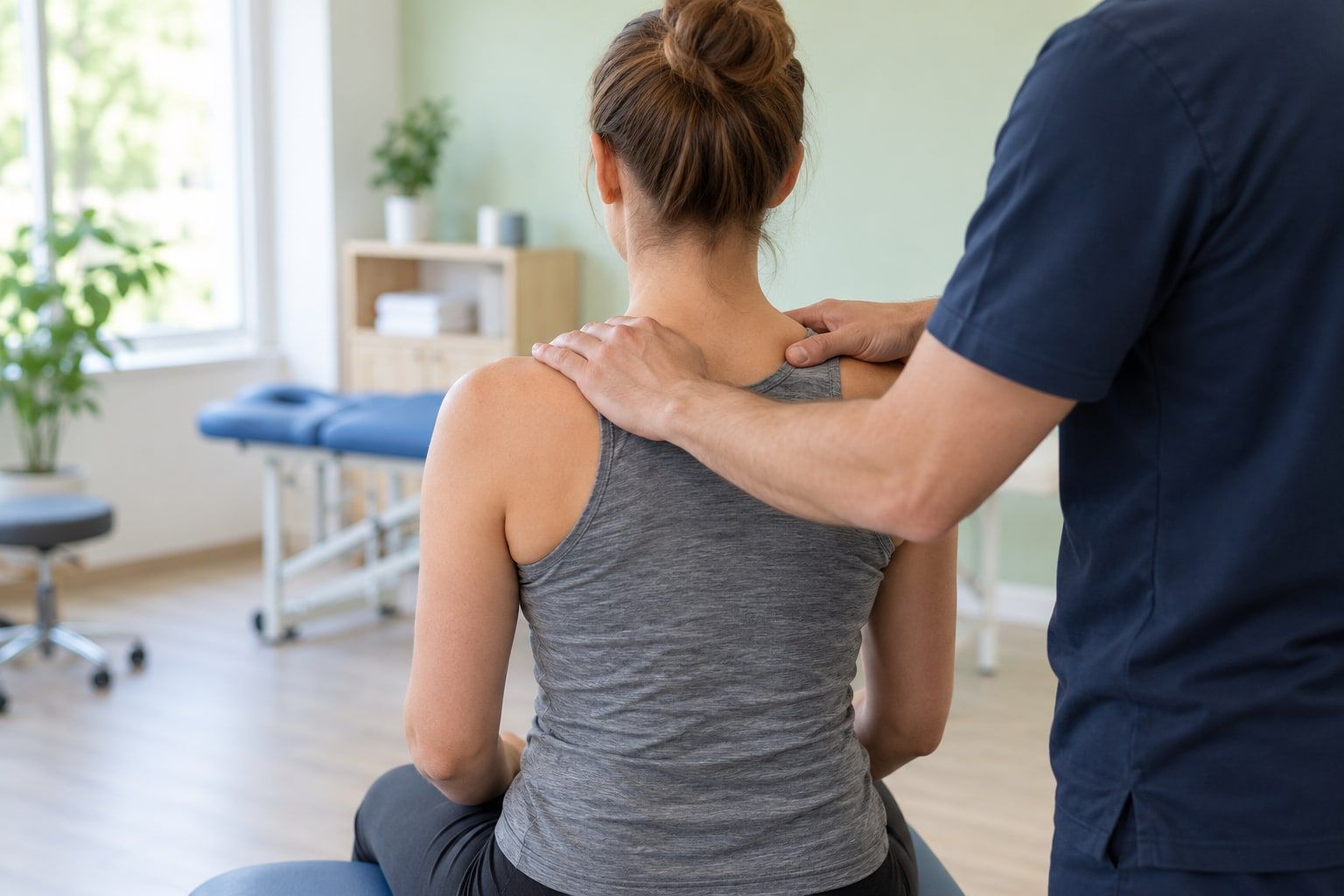
Neck Pain Treatment in Cologne Esch
Professional physiotherapy for neck pain and cervical spine syndrome at Martinusstraße 53
You wake up and can hardly turn your head to the side: an acutely stiff neck is unpleasant, but in most cases harmless. Here you can find out what the term HWS syndrome (cervical spine syndrome) means, how tension in the neck develops and what you can do yourself in the first few days. We also describe how physiotherapy for neck pain works at Praxis Pirnay in Cologne-Esch.
Stiff neck and HWS syndrome explained
The cervical spine, HWS for short in German, consists of seven vertebrae. It carries the head and is the most mobile part of the spine. It is held in place by muscles that run from the back of the head to the shoulder blades. Neck pain usually arises there: in overworked muscles, irritated spinal joints and ligaments. If no specific disease can be found as the cause, it is called non-specific neck pain.
“HWS syndrome” is a collective term, not a precise diagnosis. It groups together complaints that originate in the cervical spine. With an acutely stiff neck, also called acute wry neck (torticollis), the muscles suddenly cramp up, often overnight or after a jerky head movement. The head sits slightly crooked, and every turn hurts.
In many people a stiff neck eases within a few days, and sometimes it takes a little longer. A neck brace or strict rest is not recommended for ordinary neck pain. It is better to keep moving the head within the low-pain range and to carry on with daily life as normally as possible.
What makes the neck tense up
Awkward sleeping position
If the head lies bent or twisted for hours, for example when sleeping on your stomach or on the sofa, muscles and joints respond with stiffness in the morning.
Holding the same head position for long
Screen, smartphone, reading or a long car journey: if the head stays pushed forward or tilted, the neck muscles work without a break and tire.
Jerky movement
A hasty glance over the shoulder or a jolt during sport can make the neck muscles cramp up as a reflex.
Stress and teeth clenching
Under tension, many people pull their shoulders up or clench their teeth together. The tension in the neck rises, often unnoticed.
Cold and drafts
Many people link their stiff neck to drafts. The connection is not established; in the cold, though, it is easy to tense the shoulders.
How neck complaints show up
Acutely stiff neck
- • Head can hardly be turned or tilted
- • Crooked head position toward the side that hurts less
- • Stabbing pain with sudden movements
- • Often starts in the morning after waking up
Muscular tension
- • Hard, tender bands next to the neck vertebrae
- • Pulling from the neck to the shoulder
- • Feeling of heaviness in the head in the evening
Accompanying symptoms
- • Dull headache from the back of the head to the forehead
- • Mild dizziness with head movements
- • Cracking or grinding when turning
With these signs, see a doctor first
A stiff neck is rarely dangerous. Some accompanying signs, however, have to be checked by a doctor before physiotherapy begins – some of them are an emergency.
- Stiff neck with fever, severe headache, sensitivity to light or feeling dazed: call emergency number 112, it may be meningitis.
- Sudden, unusually severe neck or head pain with dizziness, problems with vision, speech or swallowing, or a drooping corner of the mouth: call emergency number 112.
- Pain in the neck, jaw or arm with pressure on the chest, shortness of breath or cold sweat: call emergency number 112.
- Neck pain after a fall, an accident or a blow to the head.
- Paralysis, numbness or loss of strength in the arm or hand, clumsy fingers, an unsteady gait or problems with bladder and bowel control.
- Fever, unintended weight loss, a previous cancer, rheumatism, osteoporosis or pain that persists at night at rest.
How we treat neck pain in Cologne-Esch
The prescription from your doctor (Heilmittelverordnung) determines which therapy you receive. With an acute stiff neck, the first aim is to calm the pain and regain movement; after that, strength and postural endurance move into the foreground.
Manual therapy
With calm, measured hand techniques we mobilize individual sections of the cervical and upper thoracic spine and stretch shortened muscles. We work gently and within the range where pain stays low.
Physiotherapy exercises (Krankengymnastik)
You practice turning your head freely again and strengthen the deep neck muscles and the muscles between the shoulder blades, for example with gentle chin tucks and exercises for a relaxed shoulder posture.
Classic massage
Tense muscles in the neck and shoulder girdle are loosened with stroking and kneading. This can ease the pain and make movement easier. Massage makes most sense in combination with active exercises.
Fango (mud packs) and hot air
Heat on the neck and shoulders relaxes the muscles and is often used before massage or manual therapy. Moving often feels easier afterward.
How treatment works, step by step
- 1
Neck assessment
We ask about the start, the trigger and the course, and look out for warning signs. Then we test how far the head moves in each direction and feel the muscles and spinal joints.
- 2
Setting a goal
We discuss what matters most to you, for example looking over your shoulder when driving or a working day without a headache.
- 3
Easing and loosening
With mobilization, soft tissue techniques and heat we release the protective tension. You move your head actively along with it, as far as it goes without severe pain.
- 4
Exercises for home
You receive a few exercises that can be done several times a day in a minute or two. At the next appointment we look at how you perform them.
- 5
Wrapping up
At the end of the prescription we check your mobility again and discuss how you can prevent a relapse.
First aid for a stiff neck
If there are no warning signs, you can support an acutely stiff neck yourself. Move gently and do not force anything.
Apply warmth
A warm grain pillow, a scarf or a warm shower loosens the neck and shoulders. The skin should feel pleasantly warm, not hot.
Turn and tilt gently
Turn your head slowly to the right and left, only as far as it goes without stabbing pain. Repeat this several times a day; often the range grows bit by bit.
Roll your shoulders
Pull your shoulders up toward your ears, move them back and let them sink. This releases tension without straining the cervical spine.
No neck brace on your own initiative
Immobilizing weakens the muscles and can prolong the stiffness. So wear a neck brace only if a doctor has prescribed it.
Coming to the practice on Martinusstraße
Praxis Pirnay is located in Cologne-Esch, Martinusstraße 53, 50765 Köln, in the north of Cologne next to Pesch and Auweiler. If you would rather not drive yourself with a stiff neck because looking over your shoulder hurts, take the bus: the stop “Esch Schulstraße” is a few minutes’ walk away. By car you reach us via the A57 (exit Köln-Chorweiler) or the A1 (exit Köln-Bocklemünd) and can park directly in front of the practice.
For treatment, your neck and shoulders should be easy to reach. A top with a wide neckline is helpful; tie long hair back and take off necklaces beforehand. Please bring your prescription, your insurance card and, if you have them, doctors’ letters or images of the cervical spine.
You make an appointment by phone or via the appointment form on this website. Treatment is possible in German, English and Spanish, and at the reception desk also in Turkish. A session usually lasts 20 to 60 minutes depending on the prescription, the first one a little longer because of the assessment.
Opening hours: Mon 7:00–20:00, Tue 8:00–19:50, Wed 8:00–19:30, Thu 7:00–19:50, Fri 7:00–15:30
Questions about a stiff neck
How long does a stiff neck last?
Usually only a few days. In many people the stiffness eases noticeably within a week, and occasionally it lasts longer. If it does not get better, the pain spreads into the arm or it keeps coming back, you should seek medical advice.
Heat or cold: what helps with neck tension?
As a rule, heat. It relaxes the muscles and is usually felt to be pleasant. In the cold, many people involuntarily pull their shoulders up, which tends to increase the tension. Go by what clearly feels good to you.
Does a locked neck have to be manipulated back into place?
No, as a rule not. The feeling of a “blockage” usually comes from muscles tensing up to protect the area, and it eases with gentle mobilization, warmth and movement. Jerky manipulations of the cervical spine carry risks and, if used at all, belong in the hands of a doctor.
Can headaches and dizziness come from the neck?
Yes, that is possible. Tense neck muscles and irritated upper spinal joints can trigger pain that spreads from the back of the head toward the front; some people also report mild dizziness. Severe, new or persistent dizziness should be examined by a doctor first, because it can have many other causes.
Can I drive with a stiff neck?
Only if you can turn your head far enough to survey the traffic safely. If looking over your shoulder does not work, leave the car at home. This also applies if you are taking medication that can make you drowsy.
Does health insurance pay for physiotherapy for neck pain?
Yes, if you have a prescription from your doctor. Praxis Pirnay bills all statutory and private health insurers. If you have statutory health insurance, you pay the statutory co-payment unless you are exempt. If you have private health insurance, ask your insurer before you start what your plan reimburses.
You Might Also Be Interested In
Headaches
Treatment for tension headaches
Back Pain
Relief from vertebral blockages and tension
Shoulder Pain
Targeted treatment for shoulder problems
Jaw Pain
Treatment for jaw pain, clicking and TMJ disorders
Manual Therapy
Joint mobilization and release of blockages
All Therapies
Overview of our treatment services