
Back Pain Treatment in Cologne Esch
Professional physiotherapy for back pain at Martinusstraße 53 – serving Esch, Auweiler & Pesch
Yesterday you were still carrying the shopping, today you can barely get out of bed: acute low back pain often starts without warning and is frightening. On this page you can read what is behind lumbago (in German: Hexenschuss), why movement usually brings more than rest, and which signs mean your first stop is a doctor’s office. You will also learn how physiotherapy at Praxis Pirnay in Cologne-Esch approaches back pain.
Acute back pain: what happens in the lower back
Most back pain sits in the lower back, between the rib cage and the gluteal fold. Specialists speak of low back pain. If the medical examination finds no specific cause such as a fracture, an inflammation or a compressed nerve, the pain is called “non-specific.” That is the most common case. Muscles, ligaments, vertebral joints and discs then react in an irritated way without anything necessarily being damaged.
In lumbago, the pain shoots in during an everyday movement: when bending down to the dishwasher, when lifting a crate of drinks, sometimes even when sneezing. The back muscles tense protectively, and straightening up is difficult. However threatening this feels, the course is usually favorable: in many people acute low back pain eases noticeably within a few days to a few weeks.
In the past, bed rest used to be prescribed. Today the opposite applies: if you stay lying down, you get stiffer, lose strength and often have symptoms for longer. Medical guidelines advise staying as active as you can and gradually resuming your usual daily routine. Physiotherapy accompanies this path.
What can trigger acute low back pain
Lifting and bending
A heavy crate, a child in your arms or a jerky twist with a load overstrain the muscles and ligaments in the lower back.
Sitting for long without a change
Hours in the same posture at the desk or behind the steering wheel tire the trunk muscles. The back becomes stiff and sensitive.
Little movement in everyday life
An untrained trunk supports the spine less well. Then an unaccustomed effort, such as moving house, is enough to trigger pain.
Stress and tension
Ongoing pressure, worries and little sleep increase muscle tension and make you more sensitive to pain.
Irritated joints and discs
Vertebral joints, the sacroiliac joint or a disc can be irritated. If tissue presses on a nerve root, the pain pulls down into the leg.
How acute low back pain shows itself
Pain in the lower back
- • Pain that suddenly shoots into the lower back
- • Dull pulling next to the lumbar spine, on one or both sides
- • Radiating into the buttock or thigh
Movement and posture
- • Straightening up after bending is barely possible
- • Crooked protective posture to the side
- • Stiff back right after getting up
- • Putting on socks and tying shoes are difficult
Signs of an irritated nerve
- • Pain pulls below the knee
- • Tingling or numbness in the lower leg or foot
- • Worse when coughing, sneezing or straining
These warning signs belong in a doctor’s hands first
Acute low back pain is as a rule harmless. Some signs, however, point to a cause that must be examined by a doctor before physiotherapy begins.
- Numbness in the crotch, at the anus or on the inner thighs, new problems urinating or with bowel movements: call 112.
- Paralysis or increasing weakness in the leg, such as a foot that can no longer be lifted: go to the emergency room the same day.
- Pain after a fall or accident – with osteoporosis or long-term cortisone use, even after a minor knock.
- Fever, chills or a strong feeling of illness, especially with a weakened immune system or after an injection into the spine.
- Previous cancer, unintentional weight loss, night sweats or pain that gets worse at night and when lying down.
- Especially in younger people: deep-seated pain with long morning stiffness that wakes you at night and improves with movement.
Physiotherapy for acute low back pain in Cologne-Esch
The focus is on getting you moving again. Passive treatments can make the start easier but do not replace active exercise. Which therapy you receive is set by the prescription from your doctor (Heilmittelverordnung).
Physiotherapy exercises (Krankengymnastik)
You learn movements that calm the irritated back: gentle pelvic tilts, mobilizing while lying down, later strengthening for the abdomen, back and buttocks. In addition we practice standing up, bending and lifting.
Manual therapy
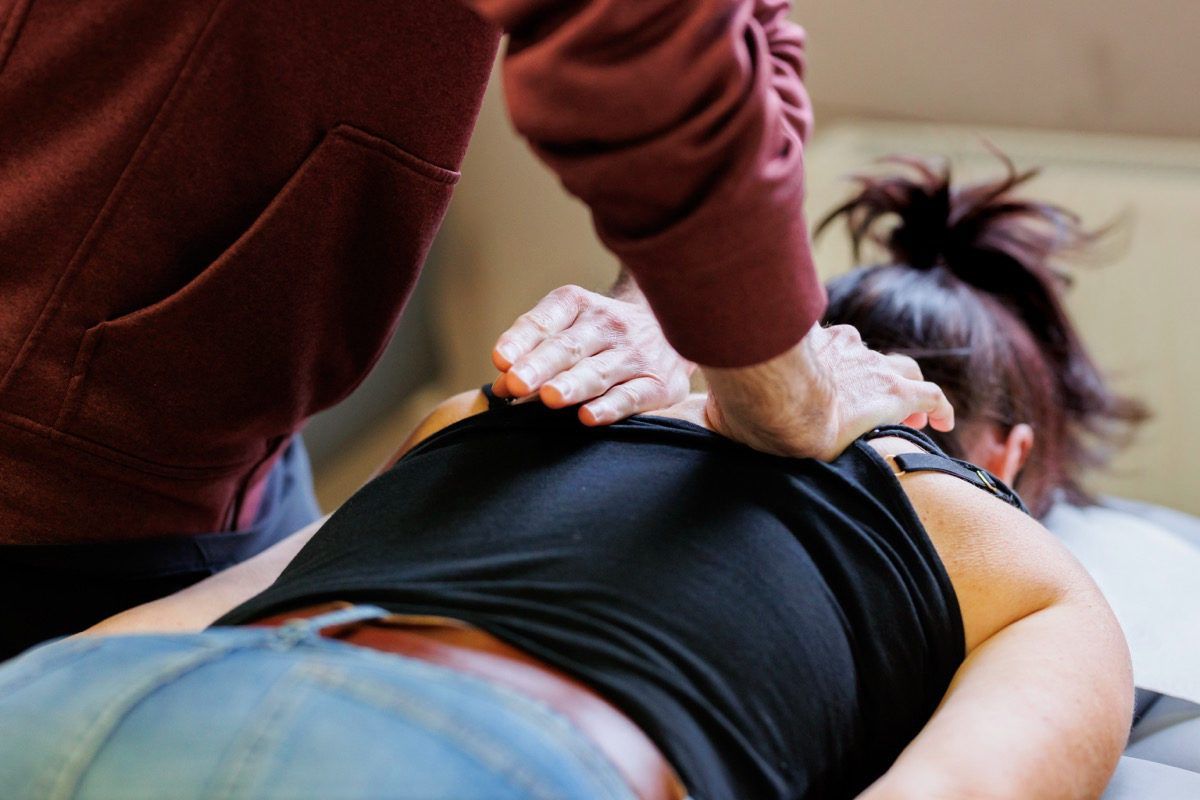
With targeted hand techniques we mobilize stiff sections of the lumbar spine and the sacroiliac joint. This can improve mobility and dampen the pain. The technique does not replace active exercises.
Fango (mud packs) and hot air
Heat relaxes cramped back muscles. Applied before exercise therapy, moving afterward often becomes easier. Heat is not suitable with a fever or an acute inflammation.
Classical massage
With a fresh case of lumbago, massage is not the first choice. If tension lasts longer, it can loosen the muscles and prepare for exercising – useful above all together with active therapy.
From the first appointment to the end
- 1
Conversation and assessment
We ask how the pain began, what makes it worse and what you have to manage in daily life. Then we check mobility, muscle tension, strength and reflexes.
- 2
Agreeing on goals
Together we define what should work again first: getting up with less pain, sitting for an hour, returning to work.
- 3
Calming and moving
In the first appointments we ease the pain with mobilization, relieving positions and, if needed, heat. At the same time you begin with light exercises.
- 4
Increasing the load
As the acute pain eases, strengthening and everyday movements are added. You take two or three exercises home with you.
- 5
Conclusion and prevention
At the end of the series we record what you have achieved and how you can prevent a relapse.
What you can do yourself with acute low back pain
With lumbago and no warning signs, you may and should move. If the pain becomes much stronger as you do, or new symptoms appear, have a doctor check it.
Short walks instead of bed rest
Walk for a few minutes several times a day through the apartment or around the block. Short, frequent rounds are better tolerated than one long walk.
Stepped position as a break
Lie on your back with your lower legs on a chair, hips and knees at roughly a right angle. This takes the load off the lower back for a few minutes – as a break, not as a permanent solution.
Warmth on the lower back
A hot-water bottle, a grain pillow or a warm shower loosen the muscles. Put a cloth in between so that your skin does not get too hot.
Getting up via your side
In bed, first turn onto your side, push your legs over the edge and push yourself up with your arms.
Pain medication only after consultation
If you need pain medication to stay on the move, discuss the choice and duration beforehand at your doctor’s office or at the pharmacy.
Coming to your appointment in Cologne-Esch with back pain
Praxis Pirnay is at Martinusstraße 53 in 50765 Cologne, in the north of the city; neighboring districts are Pesch and Auweiler. By car you come via the A57, exit Köln-Chorweiler, or via the A1, exit Köln-Bocklemünd. You will find parking directly in front of the practice, and the bus stop “Esch Schulstraße” is a few minutes’ walk away.
Bring your health insurance card, prescription and any existing reports, such as doctors’ letters, X-ray or MRI images. Wear comfortable clothing in which you can bend over and lie down. More time is planned for the first appointment because the assessment is part of it; otherwise a treatment usually takes 20 to 60 minutes, depending on the prescription.
You can arrange an appointment by phone or via the appointment form on this website. We treat in German, English and Spanish; at the reception desk Turkish is also spoken. If a home visit is noted on the prescription, we also come to you.
Opening hours: Mon 7:00–20:00, Tue 8:00–19:50, Wed 8:00–19:30, Thu 7:00–19:50, Fri 7:00–15:30
Questions about acute back pain
Should I lie down in bed with lumbago?
No, longer bed rest is no longer recommended today. If you lie down for days, you get stiffer and often get back on your feet more slowly. Gradually resume your usual activities.
Do I need an X-ray or MRI for acute back pain?
Mostly not. If there are no warning signs, images generally bring no benefit in the early period: they often show changes that people without pain have too. Whether imaging is needed is decided by a doctor.
May I go to work with lumbago?
Often yes, if the job allows it. Returning to your usual routine early is considered favorable for the course. With physically heavy work or very severe pain, a short sick leave can make sense.
Is lumbago the same as a herniated disc?
No, as a rule not. With lumbago, muscles and joints are usually irritated, and the pain stays in the back or at most pulls into the thigh. A herniated disc with nerve irritation shows itself more through pain down to the foot, tingling, numbness or loss of strength.
Which prescription do I need for physiotherapy for back pain?
People with statutory health insurance need a prescription from a doctor. Praxis Pirnay bills all statutory and private health insurers. The statutory co-payment is added, unless you are exempt. People with private health insurance clarify reimbursement with their insurer beforehand.
You Might Also Be Interested In
Neck Pain
Treatment for neck tension and stiffness
SI Joint Dysfunction
Relief from sacroiliac joint problems
Manual Therapy
Joint mobilization and release of blockages
Pain Therapy
Effective treatment for chronic pain
All Therapies
Overview of our treatment services