
SI Joint Blockage Treatment in Cologne Esch
Professional physiotherapy for sacroiliac joint blockages at Martinusstraße 53
Grabbing a crate of water, a twist while getting out of the car – and a stabbing pain sits deep in the lower back, usually on one side. Often the sacroiliac joint is behind it, SI joint for short (in German: Iliosakralgelenk, ISG). Here you will learn what happens in an acute SI joint blockage, what you can do in everyday life and how we treat it at Praxis Pirnay in Cologne-Esch.
SI joint blockage: when the sacroiliac joint suddenly hurts
On the right and left, the sacroiliac joint connects the sacrum to the wings of the pelvis. Taut ligaments hold it firmly; it moves only minimally and transfers the load of the upper body to the pelvis and legs. A blockage is spoken of when this small range of play is disturbed and the joint, together with the surrounding muscles, reacts with pain.
The term is a figure of speech: nothing is dislocated or caught. Medically it is called SI joint syndrome or dysfunction of the sacroiliac joint. A typical trigger is an unaccustomed load, such as lifting with a twisted upper body or stepping into thin air. The pain sits at the side of the sacrum, roughly at the level of the dimples above the buttocks, and can pull into the buttock, the groin or the back of the thigh.
An acute blockage is unpleasant but usually harmless. Often the pain eases within days to a few weeks, especially if you stay on the move. If it persists, often returns or warning signs are added, a doctor should check whether something else is behind it.
Typical triggers of an acute SI joint blockage
Lifting with a twist
Lifting a crate of drinks, a laundry basket or a flower tub while turning to the side: this combination loads the pelvis on one side and is a classic trigger.
Stepping into thin air
An overlooked step or curb jolts a leg unexpectedly. The shock travels through the hip into the sacroiliac joint.
Working bent over for a long time
Working bent over or crouching for hours, for example when cleaning or weeding, tires the muscles that hold you upright. When you straighten up, the joint then makes itself felt.
Falling onto the buttocks
A slip on a wet staircase or on black ice can irritate the ligaments of the joint. After a fall, however, a broken bone must be ruled out first.
One-sided loading
The bag always on the same shoulder, the weight always on the same standing leg: over time one half of the pelvis is asked to do more than the other.
How to recognize an acute blockage
Where it hurts
- • On one side, deep in the lower back, next to the sacrum
- • Often can be pointed to exactly with one finger
- • Radiating into the buttock, groin or back of the thigh
- • Mostly not lower than the knee
What makes it hurt
- • Getting up after sitting for a long time
- • Turning over in bed
- • Standing on one leg, for example while getting dressed
- • Climbing stairs and bending
- • Getting into and out of the car
What usually does not belong
- • Numbness or loss of strength in the leg
- • Pain all the way down to the foot
- • Fever or feeling ill
Warning signs: not every lower back pain is a blockage
Something else can also be behind pain at the pelvis. Paralysis in the leg, numbness in the buttocks and genitals or disturbed bladder and bowel function are emergencies: call 112. The other signs belong in a doctor’s office promptly, before treatment.
- Numb feeling in the buttocks, in the genital area or on the inner side of the thighs
- Sudden problems holding urine or stool or emptying the bladder
- Loss of strength in the leg or foot, such as tripping over your own toes
- Pain after a fall or accident – with osteoporosis even after a minor cause
- Fever, chills or a marked feeling of illness together with the back pain
- Pain that increases at night at rest or comes with unintentional weight loss
How we treat an acute SI joint blockage
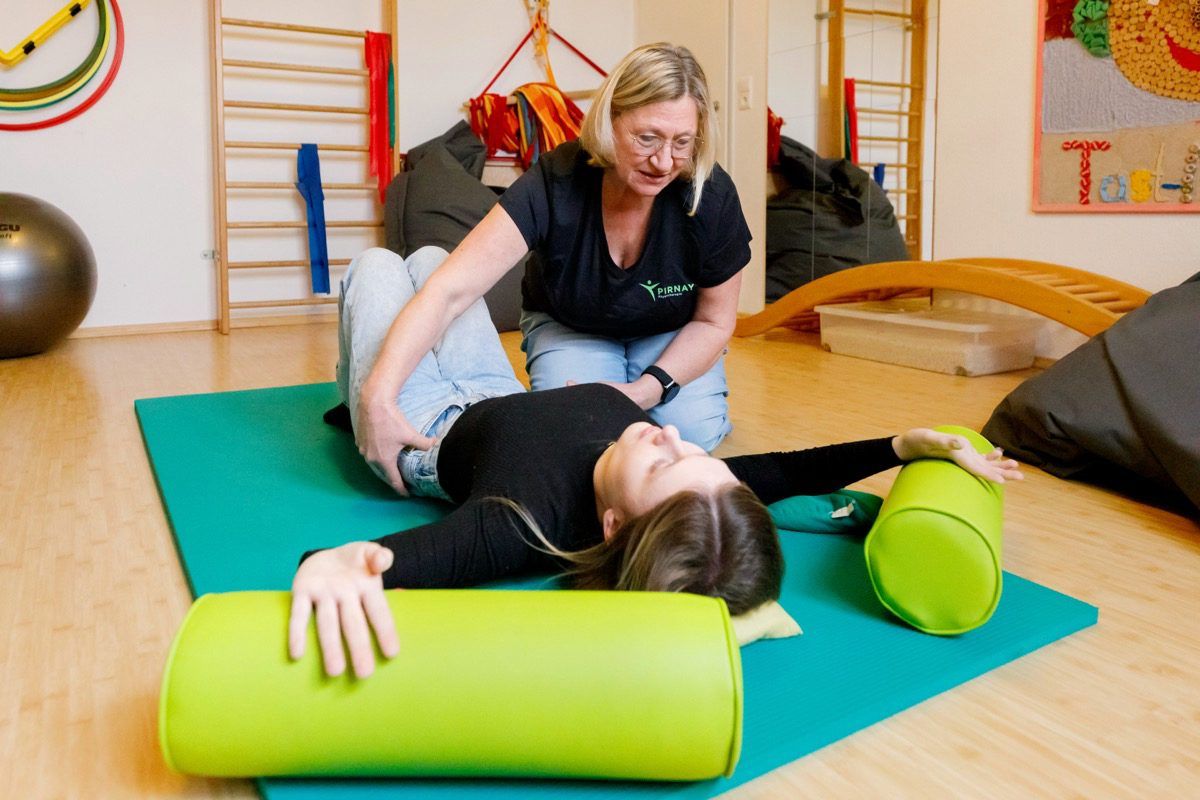
The aim is that you can move more freely again and the pain eases. For this we combine, depending on the prescription from your doctor (Heilmittelverordnung), hand techniques at the joint with active exercises. A loud crack is neither necessary nor a measure of success.
Manual therapy
We mobilize the sacroiliac joint with small, targeted movements and include the lumbar spine and hip. We often use your own muscle strength: you tense against our resistance, which can improve mobility.
Physiotherapy exercises (Krankengymnastik)
Once movement is going better again, exercises follow for the muscles that hold the pelvis: deep abdominal muscles, buttocks and back extensors. We also practice lifting, bending and carrying so that the load is distributed evenly.
Fango (mud packs) and hot air
In an acute blockage the buttock and lumbar muscles often cramp. A heat pack or hot air before treatment can lower this protective tension, so that the hand techniques are more comfortable.
Classical massage
Hard, pressure-sensitive bands in the buttocks and beside the lumbar spine often keep the pain going. Massage can loosen them and, if it is prescribed, complements the work on the joint.
Sequence: from assessment to exercises of your own
- 1
Assessment of the pelvis
You describe how the pain began. We check pelvic position and mobility of the lumbar spine and hip, and we carry out several stress tests on the SI joint that can bring on the familiar pain.
- 2
Naming the goal
We agree on what should work again first, for example getting out of the car without stabbing pain or sleeping through the night.
- 3
Mobilize and relax
In the first sessions the focus is on hand techniques at the joint, loosening the muscles and light movements.
- 4
Stabilize and conclude
After that, strengthening and everyday training are added. At the end you receive two or three exercises that you can continue with on your own.
First aid for acute SI joint pain
If there are no warning signs, you may become active yourself. The yardstick is the pain: mild pulling is fine; with stabbing pain, stop.
Walk rather than lie down
Short walks at a calm pace usually do the joint more good than bed rest. It is better to take several short walks a day than one long one.
Warmth on the lower back and buttocks
A hot-water bottle, a cherry-pit pillow or a warm bath can relax the cramped muscles. A quarter of an hour is enough; protect your skin with a cloth.
Knee gently to the chest
Lying on your back, slowly pull one knee toward your chest, hold briefly and switch sides. It should feel releasing. Please do not try with jerky movements to “pop” the joint back in yourself.
Lifting without twisting
Stand squarely in front of the load, bend your knees and turn with your feet only after straightening up. For the time being, carry heavy crates with two people or not at all.
Your appointment at Praxis Pirnay Cologne-Esch
If you can hardly walk with an acute blockage, you can park directly in front of the practice. The address is Martinusstraße 53, 50765 Cologne; by car you come via the A57 (exit Köln-Chorweiler) or the A1 (exit Köln-Bocklemünd). The bus stop “Esch Schulstraße” is a few minutes’ walk away. Pesch and Auweiler are the neighboring districts.
Bring the prescription and your health insurance card, plus any doctors’ letters or X-ray and MRI reports. The best clothing is something that gives us good access to the pelvis and lower back: loose trousers or leggings and a top that can be pushed up.
You can get appointments by phone or via the appointment form on the website. For the first appointment we plan more time, because the assessment is part of it; otherwise a treatment takes 20 to 60 minutes depending on the prescription. We speak German, English and Spanish, and Turkish as well at the reception desk.
Opening hours: Mon 7:00–20:00, Tue 8:00–19:50, Wed 8:00–19:30, Thu 7:00–19:50, Fri 7:00–15:30
Questions about acute SI joint blockage
How long does an acute SI joint blockage last?
That cannot be predicted exactly. The symptoms often improve within a few days to a few weeks, especially if you stay active. If the pain lasts longer or gets worse, have a doctor check whether the SI joint really is the cause.
Can a blocked SI joint be “popped back in”?
The expression is misleading, because the joint is not dislocated. In manual therapy we mobilize it with measured hand techniques; sometimes it cracks, often it does not. Many people feel relief afterward, but we cannot promise that. For an improvement to last, active exercises are part of it.
May I go to work with an SI joint blockage?
That depends on your job and how strong the pain is. Light work with changing postures is often possible and may even do you good. Heavy lifting and carrying are a different matter. Whether a sick note is needed is for your doctor to decide.
How do I prevent the next blockage?
It cannot be reliably prevented. Strong trunk and buttock muscles, regular movement and lifting without twisting make sense. Switch sides when carrying and avoid standing on one leg for long. We will show you suitable exercises during treatment.
Do I need a prescription, and who bears the costs?
Yes, people with statutory health insurance need a prescription from a doctor, for example from a family doctor’s office. We bill all statutory and private health insurers; people with statutory health insurance pay the statutory co-payment unless they are exempt. People with private health insurance should ask their insurer beforehand what their plan reimburses.
You Might Also Be Interested In
Back Pain
Relief from vertebral blockages and tension
Hip Pain
Targeted treatment for hip problems
Disc Herniation
Treatment for disc problems
Manual Therapy
Joint mobilization and release of blockages
All Therapies
Overview of our treatment services