
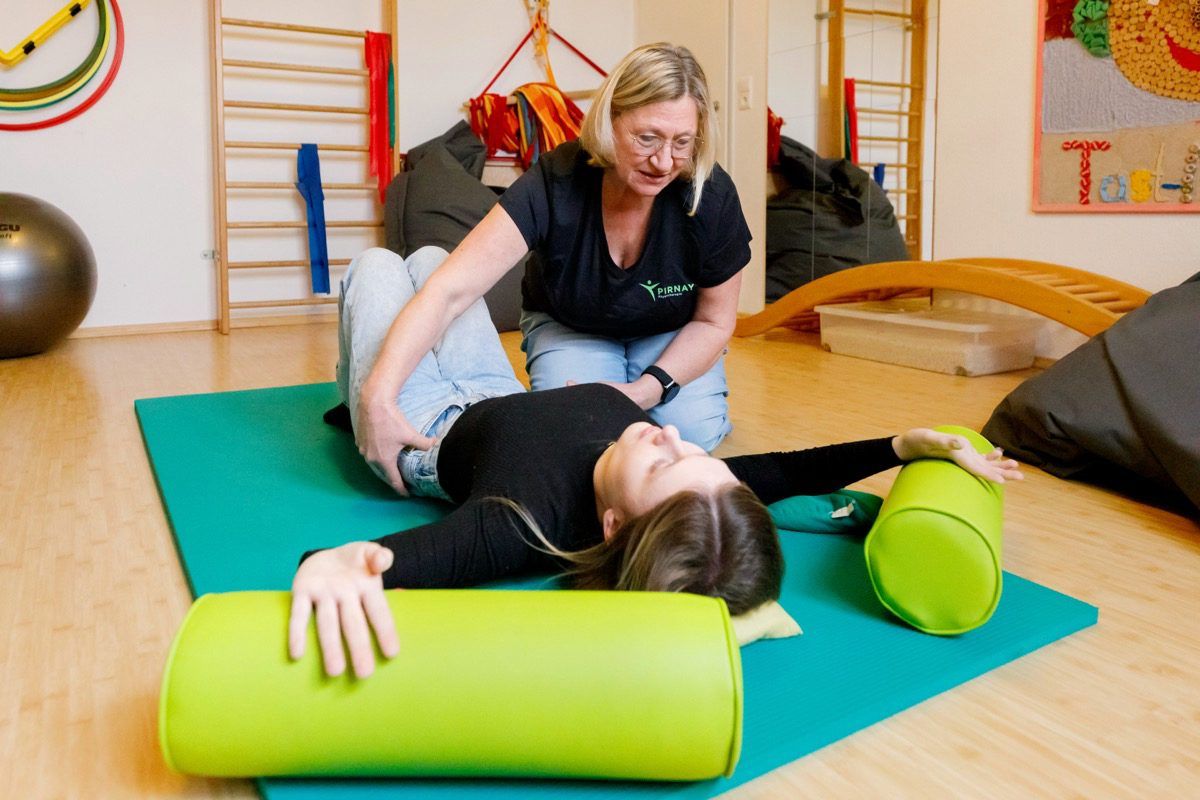
Hip Pain Treatment in Cologne Esch
Professional physiotherapy for hip pain at Martinusstraße 53
The first steps in the morning are stiff, putting on socks becomes a struggle, and after a longer walk it pulls in the groin: this is how hip osteoarthritis often makes itself felt. This page explains what happens in the joint with this kind of hip pain, which warning signs need to be checked by a doctor, and how physiotherapy at Praxis Pirnay in Cologne-Esch supports you in staying mobile in everyday life.
Hip osteoarthritis: what happens in the joint
The hip joint is a ball-and-socket joint: the head of the thigh bone sits deep in the socket of the pelvis. Both surfaces are covered with smooth cartilage that cushions impact. In hip osteoarthritis, medically called coxarthrosis, this layer of cartilage gradually becomes thinner and rougher. The joint reacts: the capsule becomes firmer, bony spurs form at the edge, and at times the lining of the joint is irritated. This usually develops over years.
Typical is start-up pain: after getting up or sitting for a long time, the first steps hurt, then it loosens up as you walk. Later, the hip hurts under load, and in advanced stages also at rest or at night. At the same time, the leg turns inward and bends less easily – noticeable when getting into a car, tying shoes or doing foot care.
Cartilage that has worn away does not grow back; physiotherapy therefore cannot reverse osteoarthritis. Even so, movement and targeted strengthening are part of the basic treatment: strong muscles guide the joint, and movement distributes the joint fluid that nourishes the cartilage. How severe the symptoms are does not depend on the X-ray image alone.
What promotes hip osteoarthritis
Age and predisposition
Over the years, cartilage loses load tolerance. In some families, osteoarthritis occurs more often; a hereditary component is considered likely.
Shape of the joint
A socket that is too shallow (hip dysplasia) or a femoral head that is not round distributes load unevenly. Individual areas of cartilage are then stressed more.
Earlier injuries and illnesses
Fractures near the joint, hip diseases in childhood, circulation problems in the femoral head or rheumatic inflammation can permanently damage the cartilage.
Body weight and heavy work
Higher weight and many years of heavy lifting or carrying increase the load on the joint and are considered risk factors.
Little movement
Cartilage has no blood vessels of its own and lives on the joint fluid, which is distributed as you move. Anyone who hardly walks any more out of caution also loses muscle strength.
Typical signs of hip osteoarthritis
Pain
- • Start-up pain after rest that eases after a few steps
- • Pain deep in the groin, sometimes in the buttock
- • Radiating across the thigh to the knee
- • In later stages, pain at rest and at night
Mobility
- • Inward rotation of the leg restricted early
- • Bending and moving the leg out to the side do not go as far
- • Stiffness in the morning that soon eases
Daily life
- • Putting on socks and shoes is difficult
- • Difficulty getting in and out of the car
- • Shorter walking distance, more breaks
- • Limping, especially when tired
When you should see a doctor first with hip pain
The diagnosis of osteoarthritis is made by your doctor, usually after an examination and an X-ray. With the following signs, the hip needs to be examined by a doctor before physiotherapy begins or continues.
- Severe pain after a fall, the leg cannot bear weight or lies shortened and turned outward: emergency number 112.
- Fever or chills together with severe hip pain: go to the emergency room the same day.
- Severe pain at rest and at night that does not ease in any position.
- Unintended weight loss, persistent exhaustion or a past cancer diagnosis.
- Numbness or paralysis in the leg, problems passing urine or stool: emergency number 112.
Physiotherapy for hip osteoarthritis in Cologne-Esch
Which therapy you receive is set out in your prescription from your doctor (Heilmittelverordnung). At Martinusstraße, these are the treatments that mainly come into question for hip osteoarthritis; they are often combined.
Physiotherapy exercises (Krankengymnastik)
You strengthen the buttock and thigh muscles that hold the pelvis while walking, and practice bending, straightening and rotating the hip. Gait training is added: even steps, upright upper body and, if needed, how to use a walking stick.
Manual therapy
The therapist moves the joint by hand in small, targeted directions and applies gentle traction on the leg. This can make the tight capsule more pliable. Active exercises then make use of the added range of motion.
Heat with fango (mud packs) or hot air
Heat before treatment can loosen tense muscles around the hip and lumbar spine and prepares you for exercising. If the joint is acutely irritated, we leave it out; cold is then usually more comfortable.
Classical massage
Anyone who protects themselves because of the pain often becomes tense in the buttock, thigh and lower back. Massage starts there. It changes nothing at the joint itself; it complements active therapy but does not replace it.
How a course of treatment for hip osteoarthritis works
- 1
Assessment
We ask about your daily life, watch how you walk, stand and sit down, measure the mobility of the hip and check strength.
- 2
Setting goals
You tell us what matters to you – for example putting on stockings by yourself again or walking to the bakery in one go. We base the treatment on that.
- 3
Treating and exercising
Every appointment combines techniques at the joint with active exercises. We increase the load step by step and ease off if the hip reacts with irritation.
- 4
Program for home
You get a few clearly described exercises. We check how you do them and change the program as soon as it becomes too easy.
- 5
Conclusion
At the end of the prescription, we measure mobility and walking distance again and discuss how you can carry on on your own. Whether another prescription is issued is decided by your doctor's practice.
Staying mobile: what you can do yourself
With osteoarthritis, regularity counts for more than effort. If the pain clearly increases, do less and talk to us about it.
Move steadily
Cycling, swimming and brisk walking on a level path move the hip without compressing it. Several short sessions a day are better than one long one.
Build in breaks from sitting
After sitting for a longer time, stand up and walk a few steps. A higher chair or a firm seat cushion makes getting up easier because the hip is bent less sharply.
Swing the leg
Stand on a stair step with your healthy leg, hold on to the handrail and let the affected leg swing loosely forward and back. Many people find this soothing.
Spread out loads, use the cane correctly
Carry shopping on both sides or in a backpack. A walking stick belongs in the hand on the healthy side; we practice this with you. Take painkillers only after consulting your doctor or pharmacist.
Your appointment at Martinusstraße
Praxis Pirnay is at Martinusstraße 53, 50765 Cologne, in the north of Cologne; Pesch and Auweiler are the neighboring districts. The bus stop "Esch Schulstraße" is a few minutes' walk away. By car, you come via the A57, exit Köln-Chorweiler, or via the A1, exit Köln-Bocklemünd. You park directly in front of the practice, so the way to the door stays short.
Please bring your health insurance card and prescription, plus any doctor's letters and X-ray or MRI findings. For the examination of the hip, shorts or loose trousers are practical. The first appointment takes longer because we carry out the assessment; otherwise it is usually 20 to 60 minutes depending on the prescribed therapy.
You can make an appointment by phone or via the appointment form on this website. In Cologne-Esch, we speak German, English and Spanish, and at reception Turkish too. Home visits are possible if the prescription expressly provides for them.
Opening hours: Mon 7:00–20:00, Tue 8:00–19:50, Wed 8:00–19:30, Thu 7:00–19:50, Fri 7:00–15:30
Frequently asked questions about hip osteoarthritis
Can physiotherapy cure hip osteoarthritis?
No, lost cartilage cannot be restored. Physiotherapy works on what can be changed: muscle strength, mobility and the way you walk and load your body. In many people, pain and limitations can be reduced this way. How far that succeeds depends on the stage and on regular exercise.
Can I still do sport with hip osteoarthritis?
Yes, as a rule movement is expressly encouraged. Steady loads such as cycling, swimming, water exercise or Nordic walking are suitable. Sports with abrupt changes of direction and jumps are less favorable. What suits you is something to clarify with your doctor.
Will I need an artificial hip joint at some point?
That cannot be predicted, and not every case of osteoarthritis leads to surgery. What counts is your pain and your limitations in daily life, not the X-ray image alone. Some people manage for a long time with movement, strengthening and medically supervised pain treatment. You make the decision together with your orthopedic doctor.
Why do I feel hip osteoarthritis in my knee?
Pain from the hip joint often radiates across the front of the thigh to the knee, because nerves supply both regions together. Some people at first feel only the knee. That is why, with unclear knee pain, the hip is examined as well.
Do I need a prescription for treatment in Cologne-Esch?
Yes, people with statutory health insurance need a prescription from their doctor, for example from a family doctor's or orthopedic practice. It states the therapy and the number of appointments. You pay the statutory co-payment unless you are exempt. We bill all statutory and private health insurers; people with private health insurance check beforehand with their insurer what the plan reimburses.
You Might Also Be Interested In
Knee Pain
Targeted treatment for knee problems
Back Pain
Relief from vertebral blockages and tension
Manual Therapy
Joint mobilization and release of blockages
KGG
Device-based training for strengthening
All Therapies
Overview of our treatment services