
Herniated Disc Treatment in Cologne Esch
Professional physiotherapy for herniated disc at Martinusstraße 53
A herniated disc in the lumbar spine often shows up less in the lower back than in the leg: as a pulling pain that many people call sciatica. This page explains what happens in the back, which signs call for medical help first and how conservative treatment works. At Praxis Pirnay in Cologne-Esch, we treat you on the basis of a prescription from your doctor (Heilmittelverordnung).
Herniated disc and sciatica: what happens in the back
Between the vertebrae lie the intervertebral discs, which act as elastic cushions. Each one consists of a firm fibrous ring and a soft, gel-like core. If the ring develops tears, the core can bulge (protrusion) or escape outward – that is the actual herniation (prolapse). In the lumbar spine this usually happens at the two lowest levels. If the tissue there irritates a nerve root, the pain radiates into the leg.
This leg pain is called sciatica, medically ischialgia. It often runs across the buttock and thigh down to the lower leg or the foot; tingling, numb patches of skin or muscle weakness may be added. Not every herniation on an MRI image explains symptoms: changes in the discs are also found in people who have no pain.
If there are no warning signs, treatment is usually conservative at first, meaning without surgery. In many people the pain eases over the course of a few weeks, and the body can partly break down tissue that has escaped. How it will go cannot be predicted in an individual case. If there is no improvement or if neurological deficits appear, the doctor decides on further steps, including surgery.
How a herniation in the lumbar spine develops
Wear of the fibrous ring
Over the years the disc loses water and elasticity. The fibrous ring becomes brittle and can tear – the most important basis of a herniation.
Lifting with a bent, twisted back
A heavy crate out of the car trunk, plus a twist: such moments are often the trigger, rarely the sole cause. Long-term heavy physical work increases the risk.
Excess weight and smoking
More body weight increases the load on the lumbar spine. Smoking is considered a risk factor because it can impair the supply to the disc tissue.
Predisposition
Herniated discs run in some families. According to current knowledge, the inherited makeup of the connective tissue plays a role.
Typical symptoms of a herniated disc and sciatica
In the lower back
- • Deep pain in the lumbar area, often on one side
- • Protective posture: the upper body leans to one side
- • Bending over and straightening up again are difficult
Radiating into the leg
- • Pulling or burning pain across the buttock and thigh
- • Often below the knee, sometimes down to the foot
- • Leg pain often stronger than the back pain
- • Worse when coughing, sneezing or straining
Sensation and strength
- • Tingling or pins and needles in the lower leg or foot
- • Numb patches of skin on the top or edge of the foot
- • Lifting the tip of the foot is harder
- • Standing on tiptoe is harder on one side
Warning signs: when sciatica is an emergency
With the following signs, a medical evaluation should come before physiotherapy. Paralysis, numbness in the crotch area and problems with the bladder or bowel are an emergency: call the emergency number 112 or have yourself taken to an emergency room right away.
- Emergency: numbness in the buttocks, anus, genitals or the inner thighs (saddle area)
- Emergency: you can no longer hold urine or stool, or you suddenly cannot pass urine
- Emergency: new or increasing paralysis, such as a drooping foot or a leg that gives way
- Emergency: the pain suddenly disappears while the weakness in the leg increases
- Have it checked by a doctor soon: back pain after a fall or accident, with osteoporosis even after a minor cause
- Have it checked by a doctor soon: fever, unintentional weight loss, previous cancer, severe pain at rest during the night
Conservative treatment: what physiotherapy contributes
Physiotherapy cannot push the herniation back. Its aim is to relieve pain, take pressure off the irritated nerve and gradually make the back able to bear load again. What we use depends on the prescription and the assessment.
Physiotherapy exercises (Krankengymnastik)
At the start we look for positions and movements that reduce the leg pain, such as the stepped position or gentle extension. Later come exercises for the deep trunk muscles and training for bending, lifting and carrying.
Manual therapy
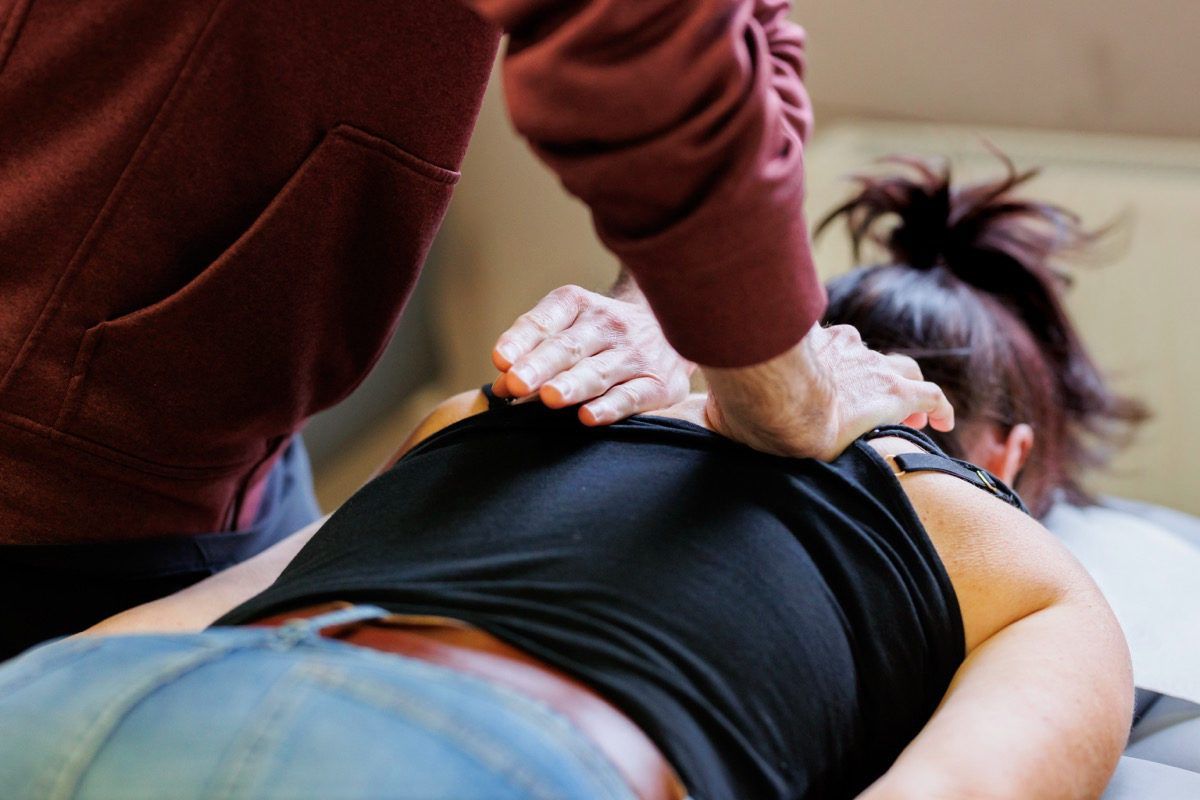
With calm hand techniques we mobilize stiff segments of the lumbar spine, the pelvis and the hips. Gentle traction can take pressure off the nerve root. In a fresh herniation with nerve irritation we do not use sudden, jerky techniques.
Fango (mud packs) and hot air
The muscles beside the spine often tense up protectively in a herniated disc. Heat before treatment can loosen this tension. If your back does not tolerate it in the acute phase, we leave it out.
Electrotherapy
If it has been prescribed, we use stimulation current against pain in the lower back or along the leg. With weakness, for example of the muscles that lift the foot, current can additionally stimulate the muscle. It does not replace active exercises.
From the prescription to the end of the treatment series
- 1
Assessment and goals
We ask about the onset and spread of the pain, go through the doctor’s letter and MRI report, and test mobility, skin sensation, reflexes and strength in the leg. Then we define what you would like to be able to do again.
- 2
Relieve pain, take pressure off the nerve
At first the focus is on positions that take the strain off, gentle mobilization and simple movements. We watch whether the leg pain retreats toward the back.
- 3
Building up load
As the pain eases, we increase strength and endurance in the trunk and leg muscles and practice the movements your everyday life demands.
- 4
Exercise plan and conclusion
You receive a few clearly described exercises to do at home. At the end we compare your progress with the initial assessment and discuss how you can continue on your own.
What you can do yourself with sciatica
These tips apply only if none of the warning signs is present. They replace neither a medical evaluation nor treatment.
Stay on the move
Days of bed rest are no longer considered helpful. Walk short distances several times a day and lie down in between if the pain calls for it. For the time being, let others lift heavy things.
Try the stepped position
Lie on your back with your lower legs on a stool or a stack of cushions, so that hips and knees are bent at roughly a right angle. Many people find this relieves the lower back and the leg.
Warmth for tense muscles
A hot-water bottle or a grain pillow on the lower back can loosen the muscles. Put a cloth in between, and stop if the pain gets worse as a result.
Pain medication only after consultation
Whether pain medication is an option for you, and which one, is something to discuss with your doctor or at the pharmacy. With less pain it is easier to stay active.
Directions and appointments in Cologne-Esch
Praxis Pirnay is at Martinusstraße 53 in 50765 Cologne, in the north of the city; neighboring districts of Cologne-Esch are Pesch and Auweiler. There is parking directly in front of the practice, and the bus stop “Esch Schulstraße” is a few minutes’ walk away. By car you reach us via the A57, exit Köln-Chorweiler, or via the A1, exit Köln-Bocklemünd.
Please bring your health insurance card and prescription, as well as doctors’ letters and, if you have it, the X-ray or MRI report. Wear comfortable trousers in which you can bend over and raise your legs. The first appointment takes longer because the assessment needs time; otherwise, depending on the prescribed therapy, it is usually 20 to 60 minutes.
You can book an appointment by phone or via the appointment form on this website. We treat in German, English and Spanish; at the reception desk you can also get help in Turkish.
Opening hours: Mon 7:00–20:00, Tue 8:00–19:50, Wed 8:00–19:30, Thu 7:00–19:50, Fri 7:00–15:30
Questions about herniated disc and sciatica
Does a herniated disc in the lumbar spine have to be operated on?
No, not every one. Without warning signs, treatment usually begins conservatively. Surgery is considered mainly with emergency signs, with marked or increasing paralysis, or with severe pain that continues despite treatment. You decide this together with your doctor. Physiotherapy cannot replace surgery in every case.
How long does it take for sciatic pain to ease?
That differs from person to person. In many people the leg pain becomes noticeably weaker in the first weeks, while in others it drags on for months. Numbness and muscle weakness often recede more slowly than the pain. If weakness increases, see your doctor again.
Is sciatica the same as a herniated disc?
No. Sciatica describes a symptom: pain along the sciatic nerve in the leg. A herniated disc is a common cause of it, but not the only one. A narrowing of the spinal canal or the sacroiliac joint can also be behind it. A medical examination clarifies this.
Do I need an MRI before physiotherapy begins?
No, an MRI is not a requirement. Without warning signs, a medical examination is often enough at first; whether imaging is needed is for the doctor to decide. For treatment with us you need the prescription. Please bring an existing MRI report with you.
Who prescribes the treatment, and what do I pay toward it?
The prescription is issued by your family doctor, your orthopedist or another treating doctor. We bill all statutory and private health insurers. People with statutory health insurance pay the statutory co-payment unless they are exempt. People with private health insurance clarify reimbursement with their insurer beforehand, because it depends on the plan.
You Might Also Be Interested In
Back Pain
Relief from vertebral blockages and tension
SI Joint Dysfunction
Relief from sacroiliac joint problems
Manual Therapy
Joint mobilization and release of blockages
Pain Therapy
Effective treatment for chronic pain
All Therapies
Overview of our treatment services