
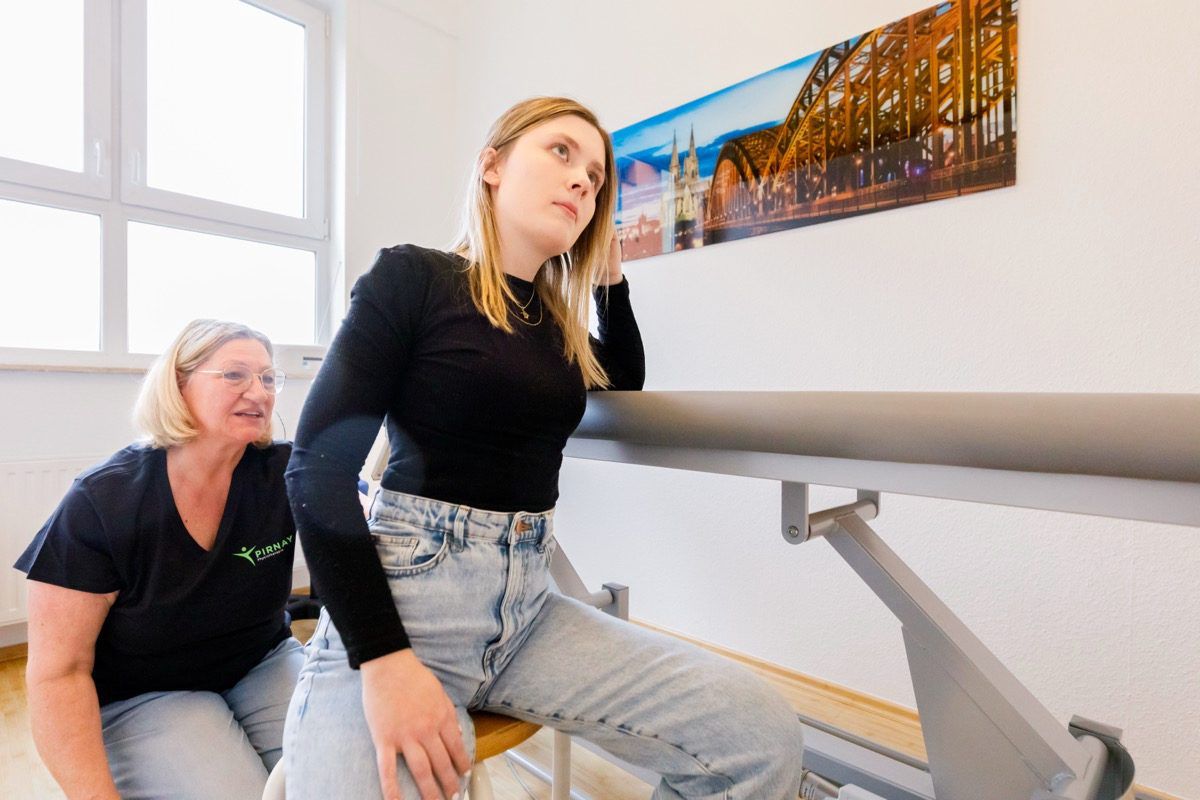
Neurological Physiotherapy in Cologne-Worringen
KG-ZNS based on the Bobath concept for stroke, Parkinson's, multiple sclerosis and other neurological conditions – at Hackhauser Weg 61 in northern Cologne
Parkinson’s disease and multiple sclerosis stay with those affected for many years. Mobility fluctuates, walking becomes less steady, the worry about a fall grows. Here you can read how neurological physiotherapy – prescribed as “KG-ZNS”, short for physiotherapy exercises (Krankengymnastik) for disorders of the central nervous system – helps you stay mobile and independent. Praxis Pirnay treats in Cologne-Worringen and, with a corresponding prescription from your doctor (Heilmittelverordnung), also comes to your home.
KG-ZNS in Cologne-Worringen: staying mobile with a chronic nerve disease
The abbreviation KG-ZNS refers to exercise therapy tailored to diseases of the brain and spinal cord. In Parkinson’s, the brain increasingly lacks the neurotransmitter dopamine; movements become smaller, slower and stiffer. In multiple sclerosis, inflammation attacks the sheaths of the nerve fibers, so that signals arrive delayed or not at all. Physiotherapy cannot halt either disease. It aims to use the abilities that are there and to maintain them for as long as possible.
The nervous system remains adaptable: anyone who practices a movement often and deliberately can stimulate changes in the nerve connections. Experts call this neuroplasticity. This is not a promise, because the course of the disease and how you feel from day to day differ greatly. The goals therefore stay realistic: standing and walking more safely, avoiding falls, managing the household yourself for as long as possible.
KG-ZNS is also prescribed after a stroke and traumatic brain injury, for spinal cord injury with paralysis and in some cases for polyneuropathy. It may only be provided by therapists with additional training recognized for this purpose. Anyone who cannot come to the practice is treated at home or in a care home if the prescription carries a corresponding note.
Diagnoses behind the prescription
Parkinson’s disease (Morbus Parkinson)
Small steps, a stooped posture, resting tremor and stiffness characterize the picture. Sometimes the feet seem glued to the floor when starting to walk (freezing).
Multiple sclerosis
Runs in relapses or progresses slowly. Possible signs are weakness, spasticity, disturbances of sensation, balance problems and marked exhaustion (fatigue).
Stroke
A cerebral infarction or a brain hemorrhage often leaves weakness on one side. Work on walking and arm function continues long after rehabilitation.
Polyneuropathy
Damaged nerves report the position of the feet inaccurately; in the dark and on uneven ground, walking becomes unsteady. Depending on the assessment, the prescription reads KG-ZNS or exercise therapy.
Traumatic brain injury
The consequences range from mild coordination problems to paralysis. Treatment is guided by the abilities that remain.
Spinal cord injury with paralysis
Below the level of the spinal cord damage, movement and sensation are partly or completely lost. The focus is on sitting balance, transfers and arm strength.
Typical limitations and goals of treatment
Gait pattern
- • Small, shuffling steps
- • Freezing at doors and narrow spots
- • Dragging one leg
- • Tiring quickly over longer distances
Balance and risk of falling
- • Unsteadiness when turning around and walking backward
- • Swaying when standing or in the dark
- • Fear of another fall
Strength, spasticity, mobility
- • Stiff muscles that are hard to loosen
- • Sudden spasticity in the legs
- • Declining strength in the trunk and legs
Hands and daily activities
- • Fastening buttons, writing, using cutlery
- • Turning over and sitting up in bed
- • Using a walker or cane appropriately
Warning signs: see a doctor first, in an emergency 112
Some signs must first be assessed by a doctor, and some are an emergency. Even people who have Parkinson’s or multiple sclerosis can suffer a stroke; if you suspect one, call 112 immediately.
- Emergency number 112: sudden paralysis or numbness on one side, a drooping corner of the mouth, disturbed speech, sudden loss of vision.
- Multiple sclerosis: new or markedly stronger symptoms lasting more than a day can be a relapse – call the neurologist’s practice.
- A fall with a blow to the head, persistent pain or being unable to put weight on the foot any more.
- Several falls or near-falls within a short time.
- Rapidly declining mobility, strength or alertness, especially together with fever.
- A new problem with urination or bowel movements, new difficulty swallowing or frequent choking.
Therapy building blocks for Parkinson’s, MS and risk of falling
KG-ZNS is written on the prescription; the focus follows from the assessment and goals. In Cologne-Worringen, certified therapists treat on the basis of the Bobath concept. Vojta is available at our practice in Cologne-Esch, PNF in Düsseldorf.
Bobath concept
The focus is on postural control: sitting safely, standing up, standing and shifting weight as the basis for walking. Increased muscle tension is influenced through positioning and guided movement.
Large movements and strengthening
With Parkinson’s you deliberately practice large movements: trunk rotation, straightening up, long steps and arm swing. Exercises for strength in the trunk and legs are added. With multiple sclerosis, the amount of exercise and the breaks depend on how you are feeling that day.
Fall prevention and walking safety
You practice turning, stopping, stepping over obstacles and walking while distracted. With freezing, external cues such as counting aloud or markings on the floor help many people. Getting up from the floor is part of it too.
Home visit in Worringen and the surrounding area
In Worringen, Chorweiler and the surrounding area we come to your home or to the nursing home if the home visit has been prescribed. Practice takes place on the routes where falls really threaten, for example between bed and bathroom.
How a treatment series works
- 1
Assessment with fall history
We ask about falls, medication times and good and bad phases of the day. Then we test gait, balance, strength, muscle tension and how you handle walking aids.
- 2
Setting goals
You tell us what matters to you, for example walking safely to the mailbox or getting up from the armchair on your own. From this, intermediate goals that can be checked are set.
- 3
Treatment according to how you feel that day
Content and load depend on your current condition. With multiple sclerosis, breaks are firmly planned. For home we note two or three exercises that you can carry out safely on your own.
- 4
Interim review and coordination
With chronic diseases a further prescription usually follows. Beforehand we compare the current state with the initial assessment and report anything unusual to the treating doctor’s practice.
Preventing falls and staying active
Regular movement within your own limits is part of treatment in Parkinson’s and multiple sclerosis. Please check new exercises with your therapist first.
Making the home fall-safe
Take rugs and cables out of walkways, leave a light on at night on the way to the toilet and keep frequently used things within reach. Grab bars in the bathroom give extra support.
One thing at a time
Walking while at the same time carrying something, phoning or looking around easily overtaxes balance. Stop to talk, and turn in an arc rather than on the spot.
Big movements, steady rhythm
With Parkinson’s it helps many people to walk deliberately big: long steps, arms swinging along. If the feet stop, counting aloud or stepping over an imagined line can make starting easier.
Pacing your energy with MS
Put demanding tasks in your good time of day and take breaks before exhaustion sets in. Heat can temporarily make symptoms worse; a cool room and lukewarm showers are then more pleasant.
For relatives
Walk alongside on the unsteady side without pulling. Note falls with place, time of day and situation; this makes it easier to look for causes.
Appointment at the practice on Hackhauser Weg or a home visit
You will find Praxis Pirnay at Hackhauser Weg 61, 50769 Köln, in Worringen, the northernmost district of Cologne, close to the Rhine. From the A57 take the exit Köln-Worringen and park directly in front of the practice; there is one step at the entrance. If you take the bus, get off at the stop “Worringen Hackhauser Weg” and walk a few minutes.
For the first appointment, put your insurance card, prescription and current doctors’ letters in your bag. Come in comfortable clothing and your usual shoes, and bring your walker or cane. The assessment needs more time at the start; otherwise a session usually lasts between 20 and 60 minutes.
You make an appointment by phone or with the appointment form, in German, English or Spanish. If a home visit has been prescribed, please say so right when you book: we come to Worringen, Chorweiler and the surrounding area.
Opening hours: Mon–Tue 7:00–18:00, Wed 7:00–18:20, Thu 8:00–19:30, Fri 8:00–14:00
Common questions about Parkinson’s, MS and home visits
Can physiotherapy stop Parkinson’s?
No, it cannot stop the course of the disease. It aims to maintain walking, posture and mobility for as long as possible and to prevent falls. Therapy complements medical treatment; it does not replace it.
May I exert myself physically with multiple sclerosis?
Yes, adapted exercise is considered worthwhile in multiple sclerosis. What matters is a dose that suits how you feel that day, and breaks. During a relapse, the neurologist’s practice decides whether and how treatment continues.
Who can get a home visit prescribed?
A home visit is prescribed by the doctor if you cannot come to the practice for medical reasons. It must be ticked on the prescription. At home, a little free space and a stable chair are helpful.
I have already fallen: what happens in therapy?
First we clarify how the fall came about: when turning around, when getting up, in the dark. Then you practice exactly these situations and train getting up from the floor again. Also tell your doctor’s practice about falls, so that other possible causes are checked.
Does health insurance cover KG-ZNS over a long period?
With a doctor’s prescription, KG-ZNS is covered by statutory health insurance. For certain chronic neurological diagnoses it can be prescribed for a longer period. If you have statutory health insurance, you pay the statutory co-payment unless you are exempt. Privately insured and self-paying patients can also get an appointment without a prescription if a medical finding (Befund) is available; if you have private health insurance, ask your insurer beforehand about reimbursement.
You Might Also Be Interested In
Bobath Therapy
Neurophysiological treatment after a stroke
Physiotherapy in Nursing Homes
Treatment in the care home instead of at the practice
Therapeutic Exercise (Krankengymnastik)
Active exercises for strength, mobility and balance
Home Visits
Physiotherapy at home and in nursing homes
Neurological Physiotherapy
Everything about KG-ZNS at our three locations
Book Your Appointment for Neurological Physiotherapy
Hackhauser Weg 61 in Cologne-Worringen – with parking directly outside the practice, and home visits available on request.
0221 - 782571