
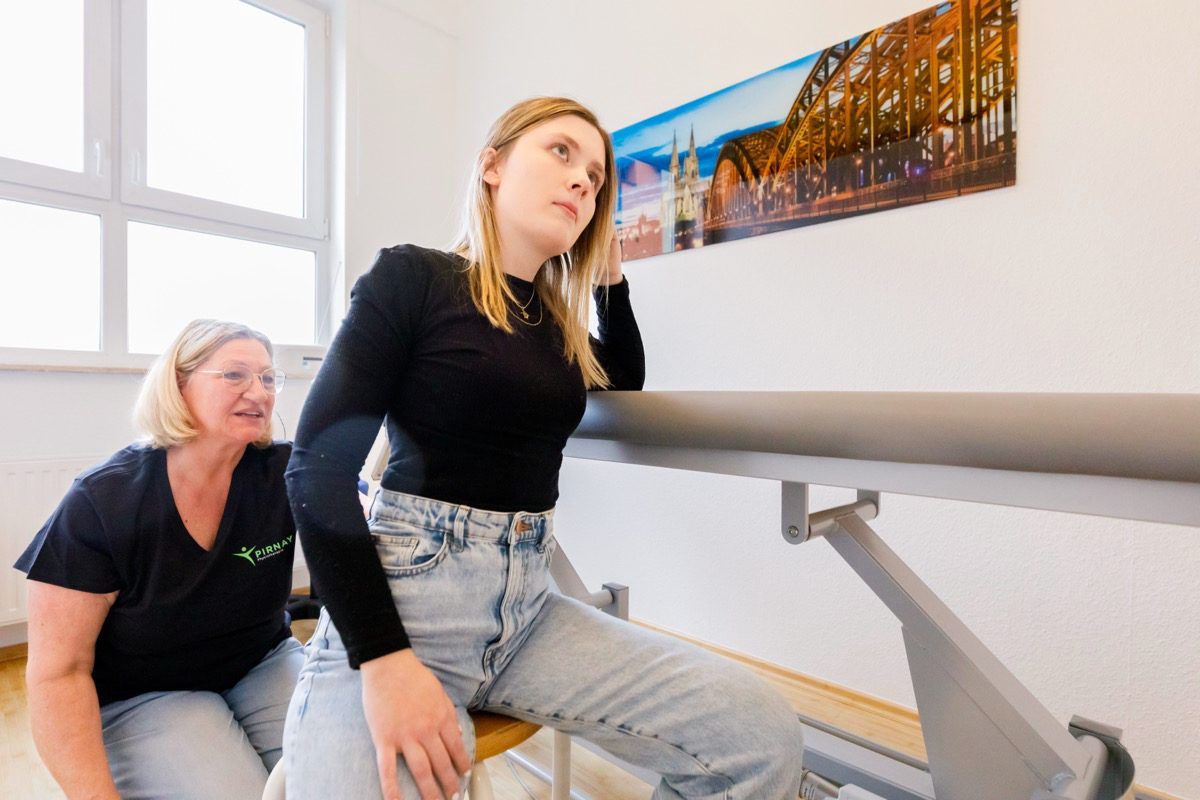
Neurological Physiotherapy in Cologne-Esch
KG-ZNS based on the Bobath and Vojta concepts for stroke, Parkinson's, multiple sclerosis and other neurological conditions – at Martinusstraße 53 in northern Cologne
A stroke changes everyday life from one day to the next: getting up, walking, picking up a cup. This page explains what neurological physiotherapy does – on the prescription from your doctor (Heilmittelverordnung) it appears as “KG-ZNS”, short for physiotherapy exercises (Krankengymnastik) for disorders of the central nervous system – which conditions it is prescribed for and how relatives can help. At Praxis Pirnay in Cologne-Esch, therapists with additional Bobath and Vojta training treat adults and children.
Neurological physiotherapy in Cologne-Esch: practicing for everyday life
“KG-ZNS” stands for exercise therapy for diseases of the central nervous system, that is, of the brain and spinal cord. If tissue there is damaged, for example by a stroke, movement commands no longer reach the muscles as usual: an arm stays weak, a leg is hard to control, muscles tense up involuntarily. So what is practiced are whole actions such as turning over in bed, sitting up, standing up, walking and reaching.
The basis is neuroplasticity: the nervous system can rebuild connections between nerve cells when a movement is practiced often and attentively. How far this adaptation goes in an individual case, nobody can predict; it depends, among other things, on the location and extent of the damage. The aim is to maintain and improve mobility and independence as far as the assessment allows.
KG-ZNS may only be provided by physiotherapists with an additional qualification recognized for this. For infants, children and adolescents there is a separate prescription, “KG-ZNS-Kinder” (KG-ZNS for children). Certified Bobath and Vojta therapists work in Cologne-Esch, so children with movement disorders are also treated here.
Conditions for which KG-ZNS is prescribed
Stroke
A circulation disorder or bleeding in the brain. Often one side of the body stays weakened or paralyzed, frequently with disturbances of sensation, balance or speech.
Movement disorders in childhood
For example infantile cerebral palsy or delayed motor development. The pediatrician’s practice then prescribes treatment based on Bobath or Vojta.
Traumatic brain injury
After an accident or fall involving the brain, paralysis, coordination problems and quick fatigue can remain, depending on the injured region.
Spinal cord injury with paralysis
The spinal cord is partly or completely interrupted. What is practiced includes trunk control, transfers, handling the wheelchair and the functions that remain.
Parkinson’s disease and multiple sclerosis
Both are chronic. With Parkinson’s, walking and posture are in the foreground; with multiple sclerosis, fluctuating strength, spasticity and exhaustion.
Polyneuropathy
Nerves in the feet and hands are affected; typical signs are numbness and unsteady walking. Whether KG-ZNS or general exercise therapy is prescribed is decided by the doctor’s practice.
What the therapy addresses
Walking and standing
- • Getting up from bed and chair
- • Putting weight on the affected leg
- • Catching the tip of the foot
- • Stairs and curbs
Arm and hand
- • Painful or drooping shoulder
- • Reaching, holding and letting go
- • Using the hand when dressing and eating
Muscle tension and perception
- • Spasticity: involuntarily increased muscle tension
- • Floppy, weak muscles
- • Neglecting one side of the body (neglect)
Independence in daily life
- • Washing, dressing, going to the toilet
- • Transferring from bed to wheelchair
- • In children: rolling over, crawling, sitting, walking
Emergency number 112: recognizing the signs of a stroke
A stroke is an emergency, even if the symptoms disappear again after minutes. If you notice any of the first four signs, call emergency number 112 immediately and note when it started. The last two points must be checked by a doctor, if in doubt also by calling 112.
- Sudden weakness, paralysis or numbness on one side of the body.
- A corner of the mouth drooping on one side.
- Suddenly slurred speech, difficulty finding words or not understanding speech.
- Sudden problems with vision, double vision, severe dizziness or unusually severe headache.
- A fall with a head injury, severe pain or a leg that cannot bear weight.
- Rapid worsening of strength, gait or spasticity; with multiple sclerosis, suspected relapse.
Treatment concepts: Bobath and Vojta
Which concept is used depends on the prescription and the assessment. Both facilitate movements needed in daily life and rely on frequent repetition. We do not offer PNF in Cologne-Esch; that concept is available at our practice in Düsseldorf.
Bobath therapy
The therapist guides movements such as sitting up, standing up or reaching with their hands and involves the affected side of the body instead of working around it. Parents of infants and children learn handling techniques for carrying, changing diapers and feeding.
Vojta for children and adults
From set starting positions the therapist applies pressure to particular body zones. According to the Vojta principle, the body responds with involuntary movement patterns of straightening up and moving forward. With children, parents continue the exercise at home after being shown how.
Walking and balance
Standing up, bringing weight onto the affected leg, steps on level ground and on the stairs: you practice these sequences in small stages, at first with the therapist’s support, later with a cane or walker (rollator) or unaided.
Home visit on prescription
If getting to the practice is not yet manageable, a home visit can be prescribed. You then practice where it matters: at your own bed, in the bathroom or on the stairs.
From the first assessment to the follow-up prescription
- 1
Assessment and history
We read the discharge letter and prescription and look at how you sit, stand up, walk and use your arm and hand. The diagnosis is made by your doctor.
- 2
Goals from your daily life
Together with you and your relatives we decide what is important next, for example going to the toilet alone or dressing yourself.
- 3
Practicing and guidance
You repeat the chosen actions with support that gradually decreases. For home you receive a few clearly described exercises; relatives try out the handling techniques themselves.
- 4
Feedback to the doctor’s practice
At the end of the series we record what has changed. A further prescription is decided by the prescribing practice.
Practicing at home: advice for those affected and their relatives
The time between appointments counts too. This advice is simple and safe; please discuss anything beyond it in therapy beforehand.
Short and often rather than long
Several short practice sessions a day are usually better than one long one. Tie exercises to fixed routines, for example getting up from the chair before every meal, and stop before exhaustion.
Protect the affected arm
When sitting, place the arm visibly on the table or a cushion instead of letting it hang. Whoever helps with standing up holds the trunk or pelvis, not the arm: pulling on the shoulder can cause pain and injury.
Helping without taking over
Let the person affected do what they can themselves, even if it takes longer. Clear away tripping hazards such as loose rugs and cables and make sure they wear sturdy footwear.
Practicing with children in the daily routine
The handling techniques from children’s therapy belong in the day: when picking up, changing, dressing and playing. Practice the way you were shown, and raise any uncertainties at the next appointment.
Your appointment on Martinusstraße in Cologne-Esch
Praxis Pirnay is at Martinusstraße 53, 50765 Köln, in the north of Cologne near Pesch and Auweiler. There is parking directly in front of the practice, and access is step-free. By car you take the A57, exit Köln-Chorweiler, or the A1, exit Köln-Bocklemünd; the bus stop “Esch Schulstraße” is a few minutes’ walk away.
Please bring your insurance card, prescription, discharge letter and any other doctors’ letters. Wear comfortable clothing and sturdy shoes; a splint, cane or walker (rollator) comes along too. At the first appointment more time is planned for the assessment; otherwise a treatment usually lasts 20 to 60 minutes, depending on the prescription.
You make an appointment by phone or via the appointment form on this website. We speak German, English and Spanish, and at the reception desk also Turkish. If the prescription provides for a home visit, we treat you at home or in a nursing home.
Opening hours: Mon 7:00–20:00, Tue 8:00–19:50, Wed 8:00–19:30, Thu 7:00–19:50, Fri 7:00–15:30
Common questions: stroke, Bobath and Vojta
When does outpatient physiotherapy begin after a stroke?
As a rule it follows on from the hospital and rehabilitation. The family doctor’s or neurologist’s practice prescribes KG-ZNS for it. Get in touch early and bring the discharge letter, so that there is no long gap.
Is there still any point in practicing if the stroke was a long time ago?
Yes, therapy can make sense even then, for example to maintain mobility, influence increased muscle tension and prevent falls. How much can still change in an individual case cannot be predicted. Your doctor decides on the prescription.
What is the difference between Bobath and Vojta?
With Bobath you take an active part in everyday movements while the therapist guides and supports. Vojta triggers involuntary movement patterns through pressure on particular body zones. Which concept fits depends on the prescription, the assessment and age.
What is written on the prescription for children?
It says “KG-ZNS-Kinder” with the addition Bobath or Vojta. It is usually issued by the pediatrician’s practice when a central movement disorder has been diagnosed. Children and adolescents under 18 pay no statutory co-payment. One parent comes along to the treatment.
May relatives be present during treatment?
Yes, that is welcome if you agree. Relatives see how much help is really needed and practice positioning, transfers and assisting under guidance. This makes handling at home safer for both sides.
What costs will I have with a prescription for KG-ZNS?
With the prescription, Praxis Pirnay bills your statutory health insurer; if you have statutory health insurance, you pay the statutory co-payment unless you are exempt. Privately insured and self-paying patients can, incidentally, also make an appointment without a prescription if a medical finding (Befund) is available. If you have private health insurance, clarify reimbursement with your insurer beforehand, because it depends on your plan.
You Might Also Be Interested In
Bobath Therapy
Neurophysiological treatment for adults and children
Vojta Therapy
Reflex locomotion for neurological movement disorders
Physiotherapy in Nursing Homes
Physiotherapy for people who live in a care home
Home Visits
Physiotherapy at home and in nursing homes
Neurological Physiotherapy
Everything about KG-ZNS at our three locations
Book Your Appointment for Neurological Physiotherapy
Martinusstraße 53 in Cologne-Esch – easily accessible from across northern Cologne, with home visits available on request.
0221 - 7099885