
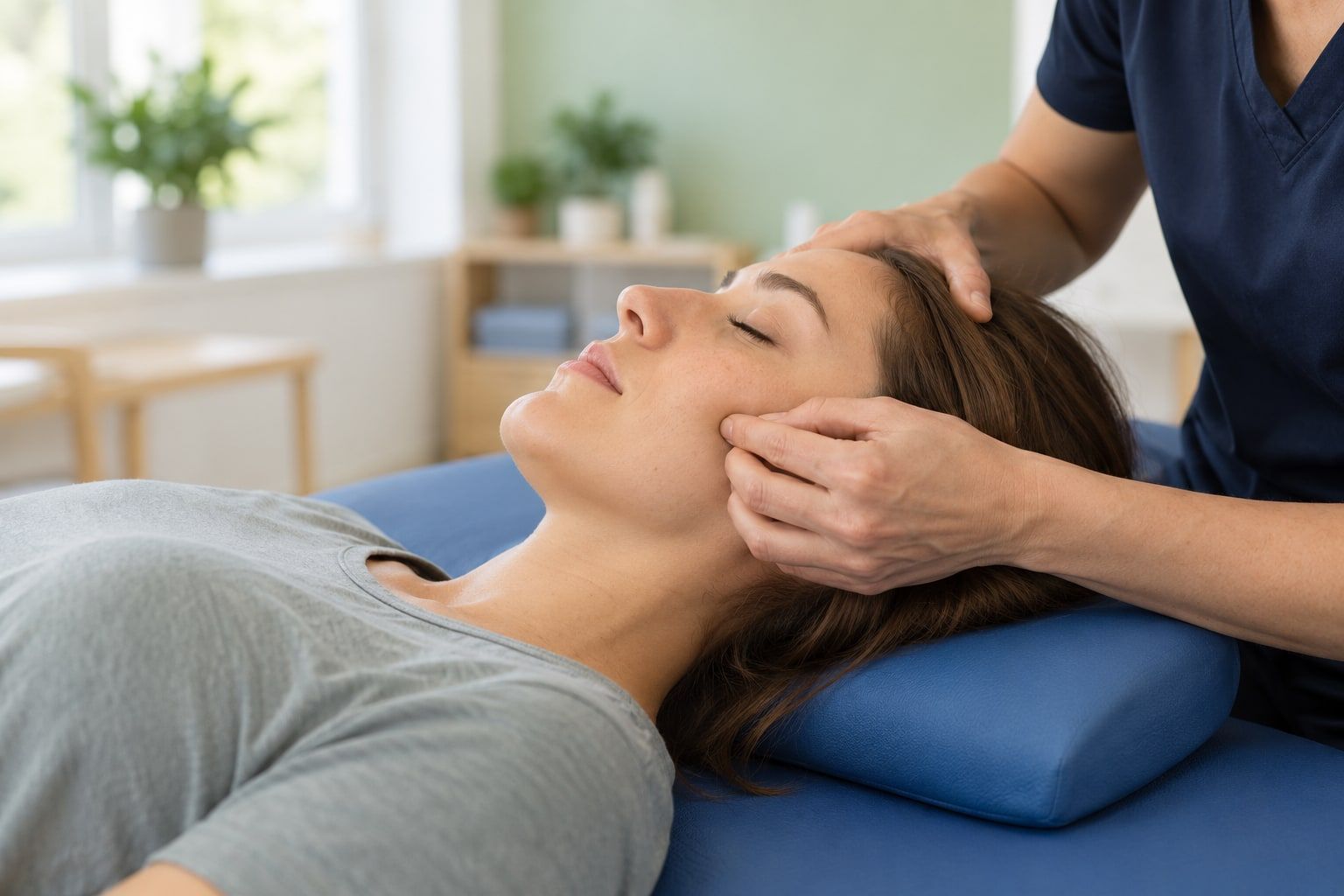
TMJ Disorder Treatment in Cologne Worringen
Professional TMD therapy for jaw pain at Hackhauser Weg 61
Your jaw clicks when you yawn, your mouth no longer opens as wide as it used to, or a pulling runs from the ear into the cheek: such complaints often originate in the jaw joint and its muscles. Praxis Pirnay in Cologne-Worringen examines how your lower jaw moves and what share the neck has in it. Here you can find out what is behind clicking and locking.
When the jaw clicks and the mouth does not open wide
When the mouth opens, the head of the lower jaw (the condyle) first rotates and then glides forward. A cartilage disc, the articular disc, accompanies it. If the disc lies a little too far forward, the condyle jumps onto it with a click on opening. The noise alone is usually harmless and needs no treatment, as long as nothing hurts and the mouth opens normally.
It is different if the disc stays in front. Then the clicking falls silent, and the mouth can suddenly be opened only a little; the lower jaw deviates toward the affected side. More often, however, it is the muscles that put the brakes on: cramped chewing muscles do not allow the movement. As a rough guide for a normal opening, three of your own fingers stacked on top of each other fit between the front teeth.
Because the joint lies directly in front of the ear canal, pain from there is easily mistaken for ear pain. Cheek, temple and teeth can also hurt. Taken together, such disorders are called craniomandibular dysfunction (CMD). It is diagnosed in a dental or doctor’s office; for ear complaints, an examination by an ENT doctor is part of it.
Possible reasons for clicking, locking and facial pain
Displaced joint disc
If the disc slips forward, there is a click on opening and often another on closing. If it stays displaced, the opening becomes smaller.
Cramped chewing muscles
Overloaded muscles at the cheek and temple shorten painfully. The mouth opens only hesitantly, and chewing tires early.
Mouth open wide for a long time
After extended dental treatment, a strong yawn or a bite into something very large, the joint can react with irritation.
Upper cervical spine
Head posture and jaw position are connected. Tension in the neck can intensify pain in the face and jaw – and the other way around.
Wear in the joint
Grating noises instead of clicking can point to osteoarthritis of the jaw joint. Stiffness and pain at the first movements are typical.
Complaints that can come from the jaw joint
Noises
- • Clicking on opening or closing
- • Grating like sand in the joint
- • On one or both sides
Movement
- • Mouth opens less wide than usual
- • Lower jaw deviates to the side
- • Feeling that the jaw catches or jumps
- • Biting into food and yawning are difficult
Ear and face
- • Pain in front of the ear or seemingly in the ear
- • Feeling of fullness in the ear
- • Pulling in the cheek, temple or teeth
Neck
- • Stiff neck, especially in the morning
- • Headache starting from the back of the head
- • Pain when turning the head
Warning signs with jaw, ear and facial pain
Some complaints look like a jaw problem but have another cause. Have the following signs clarified first by a doctor or dentist. Where minutes count, the emergency number 112 is given.
- Emergency number 112: jaw pain that occurs with tightness in the chest, shortness of breath or pain in the left arm – a possible heart attack.
- Emergency number 112: a suddenly crooked face, speech disturbance or paralysis; likewise difficulty breathing or inability to swallow with swelling of the mouth or throat.
- The mouth cannot be closed after yawning or an accident, or the rows of teeth no longer fit together: go straight to the emergency department.
- Mouth opening that decreases sharply within days, with fever, swelling or toothache: see a dentist today.
- Ear pain with discharge, hearing loss, dizziness or fever, as well as a new one-sided noise in the ear: have it checked by an ENT doctor.
- Attacks of electric-shock-like pain in the face, numbness at the lip or chin, pain when chewing with temple headache from age 50, or a lump that does not go away.
Physiotherapy for clicking, locking and pain
Painless clicking usually needs no therapy. Therapy is appropriate if the mouth does not open wide enough, chewing hurts or the neck is involved. What is done depends on the prescription from your doctor (Heilmittelverordnung) and on the assessment.
Treatment of the jaw joint
With gentle traction and gliding movements at the lower jaw, we relieve the joint and promote its mobility. Shortened chewing muscles are stretched and loosened, with the aim that the mouth opens wider and straighter.
Manual therapy
We examine the cervical spine, especially its upper segments, and mobilize stiff sections. This makes sense if neck movements change the facial or ear pain.
Physiotherapy exercises (Krankengymnastik)
You practice in front of the mirror opening the mouth slowly and without deviating to the side. Coordination exercises for the lower jaw and exercises for head posture complement the program.
Heat or cold
Heat is suitable for firm, tense muscles, cold more for a freshly irritated joint. Both prepare the actual treatment and are prescribed in addition.
The course of treatment in Cologne-Worringen
- 1
Measuring and palpating
We measure how wide the mouth opens and whether the lower jaw deviates, pay attention to joint noises and palpate muscles, joint and neck. More time is scheduled for this the first time.
- 2
Classifying and planning
The assessment shows whether the muscles, the joint or the neck are putting the brakes on the movement more. Then we decide with you what to tackle first.
- 3
Regaining movement
Treatment works step by step on opening and side-to-side movement. Pain is the limit: stretching is not forced, but done in small, repeated steps.
- 4
Continuing to practice on your own
You receive exercises for several times a day, only a few repetitions each. Short, frequent sessions are better for the joint than rare, long practice.
- 5
Measuring again
At the end, we measure the mouth opening again. If it remains clearly restricted, we recommend a further dental or medical check-up.
Keeping the jaw joint moving gently
The joint should move calmly without being irritated. Leave out anything that clearly increases the pain or triggers a locking.
Guided opening
Place the tip of the tongue on the palate behind the upper front teeth and open your mouth slowly as far as the tongue can stay there. A few repetitions, but several times a day.
Support yawning
When yawning, support the chin from below with your fist or tilt your head slightly forward. This way the mouth does not open all the way to the limit.
Small bites
Cut bread rolls, apples and burgers small instead of biting wide. Chew alternately on the right and left and take a break from chewing gum.
Do not make it click
Some people make the joint click out of habit or push the lower jaw back and forth. That irritates the structures. Also, do not rest your chin in your hand.
Praxis Pirnay at Hackhauser Weg: directions and appointments
The practice is at Hackhauser Weg 61 in Cologne-Worringen, the northernmost district of Cologne, not far from the Rhine. By bus, ride to “Worringen Hackhauser Weg” and walk a few minutes. By car, you reach us via the A57, exit Köln-Worringen; parking spaces are directly in front of the practice.
Please bring your prescription, insurance card and any existing findings, for example from the dental or ENT practice, as well as X-ray or MRI images of the jaw. Wear comfortable clothing, because besides the jaw we also examine the neck and shoulders.
We schedule appointments by phone and via the appointment form on this website. We speak German, English and Spanish. A treatment session usually lasts between 20 and 60 minutes, depending on the prescription.
Opening hours: Mon–Tue 7:00–18:00, Wed 7:00–18:20, Thu 8:00–19:30, Fri 8:00–14:00
Frequently asked questions about jaw clicking and mouth opening
Is jaw clicking dangerous?
Usually not. Clicking without pain and without restricted mouth opening is common and is generally not considered in need of treatment. You should pay attention if pain is added, the jaw catches or the mouth suddenly opens less wide. Then a dental examination is the right first step.
Does the clicking go away with physiotherapy?
Not necessarily. The noise arises from the position of the joint disc and persists in many people even when pain and mobility improve. Treatment aims at a jaw that can move sufficiently wide and, as far as possible, without pain, not at a noiseless joint.
Why does my ear hurt with jaw problems?
Because the jaw joint lies directly in front of the ear canal and both regions are partly supplied by the same nerve. Pain from the joint or chewing muscles is therefore often felt in the ear. Even so, have ear complaints examined by an ENT doctor first. If everything is normal there, the jaw comes into question as the source.
My mouth suddenly hardly opens – what should I do?
Have it examined promptly by a dentist or doctor, on the same day in case of fever, swelling or after an accident. Do not force the mouth open. If a displaced joint disc or cramped muscles are behind it, physiotherapy can then help to regain mobility step by step.
What do I need to know about the prescription and costs?
A prescription is needed for the treatment. People with statutory health insurance bear the statutory co-payment if they are not exempt. With private health insurance, reimbursement depends on the plan; a short inquiry before the first appointment provides clarity. The practice bills statutory and private health insurers alike.
You Might Also Be Interested In
Headaches
Treatment for tension headaches
Neck Pain
Treatment for neck tension and stiffness
TMJ Therapy
Treatment for jaw joint problems
Manual Therapy
Joint mobilization and release of blockages
All Therapies
Overview of our treatment services