
Back Pain Treatment in Cologne Worringen
Professional physiotherapy for back pain at Hackhauser Weg 61 – serving Worringen, Roggendorf & Langel
Some back pain does not simply go away. It returns again and again at intervals, sits between the shoulder blades or accompanies you through the day for a long time. This page explains why pain can persist although nothing is “broken,” what role strength and endurance play, and what the thoracic spine has to do with it. It is aimed at everyone looking for physiotherapy for their back in Cologne-Worringen.
When back pain stays or keeps coming back
Back pain is considered chronic when it lasts longer than about three months. Alongside that there is the recurring course, in which quiet periods and phases of pain alternate. In both cases the original irritation has usually long subsided. Often, however, the nervous system reacts more sensitively than before, and the muscles have lost strength through avoiding strain. The back is then less able to bear load, but not necessarily damaged.
Not every back pain sits in the lower back. The thoracic spine, the section between the neck and the lower back, carries the ribs and is naturally less mobile. If long periods of bent-over sitting make it even stiffer, pain develops between the shoulder blades that sometimes pulls forward in a belt-like way or stabs on deep breathing.
With persistent symptoms, active movement therapy is at the center: strengthening, mobility and a load that grows step by step. This takes patience. Progress often shows first in that you manage more – standing longer, walking farther, sleeping more peacefully – before the pain itself eases.
Why the back does not settle down
Too little strength in the trunk
Abdominal, back and gluteal muscles stabilize the spine. If they lack strength or endurance, the back tires early under longer loads.
Holding back out of worry
If you avoid movements out of fear of pain, you keep losing condition. This creates a cycle of holding back, loss of strength and growing sensitivity.
Stress, sleep and mood
Constant pressure at work or in the family, restless nights and a low mood can intensify pain and delay its easing.
One-sided postures
Hours in a bent-forward position or the same hand movements over and over make the thoracic spine stiff. The muscles between the shoulder blades work without a break.
Changes in the spine
Wear of the vertebral joints and discs, a sideways curvature (scoliosis) or a rounded back can contribute. How much they explain is shown by the medical examination.
Typical symptom patterns
Lower back, constant or in flare-ups
- • Dull constant pain in the lumbar area
- • Phases of pain that begin without a clear reason
- • Worse with long standing
- • Tiring quickly when carrying
Thoracic spine
- • Pressure or burning between the shoulder blades
- • Stabbing pain on deep breathing or turning
- • Belt-like pulling along a rib
- • Hard to straighten the upper body
Effects on everyday life
- • Restless sleep from frequently shifting position
- • Uncertainty with physical work
- • Withdrawal from sport and hobbies
When back pain has to be checked by a doctor
Even back pain of many years’ standing can change. With the following signs, a medical check comes before the next treatment. Pain in the chest deserves particular attention, because the heart or lungs can be behind it.
- Pain or tightness in the chest with shortness of breath, cold sweat or radiating into the arm, neck or jaw: call 112 immediately.
- Loss of sensation around the anus and genitals or suddenly impaired control over bladder and bowel: also call 112.
- New muscle weakness or paralysis in a leg, persistent numbness or an unsteady gait.
- Sudden pain after a fall or even after minor strain, if osteoporosis is known or you take cortisone for a long time.
- Raised temperature, night sweats, unintentional weight loss, a history of cancer or pain that increases at rest and at night.
- Onset at a young age with marked stiffness in the morning and improvement through movement rather than rest – a possible sign of inflammatory rheumatism.
Treatment of chronic back pain in Cologne-Worringen
With symptoms that have lasted a longer time, active training carries the treatment; strengthening is part of physiotherapy exercises (Krankengymnastik). We use passive methods in addition if they make exercising easier for you.
Exercise therapy with strengthening
You train the trunk, buttocks and shoulder girdle with exercises whose difficulty grows from appointment to appointment. For the thoracic spine, rotation and extension movements as well as breathing exercises are added.
Manual therapy
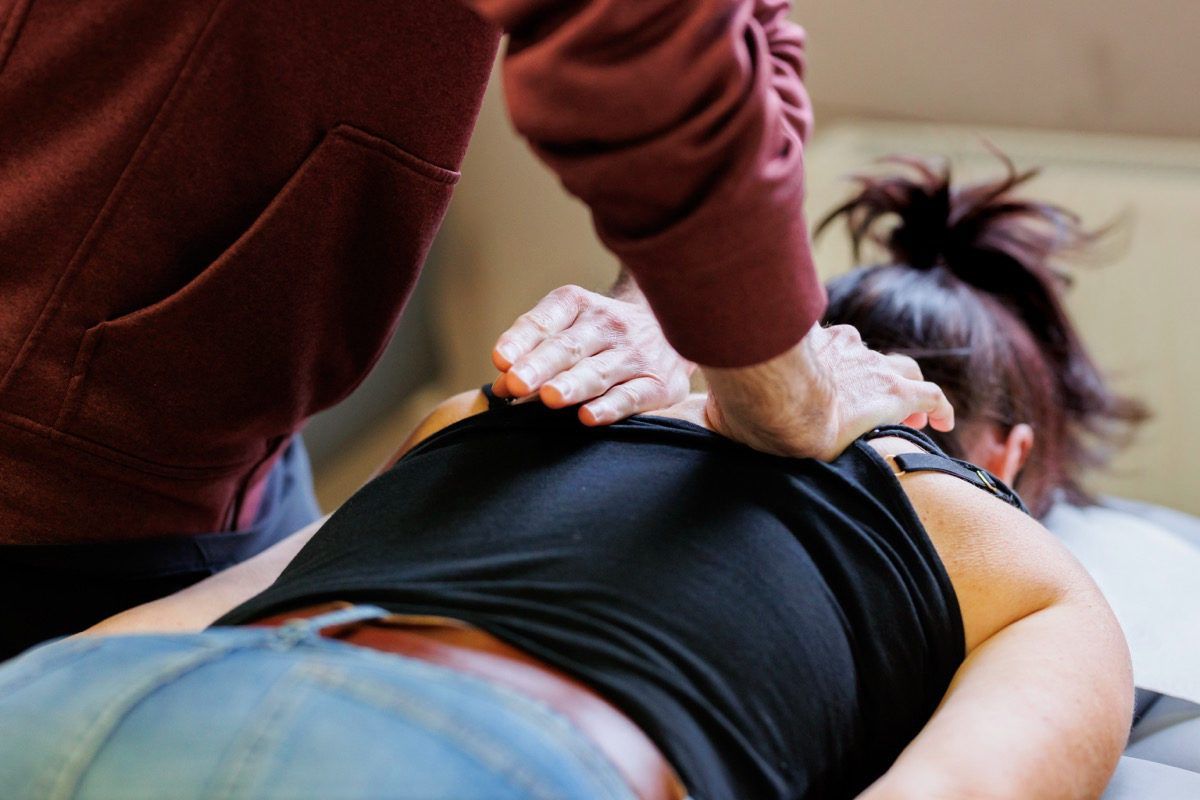
Stiff segments of the thoracic spine and the rib-vertebra joints can be mobilized by hand. This can make straightening up and breathing easier. Exercises that use the newly gained range of movement follow directly afterward.
Massage as a complement
Hardened muscle bands next to the vertebrae and at the shoulder blade are loosened. With chronic pain, massage accompanies the training; on its own, its effect usually does not last long.
Heat treatments
Fango (mud packs) or hot air before treatment lower muscle tension and make the tissue more yielding. Many people find exercising easier afterward.
Sequence of a treatment series
- 1
Taking stock
First we go over the course so far, earlier therapies and what the pain keeps you from doing. Then comes the examination of posture, mobility and trunk strength.
- 2
Tangible goals
Instead of “no more pain,” we agree on concrete steps, for example walking twenty minutes at a stretch or carrying a full shopping bag.
- 3
Practicing with growing load
Every appointment includes active exercises. We increase the amount and resistance according to plan so that the back can adapt. Mobilization and heat are added as needed.
- 4
Program for home
You receive a few clearly described exercises. We check how you perform them and adjust them as soon as something has become too easy.
- 5
Review and outlook
At the end we compare your status with the goals and clarify how you continue training on your own.
Keeping the back able to bear load in the long run
With recurring pain, regularity counts more than any single exercise. Mild pulling while exercising is harmless; sharp or radiating pain is a reason to stop.
Endurance that suits you
Brisk walking, cycling or swimming on several days of the week keep the back in shape. Which movement you choose matters less than that you stick with it.
Extend the thoracic spine
Sit on a chair, clasp your hands behind your neck and gently lean your upper back over the backrest. A few calm repetitions, several times a day.
Strengthen the trunk on all fours
On hands and knees, alternately stretch out one arm and the opposite leg without letting the back sag. Hold briefly, then switch.
Pace your energy
Spread demanding tasks over the day instead of getting everything done at once on good days. Planned breaks prevent overload.
Putting flare-ups in perspective
If the pain flares up again, it usually does not mean new damage. Cut back the load for a few days, keep moving, and then build up again.
Directions and appointments at Hackhauser Weg
You will find Praxis Pirnay at Hackhauser Weg 61, 50769 Cologne. Worringen is the northernmost district of Cologne and lies close to the Rhine. From the A57, take the exit Köln-Worringen; parking is right in front of the practice. If you take the bus, get off at the stop “Worringen Hackhauser Weg” and walk a few minutes.
Treatment includes exercises standing, lying down and on all fours; shorts and a T-shirt are suitable for this. Besides your prescription from your doctor (Heilmittelverordnung) and your health insurance card, please also bring older documents: doctors’ letters and X-ray or MRI reports.
Appointments are available by phone or with the form on the website. Treatment takes place in German, English or Spanish and usually lasts 20 to 60 minutes depending on the prescribed therapy; at the start, time for the assessment is added. If a home visit has been prescribed, we treat you at home or in a nursing home.
Opening hours: Mon–Tue 7:00–18:00, Wed 7:00–18:20, Thu 8:00–19:30, Fri 8:00–14:00
Common questions about persistent back pain
Can I do strength training with chronic back pain?
Yes, targeted strengthening is a central building block of treatment. Starting with a light load and increasing slowly are important. In exercise therapy you learn the exercises under guidance. Mild muscle soreness is normal and not a warning sign.
Where does pain between the shoulder blades come from?
Mostly it comes from a stiff thoracic spine, irritated rib joints or overloaded muscles. Because the heart, lungs or gallbladder can also radiate pain into this region, new, severe pain or pain accompanied by shortness of breath belongs first in a doctor’s office.
Why does back pain keep coming back?
Often because no load tolerance was built up between the pain phases. When the pain eases, many people stop exercising, and the next load peak triggers symptoms again. Regular movement can make relapses less frequent and milder, but it cannot rule them out.
Do I have to expect surgery with years of back pain?
As a rule, no. Non-specific back pain is usually not operated on. An operation comes into consideration for certain causes, such as paralysis from a herniated disc or a marked narrowing of the spinal canal. Whether that applies to you is judged by the specialist doctor.
What does treatment cost me as a patient with statutory health insurance?
You pay the statutory co-payment, unless you are exempt; the practice bills the remaining amount to your health insurer. The basis is a prescription from a doctor. With private health insurance, reimbursement depends on your plan – ask your insurer before you begin.
You Might Also Be Interested In
Neck Pain
Treatment for neck tension and stiffness
SI Joint Dysfunction
Relief from sacroiliac joint problems
Manual Therapy
Joint mobilization and release of blockages
Pain Therapy
Effective treatment for chronic pain
All Therapies
Overview of our treatment services