
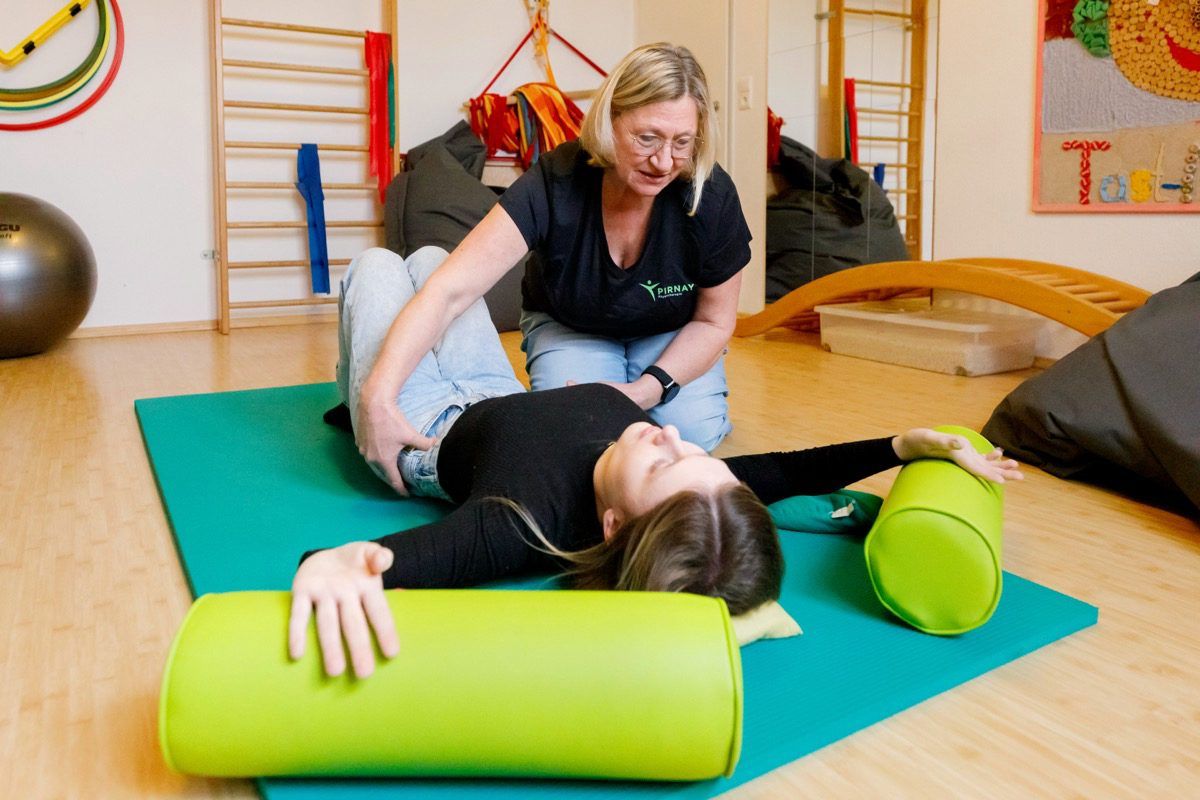
SI Joint Blockage Treatment in Cologne Worringen
Professional physiotherapy for sacroiliac joint blockages at Hackhauser Weg 61
During pregnancy and in the time after birth, the sacroiliac joints (SI joints) often make themselves felt. People who keep getting the same pain at the pelvis also usually look for more than a short-term fix. This page shows why the pelvis needs support then and how physiotherapy can help with that. Praxis Pirnay in Cologne-Worringen treats on a prescription from your doctor (Heilmittelverordnung).
SI joint problems during pregnancy and with a recurring course
The two sacroiliac joints, SI joints for short (in German: Iliosakralgelenke, ISG), lie at the back of the pelvis between the sacrum and the iliac bone. Together with the pubic symphysis at the front they form the pelvic ring. This ring is built for firmness: strong ligaments and the surrounding muscles press the joint surfaces together so that the weight of the trunk passes safely to the legs.
In pregnancy, hormones loosen the ligaments so that the pelvis can give way for the birth. At the same time the belly grows, the center of gravity shifts forward, and the abdominal muscles give less support. The joints of the pelvic ring are therefore under more strain. Pain at the back at the SI joint, at the front at the pubic symphysis or at both places is grouped together as pelvic girdle pain.
In many women the symptoms ease after the birth, while in some they last longer. If SI joint pain keeps coming back independently of pregnancy, the pelvis often lacks muscular support, or the hip and lumbar spine are involved. Manual techniques alone are then rarely enough; the focus is on training the stabilizing muscles.
Why the pelvis loses its support
Ligaments loosened by hormones
Pregnancy hormones make the connective tissue more yielding. The sacroiliac joints gain more play, and the muscles have to do more holding work.
Changed alignment
As the belly grows, the lower back often arches more. The weight rests on the pelvic ring differently than usual.
Strain after birth
The pelvic floor and abdominal wall need time before they build tension again. At the same time come lifting, carrying and breastfeeding, often in a one-sided posture.
Weak trunk and gluteal muscles
Deep abdominal muscles, gluteal muscles and the pelvic floor hold the pelvic ring together. If they are little trained, symptoms recur more easily.
Hip, lumbar spine, leg length
A stiff hip, a previous fusion of the lumbar spine or a marked difference in leg length can load the SI joint more heavily over time.
Typical signs at the pelvic ring
In pregnancy
- • Stabbing pain at the back of the pelvis, on one or both sides
- • Pain at the pubic symphysis or in the groin
- • Waddling gait with small steps
- • Difficulty turning while lying down
After birth
- • Pulling in the lower back when picking up the baby
- • Discomfort when sitting for long while breastfeeding
- • Pain when carrying the infant car seat
- • A feeling that the pelvis is unstable
With recurring symptoms
- • Phases of pain after similar loads
- • Unsteadiness when standing on one leg
- • Tiring quickly when standing or walking for longer
- • Relief when supporting yourself or sitting down
When a doctor, midwife or emergency call is needed
Back pain in pregnancy is often harmless, but not always. With paralysis, numbness in the buttock and genital area or problems with the bladder and bowel, call the emergency number 112. Clarify the other signs promptly with a gynecologist’s office, a midwife or your family doctor.
- Weakness in a leg, numb feeling in the crotch, bladder or bowel no longer controllable
- Bleeding, loss of fluid or regularly recurring, wave-like pains during pregnancy
- Fever, burning when urinating or pain in the flank
- One leg swells, hurts and becomes warm
- Severe pain after a fall or accident
- Pain at night with long morning stiffness that improves with movement
Physiotherapy for more stability in Cologne-Worringen
During pregnancy we treat in a side-lying or sitting position and with little pressure. We do not use electrotherapy or strong heat on the pelvis during this time. With recurring symptoms the emphasis is on active training.
Physiotherapy exercises (Krankengymnastik)
You learn to tense the pelvic floor and deep abdominal muscles before you turn, stand up or lift. Exercises for the buttocks and trunk build on that – adapted during pregnancy, matched to postnatal recovery after the birth.
Manual therapy
With gentle techniques we treat the sacroiliac joint, the lumbar spine and the hips. That can ease the pain and make exercising easier. Jerky techniques are not part of this in pregnancy.
Classical massage
With a yielding pelvic ring, the buttock, hip and lower back muscles constantly work against it and harden. In a comfortable side-lying position we loosen these areas, if massage is prescribed.
Fango (mud packs) and hot air
Outside of pregnancy, heat before treatment can relax the tense muscles around the sacrum and buttocks. It prepares you for mobilization and exercises.
Series of treatments: first relieve, then stabilize
- 1
Initial conversation and assessment
We ask about the week of pregnancy or the course of the birth, about earlier episodes and about your daily life. Then we gently test which movements and loads trigger the pain at the pelvis.
- 2
Goals for everyday life
Together we define what should become easier: turning over at night, climbing stairs, carrying the child, doing sport again.
- 3
Relieve and activate
First we ease the pain with manual techniques and positioning. In parallel you practice consciously activating the deep holding muscles.
- 4
Build strength, home program
The exercises become more demanding: from lying down through the all-fours position to standing, later with loads from your everyday life. At the end there is a short program that you continue on your own.
Everyday tips for pregnancy, the postpartum period and beyond
Small changes in everyday life can take load off the pelvic ring. Try what does you good, and discuss exercises during pregnancy with your midwife, doctor or therapist.
Knees together when turning
When turning over in bed and getting out of the car, keep your knees together and move both legs as one. In a side-lying position, a pillow between the knees gives relief.
Get dressed sitting down
Put on trousers, socks and shoes while sitting rather than balancing on one leg. On stairs, small steps and a hand on the railing help.
Distribute loads evenly
Carry the child alternately on the right and the left or in front of your body, with the infant car seat close to your belly. Spread your shopping across two bags or a backpack.
Postnatal recovery before strain
After the birth, the postnatal recovery class (Rückbildungskurs) lays the foundation for the abdomen and pelvic floor. Do not begin demanding training such as running or jumping until your midwife or doctor agrees.
For your appointment at Hackhauser Weg: what matters
Praxis Pirnay is at Hackhauser Weg 61 in 50769 Cologne-Worringen, the northernmost district of Cologne, close to the Rhine. By car you come via the A57, exit Köln-Worringen; you park directly at the door, so the walk stays short. If you take the bus, get off at the stop “Worringen Hackhauser Weg” and you are there after a few minutes’ walk.
Please remember your prescription and health insurance card and, if there are any, doctors’ letters and reports. Wear comfortable, stretchy clothing in which you can lie on your side and do exercises on all fours.
You can get an appointment by phone or via the form on this website. The first visit takes a little longer because the assessment is part of it; after that the duration depends on the prescribed therapy and is 20 to 60 minutes. Treatment is available in German, English and Spanish.
Opening hours: Mon–Tue 7:00–18:00, Wed 7:00–18:20, Thu 8:00–19:30, Fri 8:00–14:00
Questions about pregnancy, birth and recurrences
Can I have physiotherapy for SI joint pain during pregnancy?
Yes, that is possible with a prescription from your doctor. We adapt positioning, techniques and exercises to the pregnancy; lying on the stomach and strong pressure are left out. Talk to your gynecologist if pain at the pelvis limits your daily life.
Does a pelvic belt help?
For some women it brings noticeable relief, for others it does not. The belt wraps around the pelvis from the outside and can give support when walking and standing. It does not replace muscle work and should be worn only temporarily. Whether it is an option for you, clarify with your doctor, your midwife or in therapy.
Do the symptoms go away by themselves after birth?
In many women they improve noticeably after the birth, but that cannot be promised. The ligaments gradually firm up again, while lifting and carrying bring new strain. If the pain persists or increases, talk to your midwife or doctor about it.
Why does my SI joint pain keep coming back?
Usually several things come together. Often the pelvis lacks muscular stability, and one-sided loads or a restricted hip add to it. With recurring pain, a doctor should also check whether another cause is present, such as inflammation of the joints. Therapy then relies on regular training.
Which exercises give the pelvis support?
Suitable are exercises that challenge the deep abdominal muscles, pelvic floor and buttocks together, such as the pelvic lift lying on your back, arm and leg raises on all fours or the side forearm plank. Which variant fits depends on pregnancy, birth and training level. That is why we choose them based on the assessment.
Who issues the prescription – gynecologist or orthopedist?
Both can, as can the family doctor’s office. What matters is that the symptoms are assessed by a doctor and physiotherapy is prescribed. With the prescription we bill your health insurer; for people with statutory health insurance, the statutory co-payment applies unless they are exempt. People with private health insurance ask their insurer about reimbursement.
You Might Also Be Interested In
Back Pain
Relief from vertebral blockages and tension
Hip Pain
Targeted treatment for hip problems
Disc Herniation
Treatment for disc problems
Manual Therapy
Joint mobilization and release of blockages
All Therapies
Overview of our treatment services