
Hip Pain Treatment in Cologne Worringen
Professional physiotherapy for hip pain at Hackhauser Weg 61
With the fitting of an artificial hip joint, the real work only begins: walking safely, managing stairs, regaining strength. Others come because of pain on the outside of the hip that wakes them at night when lying on their side. These two topics are what this page of Praxis Pirnay in Cologne-Worringen is about – with warning signs, treatment and tips for at home.
Hip pain after surgery and on the outside of the hip
In a hip replacement, in German short Hüft-TEP (total endoprosthesis), the femoral head and the socket are replaced by implants. Afterward, the muscles around the hip are weakened, the leg is swollen at first, and a limp practiced over a long time does not disappear by itself. Physiotherapy begins already in the clinic and is continued on an outpatient basis after rehabilitation. How much weight the leg may bear and which movements are allowed is determined by the surgical team.
Another picture is pain at the side of the hip. On the outside of the thigh, you can feel a bony prominence, the greater trochanter. This is where the tendons of the buttock muscles attach, with a bursa lying over it as a gliding cushion. If the tendon attachments or the bursa are irritated, the spot hurts under pressure, on the stairs and at night. The medical term for this is greater trochanteric pain syndrome. It often takes a long time to run its course and responds more to adjusted loading and strengthening than to rest alone.
Triggers on the outside of the hip, hurdles after the operation
Unusually high load
Long hikes, many steps or a rapidly increased workload overtax the tendon attachments at the greater trochanter if they are not prepared for it.
Pressure from outside
Lying on the side of the affected hip, crossed legs or standing with the pelvis pushed out to the side press the tendons and bursa against the bone.
Loss of strength in the buttock muscles
The side buttock muscles keep the pelvis level when one leg is in the air. If they lack strength, the pelvis drops with every step and the tendons come under tension.
Effects of the procedure
To reach the joint, muscles are held aside or partly detached. They need time and training; at first, the scar and swelling slow things down further.
Old protective patterns
If you limped for a long time before the operation, you often keep the pattern even though the new joint would allow more. Sometimes the legs feel unequal in length.
How the symptoms show up
Pain at the side of the hip
- • Tender bony prominence on the outside
- • Waking up as soon as you turn onto your side
- • Pulling along the outside of the thigh
- • Pain when getting up from an armchair
After the joint replacement
- • Swollen, tight leg
- • Scar sensitive or hardly movable
- • Quick tiredness on short distances
- • Insecurity when walking without forearm crutches
Gait and strength
- • The pelvis drops toward the other side
- • The upper body leans over the standing leg
- • Standing on one leg works only briefly
- • Stairs only with a handrail
Warning signs after hip surgery and with pain at the side
Some signs do not allow any delay. In that case, do not wait until your next therapy appointment, but contact the clinic or your doctor's practice, and in an emergency the emergency services.
- Sudden shortness of breath or chest pain: emergency number 112.
- Calf or whole leg swollen on one side, painful and warm: see a doctor the same day.
- The scar turns red, hot, oozes or opens; fever is added.
- Severe pain after a fall or a wrong movement, the leg is twisted or cannot be put down: emergency number 112.
- Pain at the side that keeps increasing even at rest or comes with feeling unwell.
Treatment at Praxis Pirnay in Cologne-Worringen
The therapy depends on your prescription from your doctor (Heilmittelverordnung). After an operation, we also follow the clinic's instructions on loading and movement. At Hackhauser Weg, we work with the following methods.
Physiotherapy exercises (Krankengymnastik)
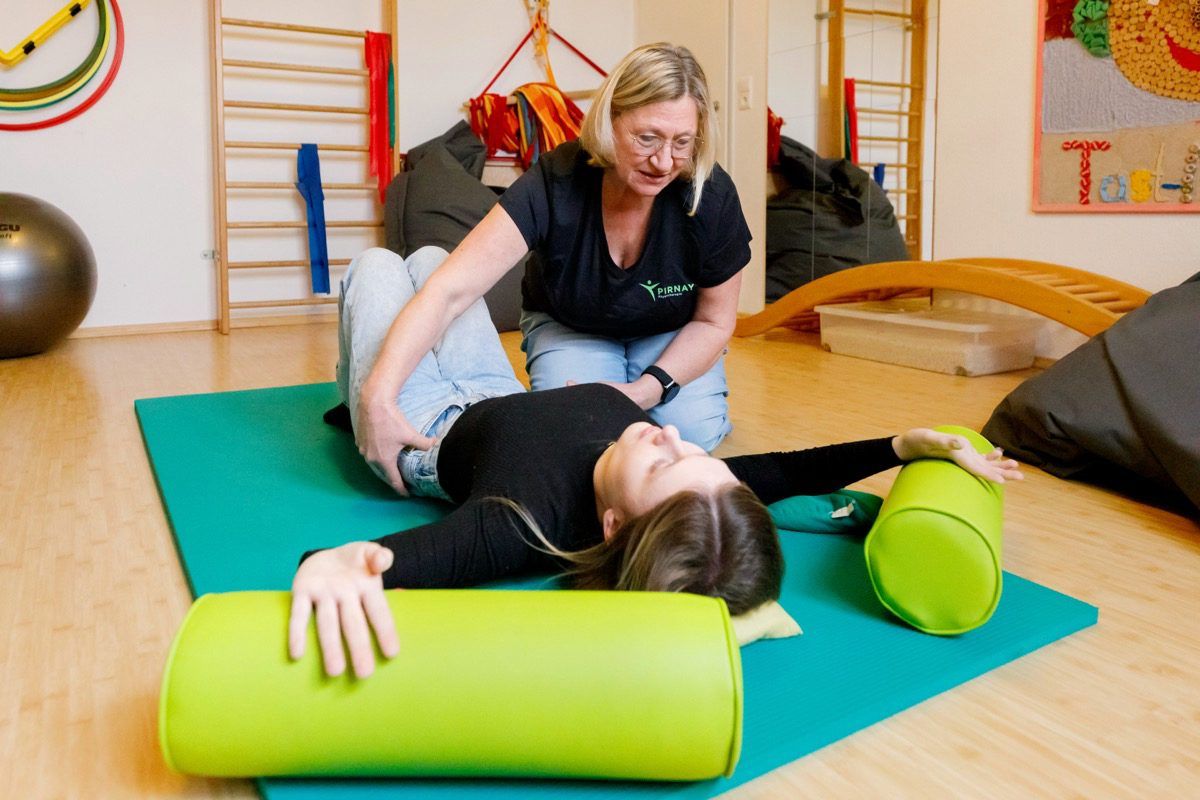
After the joint replacement, you practice walking on crutches and later without, plus stairs and getting up. With pain at the side of the hip, the focus is on slow, measured strengthening of the buttock muscles, first lying down, then standing.
Manual lymphatic drainage
With a swollen leg after the operation, gentle, rhythmic hand techniques stimulate the drainage of tissue fluid. This can reduce the feeling of tightness and make bending easier. Lymphatic drainage has to be prescribed separately.
Manual therapy
Pain on the outside of the hip can be partly caused by the lumbar spine or the sacroiliac joint. We examine and mobilize these neighboring regions. An operated joint we move only within the cleared range.
Home visit
If you cannot yet make it to the practice after the operation, we treat you at home or in a care home. For this, the home visit has to be noted on the prescription.
From hospital discharge to walking freely
- 1
Documents and assessment
We read the discharge letter and the loading instructions, assess the scar, swelling and gait, and test the hip muscles. With pain at the side, we look for the movements that trigger it.
- 2
Goals in stages
From this come interim goals: first safe walking on crutches, then stairs, then longer distances. With irritated tendons, the first goal is usually a calmer night.
- 3
Treatment
The appointments combine gait training, strengthening and, if necessary, decongesting techniques. We increase only what the clinic's instructions and the tissue's reaction allow.
- 4
Exercising between appointments
You repeat two to three exercises every day. We note the number and range of movement so that you do neither too little nor too much.
- 5
Review and handover
Before the prescription runs out, we compare gait and strength with the start. You learn what you can continue on your own and what you should raise at the medical check-up.
What helps at home
After an operation, your clinic's instructions take precedence. With pain at the side of the hip, the aim is to take pressure and tension off the irritated spot.
Lie differently
If possible, do not sleep on the painful side. If you lie on the other side, a pillow between the knees prevents the upper leg from sinking forward and pulling on the outside.
Legs side by side
When sitting, do not cross your legs, and stand on both feet instead of slumping onto one. Both take tension off the tendons at the greater trochanter.
Stagger your walks
Lengthen walking distances in small steps. Three short rounds over the day are better tolerated than one long march. Put the crutches aside only when your doctor or therapist clears it.
Prepare your home
Clear away loose rugs and cables and make sure there is light on the way to the bathroom. A sturdy chair with armrests and a high seat makes getting up easier.
Getting here and the first appointment at Hackhauser Weg
You will find us at Hackhauser Weg 61, 50769 Cologne. Worringen is the northernmost district of Cologne and lies close to the Rhine. From the A57, take the exit Köln-Worringen and park directly at the door – a relief with forearm crutches. If you take the bus, you get off at the stop "Worringen Hackhauser Weg" and still have a few minutes' walk ahead of you.
For the first visit, bring your prescription and health insurance card; after an operation, also the hospital's discharge letter, the rehabilitation report and X-ray images, if available. Wear comfortable sports trousers and sturdy, closed shoes, because we will look at your gait. For the assessment, more time is planned at the first visit than for later treatments.
You can get appointments by phone or via the form on our website. Treatment is in German, English or Spanish. A session usually lasts between 20 and 60 minutes, depending on the prescribed therapy.
Opening hours: Mon–Tue 7:00–18:00, Wed 7:00–18:20, Thu 8:00–19:30, Fri 8:00–14:00
Questions about hip surgery and pain at the side of the hip
When does outpatient physiotherapy continue after a hip replacement?
Usually right after the clinic and rehabilitation. Your doctor issues a prescription for this. Make the appointment early so that there is no long gap, and bring the discharge letter with the clinic's instructions.
Which movements are off limits at first with the new hip joint?
Your surgeon sets that, because it depends on the approach and on the implant. In the first period, deep bending, crossing the legs and strong rotation are often restricted. Ask at the clinic about your personal instructions; we practice with you how to get up, sit and get into a car with them.
Is pain on the outside of the hip always bursitis?
No, often the tendon attachments of the buttock muscles are involved or even the main reason. The back can also radiate into this region. The diagnosis is made by your doctor, if needed with ultrasound or MRI. In the assessment, we check which movements and loads bring on the pain.
Should I stretch the painful outside of the hip?
Better not. Stretches in which the leg is pulled across the midline of the body press the tendons against the greater trochanter and can increase the irritation. Slow strengthening exercises and less pressure on the spot are more favorable.
What will physiotherapy after hip surgery cost me?
With statutory health insurance, you pay the statutory co-payment on the prescription unless you are exempt from it; we bill everything else to the insurer. With private health insurance, reimbursement depends on the contract; asking your insurer before treatment begins gives clarity.
You Might Also Be Interested In
Knee Pain
Targeted treatment for knee problems
Back Pain
Relief from vertebral blockages and tension
Manual Therapy
Joint mobilization and release of blockages
KGG
Device-based training for strengthening
All Therapies
Overview of our treatment services