
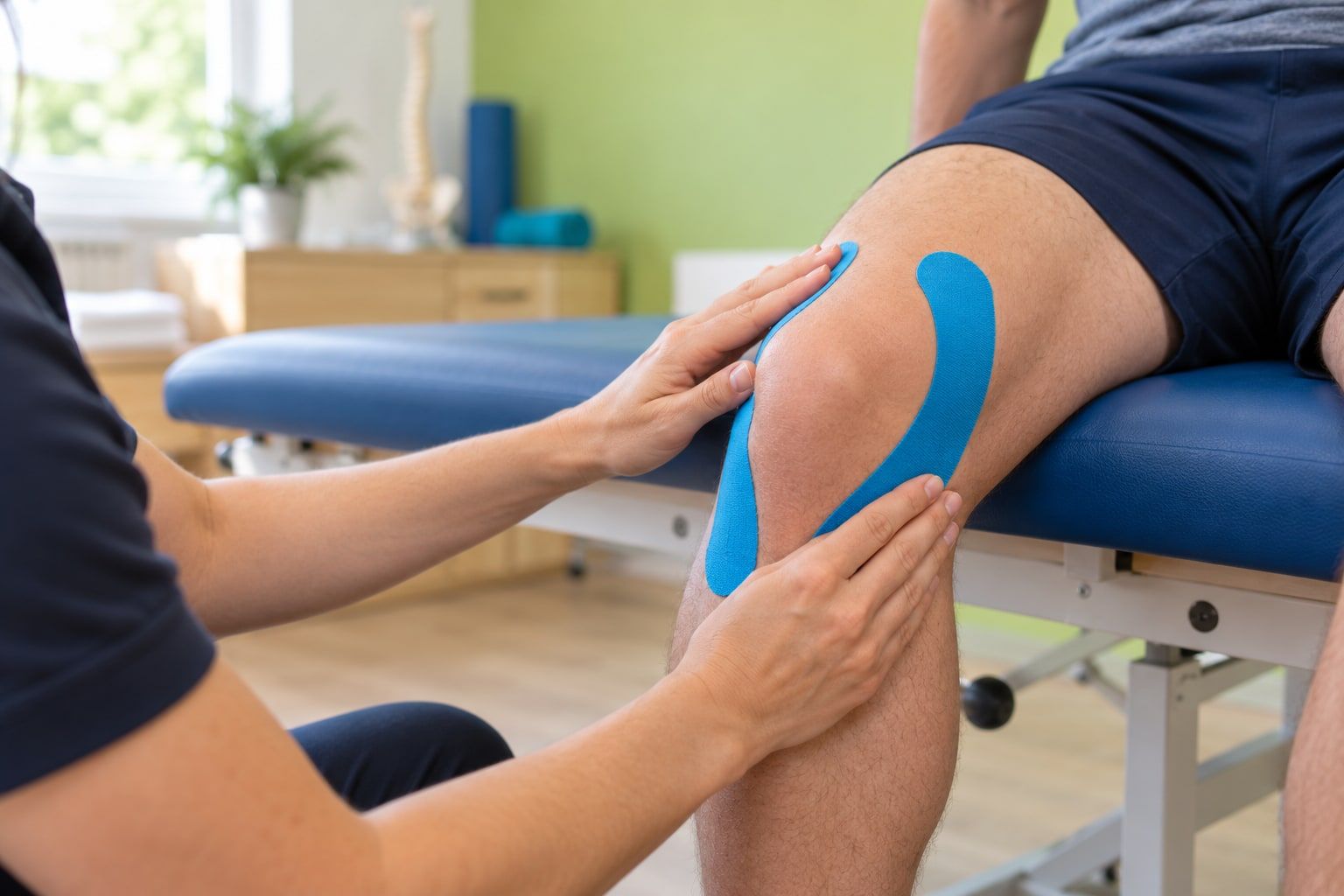
Knee Pain Treatment in Cologne Worringen
Professional physiotherapy for knee pain at Hackhauser Weg 61
A twisted knee during sport, a torn meniscus, a torn ligament or an operation after which the leg is meant to bear weight again: in such cases, the knee needs treatment that follows the healing process. In Cologne-Worringen, Praxis Pirnay provides physiotherapy on a prescription from your doctor (Heilmittelverordnung). Here you can read what happens with meniscus and ligament injuries and how follow-up treatment is structured.
Meniscus, ligaments and operated knee: knee pain in Cologne-Worringen
Two menisci lie like crescent-shaped cushions between the thigh bone and the shin bone. They distribute pressure and stabilize the joint. The knee is guided by ligaments: one collateral ligament on the inside and one on the outside, and the anterior and posterior cruciate ligaments in the middle. If one of these structures tears, the knee hurts, swells or feels unstable.
A meniscus can tear during a twisting movement under load, for example in football or when getting up from a squat. With increasing age, the tissue becomes more brittle; then a minor trigger is sometimes enough. Ligaments mostly tear in an accident: the inner ligament through sideways buckling, the anterior cruciate ligament often on landing or with an abrupt change of direction. Whether surgery is done is decided after a medical examination and MRI.
After an operation – meniscus repair, cruciate ligament reconstruction or knee replacement – the tissue heals at its own pace. How much weight the leg may bear and how far the knee may be bent is set by the clinic's follow-up protocol. Within these limits, physiotherapy works on reducing swelling, regaining extension and getting the muscles to switch on again.
How the meniscus and ligaments get damaged
Twisting under load
If the body turns over a fixed, bent leg, the meniscus gets caught between the joint surfaces and can tear.
Meniscus over the years
Meniscus tissue loses elasticity with age. Tears then develop gradually or with everyday movements such as deep squatting.
Sideways buckling
If a force pushes the knee inward, for example in a collision or when skiing, the inner ligament is overstretched or tears.
Landing and changes of direction
The anterior cruciate ligament often tears without outside contact: on landing, when stopping suddenly or with a fast turn.
Effects of an operation
After the procedure, swelling and pain inhibit the thigh muscle. A lack of full extension and a feeling of instability can persist if you do not exercise in a targeted way.
How to recognize meniscus and ligament injuries
Meniscus
- • Pain at the inner or outer joint line
- • Stabbing pain when twisting or in a deep squat
- • Catching or locking of the joint
- • Swelling, often only the next day
Ligaments
- • A pop or a tearing sensation at the moment of injury
- • Rapid swelling within a few hours
- • Giving way when twisting or stopping
After knee surgery
- • Swelling and warmth around the joint
- • Full extension is missing, bending is limited
- • The thigh muscle is hard to tense
Warning signs after injury or surgery
A freshly injured or operated knee has to be assessed by a doctor before physiotherapy begins. With the following signs, do not wait for your next treatment appointment.
- Sudden shortness of breath or chest pain, especially after surgery or immobilization: emergency number 112.
- The calf or lower leg swells, becomes warm and hurts when pressed.
- Surgical wound red, oozing or hot; fever or chills.
- After the accident, the leg cannot bear any weight, or the knee looks deformed.
- The joint jams: straightening or bending is no longer possible.
- Foot numb, cold or pale after the injury: emergency number 112.
Follow-up treatment and therapy for meniscus and ligament damage
Whether after an operation or with conservative treatment, therapy follows the healing phases. First calm swelling and pain, then bring back mobility and muscle control, and finally build strength and stability. The medical instructions are what counts.
Physiotherapy exercises (Krankengymnastik)
At the beginning come extension, permitted bending and tensing the thigh muscle, plus walking on forearm crutches. Later follow strengthening, balance, stairs and – depending on the goal – exercises for changes of direction and landing.
Manual lymphatic drainage
A swollen knee is hard to bend and inhibits the muscles. Gentle, rhythmic hand techniques promote the removal of fluid, especially in the first period after the procedure.
Manual therapy
The therapist keeps the kneecap mobile and mobilizes the joint as far as the protocol allows. The aim is full extension first, and then step by step more bending.
Electrotherapy
After knee operations, the front thigh muscle is often hard to activate. Electrical stimulation, prescribed in addition, can ease pain and support tensing the muscle; it accompanies active exercise.
Step by step back to loading
- 1
Assessment and instructions
We measure swelling, extension and flexion, check muscle tension and gait, and read the surgery report and the follow-up protocol.
- 2
Interim goals
Instead of one distant goal, we agree on stages: full extension, walking without crutches, stairs with alternating steps, later work or sport.
- 3
Treatment in phases
First reducing swelling and regaining mobility, then building muscle and stability. What is allowed when is determined by how the tissue heals, not by the calendar alone.
- 4
Exercising at home
Daily exercise is part of it. You get a few exercises that fit the current phase, and we swap them as soon as more is allowed.
- 5
Conclusion and clearance
At the end, we compare mobility and strength with the healthy side. Your surgeon decides about returning to sport that puts load on the knee.
What you can contribute yourself after an injury or operation
Everything below applies only insofar as it does not contradict your medical instructions. If in doubt, ask at the clinic, at your doctor's practice or with us.
Cool and elevate
Cool the knee for a few minutes several times a day, with a cloth between the cold pack and your skin. Position the leg so that the foot is higher than the hip.
Maintain extension
Rest your heel on a rolled-up towel so that the knee can hang freely. A pillow under the back of the knee is comfortable but in the long run encourages a bent position.
Tense the thigh
Lying down, gently press the back of the knee toward the surface, hold the tension for a few seconds and release. Repeat several times a day.
Observe the weight-bearing limits
Use the crutches for as long as prescribed and put as much weight on the leg as prescribed. Leaving them off too early easily leads to limping and new swelling.
Your appointment in Cologne-Worringen – also on crutches
Praxis Pirnay is at Hackhauser Weg 61, 50769 Cologne, in Worringen, the northernmost district of Cologne close to the Rhine. If someone drives you, you can get out directly in front of the practice; the parking spaces are there as well. The route is via the A57, exit Köln-Worringen. The bus stop "Worringen Hackhauser Weg" is a few minutes' walk away.
Along with your prescription and health insurance card, bring the surgery report, the follow-up protocol and any existing MRI or X-ray findings. Shorts or loose trousers make the examination easier; brace and crutches come along, of course. A treatment lasts 20 to 60 minutes depending on the prescription, the first appointment somewhat longer because of the assessment.
You make the appointment by phone or with the appointment form on the website. We treat in German, English and Spanish. If you cannot yet leave your home after the operation, a home visit is possible, provided the prescription states it.
Opening hours: Mon–Tue 7:00–18:00, Wed 7:00–18:20, Thu 8:00–19:30, Fri 8:00–14:00
Questions about meniscus, ligaments and knee surgery
Does a torn meniscus always have to be operated on?
No. What matters are the type and location of the tear, your age and your symptoms. Tears caused by wear and tear are often treated with physiotherapy first. If the knee locks or there is a fresh tear in a younger person, doctors tend to recommend surgery. The recommendation comes from your orthopedic doctor after an examination and MRI.
How long after cruciate ligament surgery until I can play sport?
Expect many months. When sports with jumping and changes of direction are possible again depends not on time alone, but on whether strength, stability and jump control are sufficient. Your surgeon gives the clearance. Nobody can responsibly promise you a fixed date in advance.
How far may I bend the knee after a meniscus repair?
That is in your follow-up protocol and differs depending on the tear and the surgical technique. After a repair, bending and weight-bearing are often limited for a few weeks so that the meniscus can heal. After a partial removal, the knee can usually bear weight earlier. Follow the instructions from your clinic.
My knee sometimes gives way – what does that mean?
Giving way can point to ligament instability or to a weakened, poorly activated thigh muscle. If it happens repeatedly, the knee should be examined by a doctor, because every episode of giving way stresses the menisci and cartilage. In physiotherapy, we train strength and balance; whether that is enough is shown by how things develop.
Will I get a prescription right after the knee operation, and what do I pay?
You receive the prescription when you are discharged from the clinic or from the practice that continues your care. People with statutory health insurance pay the statutory co-payment unless they are exempt; billing goes directly to the insurer. If you have private health insurance, clarify reimbursement with your insurer beforehand, as it depends on your plan.
You Might Also Be Interested In
Hip Pain
Targeted treatment for hip problems
Sports Injuries
Treatment for sports and recreational injuries
Manual Therapy
Joint mobilization and release of blockages
KGG
Device-based training for strengthening
All Therapies
Overview of our treatment services